

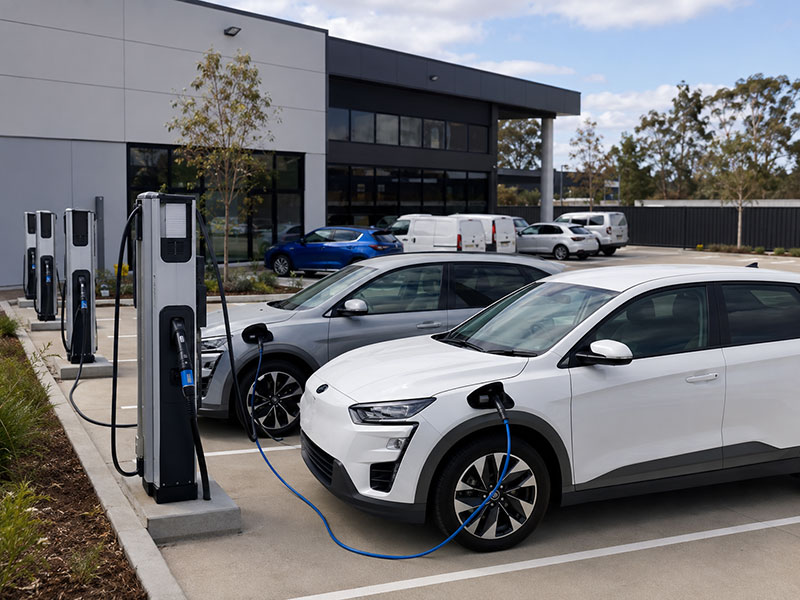
Three phase EV charging can deliver practical charging speeds for workplaces, apartment buildings, retail properties and fleet depots. It also adds a large new electrical load to a site that was never designed for many vehicles charging at once.
Installing chargers is only part of the project. Site owners need to understand how much electrical capacity is available, when existing demand peaks and how charging loads will be controlled as EV numbers grow.
Without proper planning EV chargers can contribute to overloaded infrastructure, nuisance tripping, higher demand charges and expensive supply upgrades. Load management reduces these risks by matching charging activity to the capacity that is actually available.
Key Points
Three phase EV charging adds a significant new electrical load to sites that were never designed for many vehicles charging at the same time.
Maximum demand is usually the main concern rather than total energy used across the day.
Interval metering data reveals real site capacity, existing peaks and the spare headroom available during likely charging periods.
Load management shares available power across chargers so a site can often add more charging points without a major supply upgrade.
Uncontrolled charging can create new demand peaks that raise demand charges and cause phase imbalance or power quality problems.
SATEC meters and power quality analysers give site owners the three phase data needed to plan EV charging and feed it into Expertpower for ongoing monitoring.
Why Three Phase EV Charging Can Create Capacity Problems
Three phase EV charging is attractive because it can support higher charging rates than many single phase installations. Common AC charger capacities include 11 kW and 22 kW. The actual charging speed depends on the vehicle, the charger and the electrical supply. Many EVs sold in Australia cap their onboard AC charging at 11 kW so a 22 kW charger will not always deliver its full rating.
One charger may be easy to manage for a commercial property. Ten or twenty chargers running together can create a very different demand profile.
Ten 22 kW chargers could in theory require 220 kW if every charger operated at full output. Existing services such as air conditioning, lifts, lighting, refrigeration, machinery and building management systems still draw power at the same time.
The main issue is often maximum demand rather than total energy consumption. A short burst of simultaneous high demand can exceed switchboard capacity, transformer limits or the agreed supply capacity with the network.
Start With Real Site Data
Capacity decisions should not rely only on equipment ratings or assumptions about how a building normally runs. Interval metering data gives a clearer picture of demand across different times, days and operating conditions.
A building may look like it has spare capacity during a quiet inspection while running close to its limit on hot afternoons. A fleet depot may have little capacity during business hours yet plenty of spare capacity overnight when vehicles are parked.
Metering can identify existing peak demand, when peaks occur, how long they last and how much capacity may be available during likely charging periods. It can also reveal seasonal changes and uneven loading across the three phases.
This information helps designers decide whether the existing supply can support the proposed chargers. It also shows whether load management could reduce or delay the need for a major upgrade.
How EV Charging Load Management Works
Load management controls how much power is made available to EV chargers based on site conditions. Instead of allowing every charger to run at maximum output the system shares available capacity across connected vehicles.
A fixed system places a set limit on the combined charging load. A dynamic system can respond to real time building demand. When general electricity use rises the power allocated to the chargers can be reduced. When building demand falls extra capacity can be released for charging.
This approach does not usually stop vehicles from getting the energy they need. Workplace vehicles may sit parked for eight hours while fleet vehicles may stay at a depot overnight. Charging can be spread across the available parking period rather than delivered at full power straight away.
Priority rules can also be applied. Vehicles needed for an early departure may receive more power than vehicles scheduled for later use. Chargers can give a minimum allocation to each vehicle then increase charging rates as more site capacity becomes available.
The table below compares the two main approaches.
| Aspect | Fixed Load Management | Dynamic Load Management |
|---|---|---|
| How It Works | Applies a set limit to the combined charging load | Adjusts charging power in response to live site demand |
| Responds To Building Demand | No | Yes |
| Capacity Use | Conservative because the limit is fixed for worst case conditions | Higher because spare capacity is released when the building is quieter |
| Best Suited To | Smaller sites or simpler installations with stable loads | Sites with variable demand, solar or growing EV numbers |
| Metering Required | Charging circuit measurement | Charging circuit plus incoming supply measurement |
| Relative Complexity | Lower | Higher |
Avoiding Unnecessary Electrical Upgrades
A major supply upgrade can involve new cabling, switchboard changes, transformer work and network approvals. These projects can be expensive and may delay an EV charging rollout.
Load management can sometimes let a site run more chargers within its existing capacity. The key is understanding the difference between total installed charger capacity and the maximum power used at any one time.
A car park may include twenty charging points so drivers have convenient access. Those chargers do not all need to run at full rating at the same moment. A controlled charging limit can share power according to vehicle needs, parking duration and departure schedules.
Future growth should still be considered during the initial design. A system built only for a small number of EVs may become costly to modify later. Metering, communications and controls should support additional chargers without replacing the whole system.
Controlling Demand Charges
Many commercial electricity bills include charges linked to maximum demand. Uncontrolled three phase EV charging can create a new site peak even when the charging event lasts only a short time.
This risk is highest when vehicles arrive together. Employees may plug in at the start of the workday while fleet vehicles may return to a depot at a similar time each afternoon.
A load management strategy can keep the combined charging load below a nominated demand threshold. Charging can also be shifted towards lower demand periods or aligned with onsite solar generation where practical.
Monitoring should continue after the chargers are commissioned. Vehicle numbers, charging behaviour and wider building demand will change over time. Regular reviews confirm that the control strategy still works and show when more capacity may be needed.
Phase Balance and Power Quality
Three phase EV charging should also be assessed at an individual phase level. Poor distribution of single phase chargers can create uneven loading across the supply.
One phase may approach its limit while the other two phases hold spare capacity. Metering at the incoming supply and the relevant distribution circuits can identify these imbalances so chargers or other loads can be redistributed.
Power quality may also need attention at larger charging sites. EV chargers use power electronic equipment which can contribute to harmonic distortion and other electrical conditions.
The significance of these effects depends on the charger technology, the installation design and the wider site load. Monitoring provides evidence of actual conditions and helps investigate problems if equipment trips, overheats or behaves unexpectedly after the chargers are installed.
How SATEC Supports Three Phase EV Charging
SATEC metering solutions give site owners, electrical contractors and facility managers the data needed to plan and manage EV charging with greater confidence. Three phase voltage, current, power, energy and maximum demand can all be measured across the site.
Depending on the selected model and project requirements, meters can be installed at the main incoming supply, at distribution boards or on dedicated EV charging circuits. This creates visibility across the electrical system. Users can compare general building demand with EV charging demand, monitor available capacity and identify when chargers create new peaks.
Deeper visibility is available where harmonic distortion, voltage variations or other power quality conditions need to be assessed. The SATEC power quality analysers suit this role and are particularly valuable for large commercial charging installations and fleet depots.
Metering data can also be brought into Expertpower for remote monitoring, reporting and analysis. Users can review demand trends, compare time periods and understand how EV charging affects the wider site.
A Measured Approach to EV Charging
A practical EV charging project begins with measurement. Site data should be collected over a representative operating period then reviewed alongside the proposed charger quantity, power ratings and expected usage patterns.
The charging system can then be designed around real capacity. Initial chargers may be installed with a defined site limit and room for expansion. Performance can be monitored after commissioning so settings can be refined as charging behaviour becomes clearer.
Three phase EV charging does not need to overload a property. Accurate metering, effective load controls and ongoing monitoring can protect electrical infrastructure while supporting long term EV growth.
FAQs - Three Phase EV Charging and Load Management: How to Avoid Overloading Your Site
What is the difference between total charger capacity and maximum demand?
Total charger capacity is the combined rating of every charger if all ran at full output. Maximum demand is the highest power actually drawn at one time, which load management can keep well below the total.
Can load management remove the need for a supply upgrade?
In many cases it can allow more chargers to run within the existing capacity by sharing available power. Whether an upgrade is still required depends on the site load, the number of chargers and how they are used.
Does three phase EV charging cause power quality problems?
EV chargers use power electronics that can contribute to harmonic distortion, though the significance depends on the charger technology and site load. Monitoring provides evidence of actual conditions so any issues can be investigated properly.
How does metering help plan EV charging?
Interval metering shows existing peak demand, when peaks occur and how much spare capacity is available during likely charging periods. This helps designers size the installation correctly and decide whether load management is needed.
Explore related topics:
For Your Industry
Related Reading
- How To Improve Load Factor And Reduce Electricity Demand Charges In Australia
- What Is A Power Energy Data Logger And When Should You Use One?
- Triplen Harmonics Explained: How Harmonic Spectra Reveal Neutral Conductor Overloading
Trending in Your Sector


