

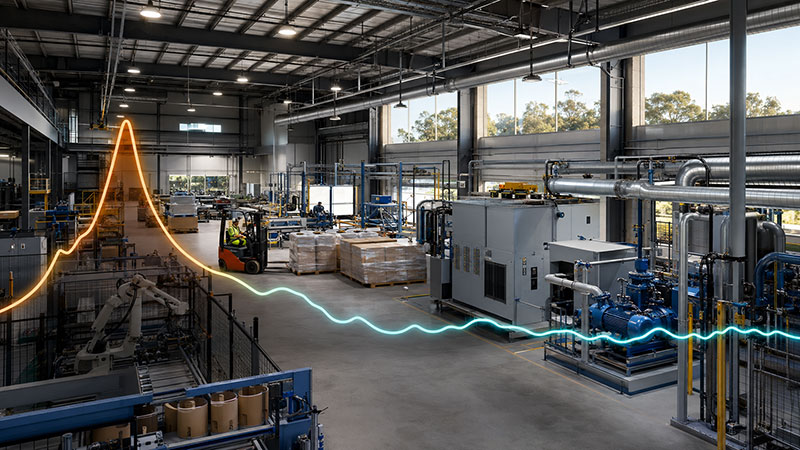
Electricity demand charges make up a large part of many commercial and industrial power bills in Australia. Rather than being based on total energy used, these charges are driven by the highest demand recorded during a billing period. A single short burst of unusually high demand can affect costs for the whole month, regardless of how efficient the site is the rest of the time.
One of the most effective ways to respond is to improve load factor. In practice this means flattening the load profile, cutting unnecessary peaks and using existing electrical capacity more consistently throughout the day.
Key Points
Demand charges are set by the highest demand recorded in a billing interval, not by total consumption.
Load factor compares actual energy use with what would occur if the site ran continuously at its peak demand.
Interval data and submetering are the starting point for finding out what is really causing peaks.
Staggering equipment start times and shifting flexible loads can flatten demand without cutting production.
Demand alerts allow a site to respond before a developing peak becomes the month’s billing figure.
Accurate meter data, of the kind SATEC provides, is what turns these strategies into measurable and repeatable savings.
What Does Load Factor Mean
Load factor compares the electricity consumed over a period with the amount that would have been used if a site had operated continuously at its highest recorded demand. It is calculated by dividing energy consumption in kilowatt hours by peak demand in kilowatts, multiplied by the number of hours in the period. The result is usually shown as a percentage.
Take a site that consumes 36,000 kWh over a 30 day month and records a maximum demand of 100 kW. That works out to a load factor of 50 per cent.
A higher percentage points to fairly consistent demand. A lower one suggests that brief peaks sit well above normal operating load. The aim is never to use more electricity just to push the percentage up. Businesses improve load factor by cutting peaks, shifting necessary consumption to quieter periods and eliminating energy that is simply being wasted.
Why A Low Load Factor Increases Costs In Australia
Most Australian commercial and industrial network tariffs include a demand charge based on the highest demand recorded during a set interval, often 15 or 30 minutes depending on the distributor. The charge may be based on kW or kVA, and the method varies by network area, retailer and connection type.
A manufacturing site might run at a stable load for most of the day. If several large motors start while electric heating and compressed air systems are already running, that single event can create a sharp spike. That spike, lasting only minutes, can become the maximum demand figure used to calculate the entire month’s charge.
A low load factor also means network infrastructure has to be sized for capacity that is rarely needed. Flattening the load profile helps a site make better use of the connection it already has, rather than paying to support headroom it hardly ever draws on.
Measure The Load Profile
First Monthly bills show consumption and billed demand but rarely explain what actually caused the peak. Interval data shows when demand rises and how long it stays elevated.
It’s worth reviewing load profiles across normal working days, weekends, overnight periods and different seasons. Compare these against production schedules, occupancy, weather and equipment run times. This often reveals whether peaks are predictable or the result of a one off event.
Submetering major loads adds further clarity. HVAC equipment, refrigeration, pumps, compressed air, process machinery and EV chargers can all be monitored separately so operational load can be told apart from demand that could be avoided.
Stagger Equipment Start Times
Simultaneous start up is one of the most common causes of short, sharp peaks. Motors, pumps, chillers, ovens and compressors can all draw significant power the moment they switch on.
A simple scheduling change can stop several large loads from starting within the same demand interval. Automated controls can sequence equipment so production or building comfort is maintained without every motor firing at once.
Critical equipment can still run exactly when it’s needed. Flexible loads, on the other hand, can often be delayed by a few minutes with no real impact on operations. This alone can lift load factor without reducing useful output.
Shift Flexible Electricity Use
Some consumption can be moved to periods when a site’s baseline demand is lower. Water pumping, battery charging, pre cooling, thermal storage and certain production processes are common candidates.
Sites with rooftop solar, which is increasingly common across Australian commercial and industrial properties, can schedule flexible loads during periods of strong generation. This lifts onsite solar use and reduces demand pulled from the grid.
Battery energy storage is another option worth considering. A battery can charge when demand is low or solar output is high, then discharge as site demand approaches a set limit. This peak shaving approach can improve load factor, although its financial value depends on the tariff structure, battery size and existing load profile.
Coordinate HVAC And Building Services
Heating, ventilation and air conditioning often contribute heavily to demand in commercial buildings. Poor scheduling can see chillers, fans and pumps all start together just before occupants arrive, and lighting, hot water and EV charging can pile straight on top of that same morning peak.
Staged HVAC start up spreads this load out. Pre cooling allows a building to reach its target temperature gradually rather than all at once. Setpoints, schedules and control sequences are worth checking regularly to make sure systems aren’t quietly working against each other.
Use Demand Alerts
Automated alerts warn energy managers when demand is approaching a set limit. That warning can be enough time to delay a flexible process, adjust HVAC operation or pause charging that isn’t urgent.
Alerts work best when they reflect the actual interval used for billing. Monitoring current load alongside projected interval demand helps a site tell a passing fluctuation apart from a genuine developing peak.
Every new peak is worth investigating on its own. Equipment faults, manual overrides, extended hours or new loads can quietly undo months of earlier improvement if nobody is watching.
How SATEC Supports Load Factor Improvement
Good decisions start with good data. Accurate demand and interval meter readings are what make it possible to understand how a site actually uses electricity, rather than guessing from a monthly bill.
Meters can be installed at the incoming supply and at key distribution points to build a detailed view of the load profile. The EM133-XM offers compact three phase meter with communications suited to commercial and industrial applications. For sites that need to know which circuit or area is driving a peak, the BFM136 can monitor numerous branch circuits at once.
Where power quality is also a concern, a device such as the PM180 can add detail on harmonics and voltage conditions. It’s worth noting the PM180 is not NMI approved, so it isn’t the right choice where a billing grade, NMI compliant meter is required at the point of supply. For that application, the EM133-XM is the more suitable option.
Meter data can be sent to Expertpower for centralised monitoring, analysis and reporting. From there, a site can review historical load profiles, compare operating periods and pinpoint exactly when maximum demand occurred. Automated alerts can then help the team respond before a developing peak becomes the highest demand interval of the month.
In our experience, this is the part many sites skip: they fix one peak, then have no way of knowing if it comes back.
Choosing The Right Meter For The Job
Not every meter suits every task. A billing grade connection meter, a branch circuit monitor and a power quality analyser each answer a different question, and picking the wrong one can waste both budget and time.
| Model | Best Suited For | Key Feature | NMI Approved |
|---|---|---|---|
| EM133-XM | Incoming supply and billing grade demand monitoring | Compact three phase meter with communications | Yes |
| BFM136 | Identifying which circuits or equipment drive peaks | Monitors numerous branch circuits simultaneously | Yes |
| PM180 | Power quality investigation alongside demand data | Harmonics and voltage condition analysis | No |
Make Improvement An Ongoing Process
A stronger load factor is usually the result of several coordinated changes rather than one large project. Measurement sets the baseline, while scheduling, control adjustments, maintenance and staff awareness chip away at avoidable peaks over time.
Results are worth reviewing across several billing periods, since production, occupancy and weather can all shift the load profile. It’s important to track consumption and maximum demand together, because a flatter profile should never be mistaken for the absence of waste.
Sites that improve load factor tend to reduce demand charges, get more out of existing infrastructure and gain a much clearer picture of how daily operations shape their energy costs. Ongoing meter data is what keeps these gains in place as equipment and operating conditions change.
If your site is ready to see where its peaks are really coming from, talk to SATEC about a meter and monitoring setup suited to your connection type and tariff.
FAQs - How To Improve Load Factor And Reduce Electricity Demand Charges In Australia
What is a good load factor for a commercial site in Australia?
There is no single benchmark, since it depends on the type of operation and equipment involved. As a general guide, a load factor above 60 per cent is often considered reasonably efficient, while anything below 40 per cent usually signals sharp, avoidable peaks worth investigating.
Can improving load factor increase my total electricity consumption?
No, improving load factor is about spreading existing consumption more evenly rather than using more energy. The goal is to reduce peak demand, not to add extra load just to change the percentage.
Do I need NMI approved meters to monitor load factor?
A meter used for billing purposes at the point of supply generally needs to be NMI approved. Submetering used internally to understand load behaviour, such as branch circuit monitoring, does not carry the same requirement.
How quickly can load factor improvements reduce demand charges?
Some changes, like staggering equipment start times, can reduce peak demand within a single billing cycle. Others, such as shifting loads around solar generation or adding battery storage, tend to show their full benefit over several months.
Explore related topics:
For Your Industry
- Energy Usage in Data Centres: What’s Driving It, How to Measure It and How to Control It
- Energy Monitoring for Shopping Centres: How to Cut Costs, Reduce Risk and Future-Proof Operations
Standards & Compliance
Related Reading
- Energy Bills Reduction with Time-of-Use Tariffs: How to Shift Load and Save
- Utility Bill Validation and Cost Recovery: How to Protect Budgets and Recover Charges
Trending in Your Sector


