

A specifier is finalising the metering schedule for a forty apartment residential development. The switchboard contractor forwards a quote for DIN rail energy meters at roughly a third of the price of the approved units in the original specification. The datasheet looks impressive. It carries a CE mark, an M marking, a notified body number and the words “MID approved, Class B accuracy”. The specifier ticks it off and moves on to the next line item.
That decision has just created a compliance problem that will surface years later, usually when a tenant disputes a bill or when the building changes hands and a due diligence report asks a simple question. Was the billing meter pattern approved?
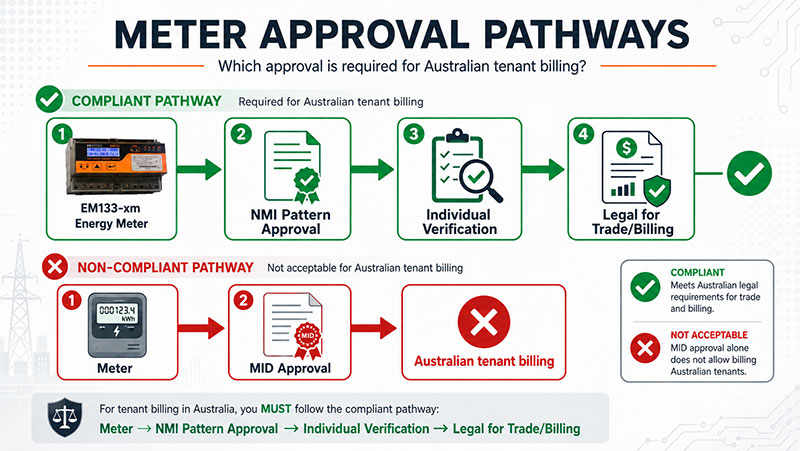
MID approval is a genuine certification. It is simply not the certification Australia recognises. The two systems solve the same problem in different jurisdictions and one of them stops at the European border.
Key Points
MID is the European Measuring Instruments Directive 2014/32/EU and it governs market access for measuring instruments within the European Union.
MID carries no legal weight under Australia’s National Measurement Act 1960, no matter how thorough the underlying testing was.
Australian electricity meters used to bill another party must hold NMI pattern approval and must then be individually verified before use.
A meter that is not pattern approved cannot be verified at all, so there is no remedial path once it is installed.
Every approved pattern is listed on the National Measurement Institute public register and can be checked in a few minutes before you buy.
SATEC supplies pattern approved options including the EM133-XM under NMI 14/2/72 and the BFM136 under NMI 14/2/80, both approved against NMI M 6-1.
What MID Actually Is
The Measuring Instruments Directive (MID) is European law. Directive 2014/32/EU replaced the earlier 2004/22/EC and has applied since April 2016. It covers ten instrument families across its annexes, from water meters through to exhaust gas analysers. Active electrical energy meters sit in Annex MI-003.
The Directive is not a product standard in the way AS 62053 is a product standard. It is a market access instrument. It sets out the essential requirements a meter must satisfy and the conformity assessment routes a manufacturer can take, usually involving a notified body carrying out a type examination followed by production quality assurance.
A compliant meter then carries two marks. The CE mark covers general product conformity. The supplementary M marking, followed by the year and the notified body number, covers metrological conformity. Within the European Union a meter with CE but without M cannot lawfully be used for commercial measurement.
MID accuracy classes for electricity meters are A, B and C, drawn from the EN 50470 series rather than the IEC class numbering most Australian engineers grew up with. Class B corresponds broadly to one per cent and Class C to half a per cent.
None of that is a criticism. MID certified meters are generally good instruments. The question is not whether the meter is any good. The question is whether the certificate means anything to an Australian trade measurement inspector.
Why MID Has No Standing Under Australian Law
Australia’s legal metrology framework sits under the National Measurement Act 1960, administered by the National Measurement Institute (NMI). The Act establishes Australian legal units of measurement and requires that measuring instruments used for trade be pattern approved and verified. Pattern approval is granted by the Chief Metrologist and evidenced by a certificate of approval carrying an NMI number.
There is no mutual recognition arrangement that converts a MID certificate into an Australian approval. A notified body in Germany or the Netherlands has no delegated authority under the Act and conversely NMI approved meters cannot be used in Europe or other jurisdictions governing energy billing meters.
Australia has moved closer to international harmonisation in one respect. NMI M 6-1 now offers alternative approval pathways, including one based on Standards Australia adoptions of IEC standards and, in time, one based on OIML R 46. That harmonisation runs through the pattern approval process itself. It does not create a shortcut around it. A manufacturer still applies, still submits samples, still funds the testing and still receives an Australian certificate at the end.
The Point Where A Meter Becomes A Trade Instrument
Confusion often comes from a genuine grey area rather than from carelessness. Plenty of metering carries no legal metrology obligation at all. Monitoring your own consumption for an energy management system, tracking a NABERS rating, sub-metering a plant room to understand where the load sits, none of that is trade use. In other words there is no traceability, customers are at the mercy of the supplier for performance, design, accuracy capabilities with no recourse other than the limited warranty.
The line is crossed the moment the measurement determines what somebody pays. NMI puts it plainly. You use a meter for trade if you use the measurement to determine the amount payable in a transaction, even proportionally. Billing tenants in an embedded network is trade use. Recovering electricity costs from a retail tenancy on a per kilowatt hour basis is trade use. Charging for an EV charging bay by energy delivered is trade use. Apportioning a landlord’s bill across tenancies using submeter readings is trade use, because the apportionment is the measurement.
There is one point worth knowing. Electricity meters were exempted from these requirements for many years while the framework was built out. That exemption was lifted for meters installed on or after 1 January 2013 that measure less than 750 MWh per year.
The drafting reads oddly at first because it catches small installations rather than large ones. Tenant submeters sit comfortably below that figure, which places them squarely inside the regulated category rather than outside it.
What Goes Wrong When You Bill From An Unapproved Meter
The Act creates separate offences for using an unverified instrument for trade, for installing an instrument that is not of an approved pattern and for supplying one. Using an unverified measuring instrument for trade attracts a maximum of one hundred penalty units. With the Commonwealth penalty unit at $364 for offences committed on or after 1 July 2026, that is a maximum of $36,400 per offence for an individual. Bodies corporate face multiples of that figure.
Fines are rarely the part that hurts most. The harder problem is that the measurement itself becomes indefensible. If a tenant challenges twelve months of billing and the meter has no pattern approval behind it, the operator has no traceable basis on which to defend the reading. Refunds, re-billing exercises and reputational damage tend to follow and in a strata or retail context they follow publicly.
Then there is the trap that surprises people most. A meter that is not pattern approved cannot be verified. Verification is only available to approved patterns. So a building that discovers the problem after handover cannot fix it with a testing exercise or a calibration certificate. The meters come out and approved meters go in, usually with switchboard work, an outage and a very awkward conversation about who pays.
What NMI Pattern Approval Under M 6-1 Involves
NMI M 6-1 sets the metrological and technical requirements for active energy electricity meters. Its companion document NMI M 6-2 sets the test report format.
A meter submitted for approval is examined against a broad envelope of conditions rather than a single accuracy test on a bench at room temperature. Testing covers accuracy across the current range, voltage and frequency variation, harmonics, temperature and humidity, dust and moisture ingress, shock and vibration, magnetic induction, phase sequence and voltage unbalance, electrostatic discharge, insulation and electromagnetic interference.
It also covers the things that have nothing to do with measurement physics and everything to do with trust. Sealing, security, tamper evidence, the audit record of configuration changes and the traceability of the internal clock all come under scrutiny. Firmware versions are declared and the certificate holder must notify NMI of any future change with the potential to affect metrology.
Approval alone is not the finish line. Once a pattern is approved, every individual meter must still be verified by an appointed utility meter verifier against NITP 14 before it is used for trade. Imported meters verified overseas still require Australian verification, though batch sampling may be permitted.
MID And NMI Approval Compared
| Feature | MID (Directive 2014/32/EU) | NMI Pattern Approval (NMI M 6-1) |
|---|---|---|
| Legal instrument | European Directive 2014/32/EU, Annex MI-003 | National Measurement Act 1960 and National Trade Measurement Regulations 2009 |
| Geographic force | European Union and EEA member states | Australia |
| Approving body | Notified body designated by an EU member state | Chief Metrologist, National Measurement Institute |
| Identifier on the meter | CE mark plus supplementary M marking, year and notified body number | NMI approval number, for example NMI 14/2/72 |
| Accuracy class system | Classes A, B and C under EN 50470 | Classes 0.2, 0.5, 1 and 1.5 under NMI M 6-1 |
| Individual meter verification | National competence, varies by member state | Mandatory verification by an appointed verifier against NITP 14 before trade use |
| Accepted for Australian tenant billing | No | Yes, once pattern approved and verified |
| Where to check status | EU notified body and national registers | NMI certificates of approval register at industry.gov.au |
How To Check Any Meter On The Official Register
This takes about three minutes and it settles the argument before an order is raised.
The National Measurement Institute publishes every certificate of approval on the industry.gov.au website under pattern approval. Utility meters, which is where electricity meters live, form their own category. Search by manufacturer name or by model number. If a certificate exists you will find it, along with a downloadable PDF listing the pattern, its variants, the approval date, the specification it was approved against and any conditions attached.
Three details require a closer look. Check that the exact model and variant you are buying appears in the certificate, because a manufacturer may hold approval for one variant of a family and not another. Check which specification the approval references, since a certificate may cite NMI M 6-1 for some variants and NMI M 13-1 for others. Check the conditions, because some approvals limit the input arrangements or current sensors that may be used.
If a supplier cannot give you an NMI number, that is your answer. Ask for the certificate, not for reassurance. An approval number is a public fact and any supplier holding one will hand it over immediately.
Where SATEC Fits
Our position on this is not a marketing stance. It comes from having been through the pattern approval process ourselves and knowing what it costs in time, samples and testing. That experience produces a fairly blunt policy internally. We will not sell a meter into a billing application unless it holds an Australian approval.
For billing applications the approved options are different products entirely. The EM133-XM is a DIN rail mounted Class 0.5S energy meter approved under NMI 14/2/72, designed for the Australian sub-metering market and available with RS-485, Ethernet or cellular communications.
Where a switchboard serves many tenancies, the BFM136 holds approval under NMI 14/2/80 and monitors up to twelve three phase circuits or thirty six single phase circuits from a single instrument, which usually removes the need to find panel space for dozens of individual meters.
Both integrate with Expertpower, hosted on Australian Microsoft Azure infrastructure, for interval data, consumption reporting and tenant billing.
Fifty plus years in energy management has taught us that the expensive metering decision is almost never the meter. It is the retrofit that follows a bad one.
Send us your metering schedule before it goes out to tender. We will check every line against the NMI register and tell you plainly which items are approved for billing, which are monitoring only and which need substituting. Contact SATEC (Australia) on 02 4774 2959 or through the enquiry form on our website.
FAQs - MID Approved Meters In Australia: Why They Cannot Legally Bill Tenants
Is MID the same as NMI approval?
No. MID is European law governing measuring instruments within the European Union, while NMI pattern approval is granted under Australia’s National Measurement Act 1960. There is no mutual recognition arrangement between the two, so a MID certificate does not satisfy Australian requirements.
Can I legally bill tenants from a MID meter in Australia?
No. Electricity meters used to determine what another party pays must hold NMI pattern approval and must then be individually verified before use. A MID certificate provides no defence if the billing is challenged or if a trade measurement inspector attends the site.
What does NMI M 6-1 cover?
NMI M 6-1 sets the metrological and technical requirements for pattern approval of active energy electricity meters in Australia. It covers accuracy across the operating range, environmental and electromagnetic influences, sealing, tamper security, audit records and firmware control. Its companion document NMI M 6-2 sets out the test report format.
How do I check if a meter is NMI approved?
Search the certificates of approval register on the industry.gov.au website under pattern approval, in the utility meters category, using the manufacturer or model name. Confirm that your exact model and variant appears in the certificate and note any conditions attached to the approval. If a supplier cannot provide an NMI number, treat the meter as unapproved.
Explore related topics:
For Your Industry
- What Is an Embedded Electricity Network? Parent Meters, Child Meters and Tenant Billing Explained
- Check Metering in Multi-Tenant Buildings: Best Practices for Fairness and Transparency
Standards & Compliance
- NCC J9D3 Sub-Metering Guide: HVAC, Lighting & Lift Compliance for Commercial Buildings
- Is Your Building Compliant? NCC J9 Energy Monitoring Requirements Explained
Trending in Your Sector


