

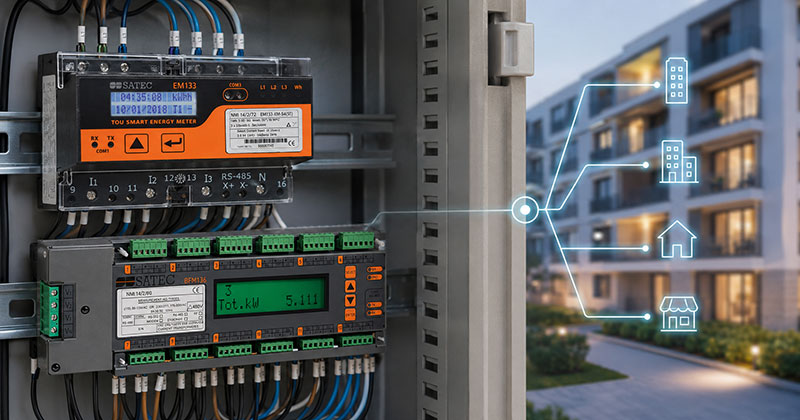
Embedded networks are now a firmly established part of Australia’s energy landscape. They are used in apartment buildings, shopping centres, retirement villages, industrial estates, commercial precincts and mixed-use developments where electricity is supplied to multiple customers through a private electrical network.
For building owners, operators and embedded network managers, accurate metering is essential. It affects billing, compliance, tenant confidence and the way energy performance is managed across a site. One of the most practical solutions for these environments is an NMI approved DIN rail meter.
Compact, accurate and designed to fit inside modern electrical switchboards, these meters help support reliable energy measurement where space, compliance and data visibility all matter.
Key Points
Embedded networks are privately owned electricity networks that distribute power to multiple tenants or residents from a single parent connection point.
Any electricity meter used for billing or trade measurement in an embedded network must hold NMI pattern approval under the NMI M 6-1 standard, a requirement that has applied in Australia since January 2013.
DIN rail meters offer a compact, space-efficient format that is well suited to switchboards where many meters must be installed in a limited area.
NMI approved meters provide a defensible billing foundation that helps embedded network operators reduce disputes and support tenant confidence.
Modern DIN rail meters with Modbus or Ethernet communications can be integrated into energy management platforms, enabling site-wide visibility beyond basic consumption data.
SATEC’s EM133-XM is an NMI approved DIN rail meter with more than 40 years of energy management expertise behind it, offering Class 0.5S accuracy, 8MB data logging and flexible communications for Australian embedded network applications.
What Is An Embedded Network?
An embedded network is a privately owned electricity network within a site or building. Instead of each tenant or customer being connected directly to the main electricity grid through their own separate supply arrangement, the site receives electricity through a parent connection point. The electricity is then distributed to individual apartments, shops, offices, tenancies or facilities within the property.
This arrangement can offer flexibility for owners and operators. It can also support shared solar, centralised energy management, electric vehicle charging and other distributed energy systems. However, it creates a clear responsibility: every customer within the network needs to be measured accurately and billed fairly.
That is where metering becomes critical. In an embedded network, the meter is not just a monitoring device. It is part of the billing process and in most cases it must meet specific Australian requirements for trade measurement.
Why NMI Approval Matters
NMI stands for the National Measurement Institute. In Australia, electricity meters used for trade measurement must meet strict requirements for accuracy and performance. Since January 2013, the exemption that previously applied to electricity meters used for billing was lifted, meaning all meters installed in residential, commercial and other business environments for trade purposes must hold NMI pattern approval.
The relevant standard is NMI M 6-1, which covers metrological and technical requirements for active-energy electricity meters. Meters must also be verified prior to installation in accordance with NITP 14, the National Instrument Test Procedures for Utility Meters. These verification certificates accompany compliant meters to provide traceability and confidence in measurement accuracy.
An NMI approved DIN rail meter is designed to meet these requirements while also offering the installation advantages of DIN rail mounting. This makes it highly relevant for embedded networks where many meters may need to be installed in a limited switchboard area. For embedded network operators, using meters that are not suitable for billing can create real risk. Disputes over energy charges are difficult to manage if measurement accuracy is questioned.
NMI approved meters help provide a stronger foundation for transparent billing and long-term site management.
Why DIN Rail Meters Suit Embedded Networks
DIN rail meters are popular in embedded network applications for a simple reason: they are compact and efficient to install. Many embedded network sites require a high number of meters within a confined electrical room or switchboard. A traditional panel meter may not always be practical where space is limited or where the project involves a retrofit.
A DIN rail format allows meters to be mounted neatly alongside other electrical components. This can simplify installation and help reduce switchboard clutter. It also makes maintenance easier as meters are grouped in a structured layout.
In retrofit projects, this can be especially valuable. Existing buildings were often not designed with modern energy management needs in mind. Adding accurate tenant metering, solar monitoring or EV charging measurement can quickly create space challenges. A compact NMI approved DIN rail meter gives consultants, contractors and operators more flexibility when upgrading existing sites.
Supporting Fair And Transparent Billing
Billing confidence is one of the biggest reasons embedded networks need accurate meters. Tenants and residents want to know they are being charged based on their actual usage. Owners and operators need reliable data to manage costs and respond to queries.
An NMI approved meter supports this by providing measurement that is appropriate for trade use. In practical terms, this means the meter can be used as part of a system where energy consumption is recorded and then used for billing or cost recovery. This matters across many embedded network settings. In an apartment building, each resident may need a separate record of electricity use. In a shopping centre, each tenancy may have different operating hours, equipment loads and energy profiles.
In an industrial estate, one tenant may use significantly more energy than another. Accurate metering helps ensure energy costs are allocated to the right customer.
Data Visibility Beyond Billing
While billing is a major driver, energy metering in embedded networks should not stop at monthly consumption totals. Modern sites need better energy visibility. Operators want to understand peak demand, load profiles, power quality and how different areas of the site are performing. A well selected NMI approved DIN rail meter can support this broader view.
With communication options such as Modbus RS485 or Ethernet, meter data can be integrated into energy management platforms, building management systems or reporting tools. This gives site operators the ability to track trends, identify unusual usage and support energy efficiency initiatives.
For embedded networks with solar, battery storage or EV charging, data visibility becomes even more important. Energy flows may no longer be simple one-way consumption patterns. A site may need to measure import, export, generation and tenant usage across multiple points. Choosing meters that can support detailed data collection helps prepare the embedded network for future energy requirements.
Key Considerations When Selecting A Meter
Not all meters are suitable for embedded network billing. Before selecting a meter, it is important to consider a few core factors.
The first is whether the meter will be used for billing/trade measurement. If so, NMI pattern approved energy metering must be used. The second is whether the installation is single phase or three phase. Embedded networks often include a mix of both, particularly in sites with residential apartments, commercial tenancies and common area loads. Thirdly, the communication infrastructure to retrieve energy data.
Communication capability is another important factor. A meter that only provides a basic local reading may be enough for some simple applications but embedded networks usually benefit from remote data access. This reduces manual reading, improves reporting and supports faster response to billing questions.
Physical space also matters. Electrical rooms and meter panels can become crowded quickly. Compact DIN rail meters help solve this challenge, especially where large numbers of meters are required.
The table below compares key attributes across metering options commonly considered for embedded network applications.
| Feature | NMI Approved DIN Rail Meter |
|---|---|
| NMI Pattern Approval | Yes |
| Suitable for billing / trade measurement | Yes |
| DIN rail mounting | Yes |
| Space efficiency in switchboards | High |
| Remote communications (RS485 / Modbus / Ethernet/TCP-IP) | Yes (model dependent) |
| Single and three phase support | Yes |
| Interval data logging (where required at 5mins, 15mins, 30mins. User selectable) | Yes (model dependent) |
| Suitable for retrofit installations | Yes |
| Integration with energy management software | Yes (model dependent) |
| NITP 14 verification certificate | Yes |
SATEC's Metering Solution For Embedded Networks
With more than 50 years of energy management expertise, SATEC provides metering solutions that are well suited to embedded network applications where accuracy, compact design and energy visibility all matter.
The EM133-XM is an NMI approved DIN rail meter designed for the Australian sub-metering market and offers a practical option for billing-grade energy measurement in a DIN rail format. Compact enough for switchboards where space is at a premium, the EM133-XM is particularly useful in retrofit projects or multi-tenant buildings where several meters need to be installed in one location. Its Class 0.5S accuracy exceeds baseline NMI M 6-1 requirements and it comes supplied with NITP 14 verification certification to support compliance from the outset.
The broader energy management needs of embedded networks are also well catered for. With RS485/Modbus communications as standard and Ethernet available as an option, meter data can be connected into reporting and monitoring platforms. This allows operators to move beyond basic consumption readings and gain genuine visibility across the site.
The EM133-XM also features 8MB of onboard memory for long-term data logging and load profiling, supporting 5-minute interval data requirements and giving operators detailed records without the need for constant manual retrieval. A retrofit-ready variant, the EM133-XM-HACS, uses split-core current sensors so existing circuits do not need to be de-energised during installation.
When paired with SATEC’s Expertpower software, metering data can be used to support monitoring, analysis and clearer energy reporting. This combination supports tenant billing, common area monitoring, energy efficiency planning and identifying unusual consumption patterns. The meter delivers accurate measurement at the point of use while the software helps turn that data into practical insight.
Where NMI Approved DIN Rail Meters Are Commonly Used
NMI approved DIN rail meters can be used across many embedded network environments. Common applications include:
- Apartment buildings and residential towers requiring individual tenant metering
- Retirement living communities with common area and dwelling-level measurement
- Shopping centres where each tenancy has a separate energy profile
- Commercial office buildings with multiple tenants
- Mixed-use developments combining residential, retail and commercial loads
- Caravan parks/tourist parks
- Marinas
- Short-term accommodation
- Industrial estates and business parks with varied consumption across tenancies
- Private embedded networks with shared solar, battery storage or EV charging cost recovery
Each application may have different technical requirements but the core need is the same: accurate measurement that is trustworthy and defensible.
Building Confidence Into The Network
Embedded networks depend on trust. Customers need confidence that they are being billed fairly. Operators need confidence that their data is accurate. Consultants and contractors need confidence that the specified equipment is fit for purpose.
Choosing an NMI approved DIN rail meter helps build that confidence from the start. It supports accurate billing, efficient installation and stronger energy visibility across the site. For embedded networks where space is limited and requirements are growing, DIN rail metering offers a practical and future-ready approach. As energy systems become more complex and sites add solar generation, batteries, chargers and smarter controls, the right meter will need to keep pace.
Selecting metering that supports detailed data collection and integrates with energy management software is no longer just good practice. It is the foundation for managing an embedded network effectively.
FAQs - NMI Approved DIN Rail Meters For Embedded Networks
What is an NMI approved DIN rail meter and why is it required in embedded networks?
A NMI approved DIN rail meter is an electricity meter that has passed pattern approval testing under the Australian NMI M 6-1 standard, confirming it is accurate and suitable for trade measurement. Since January 2013, any meter used for billing or cost recovery in an embedded network must hold this approval.
Can one DIN rail meter handle both single phase and three phase applications?
Yes, energy meters such as the SATEC EM133-XM and BFM136 can be configured for either single phase or three phase measurement, making them suitable for the mix of residential and commercial tenancies typically found in embedded networks.
What happens if an embedded network uses a meter that is not NMI approved?
Using a non-approved meter for billing creates legal and commercial risk, as the measurement cannot be defended as compliant with Australian trade measurement law, which can expose operators to disputes and potential liability.
Can NMI approved DIN rail meters be connected to energy management software?
Yes, meters with RS485/Modbus or Ethernet communications can be integrated with platforms such as SATEC’s Expertpower software, allowing operators to access interval data, monitor consumption trends and generate billing reports remotely.


