

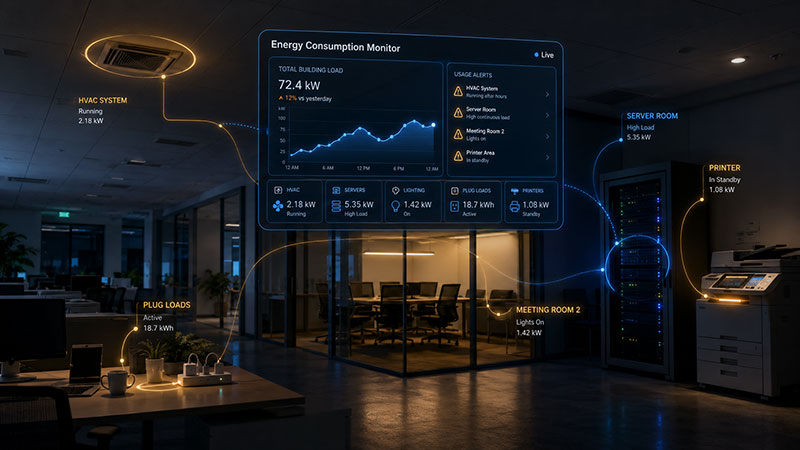
Energy waste is not always obvious. A building can look efficient while equipment runs after hours, loads spike unexpectedly or power quality issues quietly add to costs. For many Australian businesses, the problem is not a lack of effort, it is a lack of visibility. An energy consumption monitor gives that visibility. Instead of relying on monthly electricity bills, it shows how and when energy is being used across a site. This makes it easier to identify waste, understand usage patterns and make informed decisions before costs get out of hand.
For commercial, industrial and multi-tenancy buildings, hidden energy waste can build up quickly. In Australian commercial buildings, HVAC systems alone can account for up to 50% of total energy use. Lighting, pumps, compressors, chillers, production equipment, lifts and plug loads can all consume power when they are not needed.
Key Points
Hidden energy waste often comes from equipment running outside business hours, poor scheduling or avoidable demand peaks, not just faulty equipment.
Your load profile is the starting point. When it does not match your site’s actual operating hours, the gap is usually where savings are hiding.
After-hours energy use is one of the most common and correctable sources of waste in Australian commercial buildings.
Demand charges can make up 30 to 60% of a commercial electricity bill in some Australian states, reducing peak demand can have a significant impact on costs.
Sub-metering allows you to compare energy use across departments, floors, tenants or equipment, which helps move from broad assumptions to targeted action.
SATEC provides NMI-approved energy meters and the Expertpower software platform designed for Australian commercial, industrial and multi-tenancy environments, giving sites the metering accuracy and data visibility they need to act on energy waste.
What Hidden Energy Waste Looks Like
Hidden energy waste is any electricity use that does not support comfort, productivity, safety or business performance. It is not always caused by faulty equipment. Often it comes from system settings or habits that continue in the background without being noticed.
Common examples include:
- Air conditioning running overnight or across weekends
- Machinery left in standby mode outside production hours
- Equipment starting earlier than necessary
- Building services running on outdated schedules
- Excessive peak demand caused by multiple large loads starting at the same time
- Power quality issues such as poor power factor or harmonics
- Idle loads (electrical appliances that are not in use but left plugged in and on at the power point/socket)
An electricity bill may confirm that energy use has increased but it rarely explains why. An energy consumption monitor helps fill that gap by turning raw electricity data into something useful.
Start With Your Load Profile
The first step is to review your load profile. This shows how electricity demand changes across the day, week and month. A healthy load profile should broadly reflect how your site actually operates.
If your business closes at 5 pm, energy use should drop soon after. If a factory has a defined production schedule, demand should follow that pattern. When the load profile does not match real activity, it often points to hidden waste. A high overnight baseload may indicate equipment running unnecessarily. Sudden spikes may reveal machinery starting at the same time. Consistent weekend consumption may show that systems have not been properly scheduled.
This is where an energy consumption monitor becomes especially valuable. Facilities teams can compare actual energy behaviour with expected site behaviour. The difference between the two is often where savings are found.
Check After-Hours Energy Use
After-hours energy use is one of the most straightforward areas to investigate. Many Australian sites consume more electricity outside business hours than they realise. This can happen when timers are set incorrectly, cleaners require limited lighting but entire floors remain powered or HVAC systems stay active long after occupants have left.
Review energy data from evenings, weekends and public holidays. Look for patterns that repeat when the building should be mostly inactive. If the same load appears every night, identify what equipment is still operating. Sometimes the cause is essential. Often it is a simple scheduling issue that can be fixed quickly.
Identify Peak Demand Problems
Energy costs are not only driven by total consumption. Demand charges can also have a significant impact on commercial and industrial electricity bills in Australia. In some states, these charges make up between 30% and 60% of a business’s electricity bill, particularly for sites with heavy machinery or large HVAC systems.
A short period of high demand can increase costs considerably even when total energy use appears reasonable. An energy consumption monitor helps identify when peaks occur and what may be causing them. Several major loads may start at the same time in the morning. Staggering start times can reduce demand peaks without reducing output or productivity.
Monitoring also helps businesses test whether operational changes are working. If a site adjusts equipment schedules, the energy data should confirm whether peak demand has reduced.
Compare Areas, Tenants Or Equipment
Whole-site monitoring is useful. More detailed monitoring is even better. Sub-metering allows businesses to compare energy use across departments, tenants, floors, plant rooms or specific equipment. This matters because hidden waste is rarely spread evenly across a building. One tenant may have unusually high after-hours use.
One production area may consume more energy than comparable areas on the same site. Breaking energy data into smaller sections helps teams move from general assumptions to targeted action.
Look For Unusual Changes Over Time
Energy waste is not always constant. It can appear gradually as equipment ages, controls drift or building use changes. This makes trend analysis important.
Reviewing weekly and monthly energy patterns helps identify increases that cannot be explained by weather, occupancy, production volume or operating hours. A slow rise in baseload may suggest equipment is becoming less efficient or that a fault is developing before it becomes a visible problem.
Use Alerts To Catch Waste Sooner
Manual reviews are useful but they can be time-consuming. Alerts make energy monitoring more proactive. A well-configured system can notify teams when consumption exceeds a set threshold or when equipment appears to be operating outside normal hours.
Early notification can prevent wasted energy from becoming a long-term cost and helps teams respond before patterns become entrenched.
How SATEC Supports Australian Energy Monitoring
With more than 50 years of experience in power metering and energy management, SATEC is a global leader in electrical measurement solutions. In Australia, the product range is specifically suited to the demands of commercial buildings, industrial facilities and multi-tenancy environments where accurate data and compliance matter.
The range includes high-accuracy energy meters, power quality analysers and NMI-approved energy metering options for applications where billing accuracy and regulatory compliance are required. In Australia, any meter used for tenant billing or trade measurement must be approved by the National Measurement Institute (NMI) and verified in accordance with NITP-14. Using a non-compliant meter creates both regulatory and commercial risk.
The SATEC range addresses this directly with NMI-approved options suited to retrofit and new-build applications alike. When paired with Expertpower, the energy management software platform, meter readings are transformed into practical insight. Expertpower supports dashboards, reports, trend analysis and monitoring across connected devices — making it easier to identify waste, compare loads and understand site activity over time.
What sets the SATEC solution apart is the ability to capture not only energy consumption but also the quality and behaviour of electrical systems. Poor power factor, harmonics and voltage events can all contribute to energy costs in ways that a basic monitoring device will not reveal. Having access to that level of detail means facilities teams can act on problems before they become expensive.
Turning Visibility Into Savings
An energy consumption monitor is a practical tool for finding hidden energy waste. It helps businesses move beyond guesswork and focus on the areas where savings are most likely to be found. The biggest opportunities often come from straightforward discoveries, equipment running after hours, unnecessary baseload, avoidable demand peaks or a single area consuming significantly more energy than expected.
For Australian businesses that want better control over energy costs, sustainability performance and NABERS outcomes, accurate metering is a strong starting point. With the right monitoring strategy and the right metering solution, hidden energy waste does not have to stay hidden.
FAQs - How To Use An Energy Consumption Monitor To Find Hidden Energy Waste
What is an energy consumption monitor and how does it differ from a standard electricity meter?
An energy consumption monitor provides detailed, real-time data on how and when electricity is being used across your site, not just how much you have used in total. This allows you to identify specific sources of waste rather than simply reviewing a monthly bill after costs have already been incurred.
How do I know if my site has a hidden energy waste problem?
A good starting point is to check whether your load profile matches your actual operating hours. If energy use remains high outside business hours or on weekends, that is a strong indicator that equipment is running unnecessarily. Unexplained increases in your electricity bill over time can also signal that waste is building up in the background.
Are NMI-approved meters required for all commercial sites in Australia?
NMI approval is a legal requirement where meters are used for tenant billing or any form of trade measurement under Australian law. For energy management purposes only, where no billing is involved, NMI approval is not mandatory but is widely recommended for accuracy and reliability.
Can energy monitoring help reduce demand charges on my electricity bill?
Yes. By showing exactly when usage spikes occur across your site, monitoring allows you to stagger equipment start times or reschedule energy-intensive activities away from peak windows. In some Australian states, demand charges make up between 30% and 60% of a commercial electricity bill, so even modest reductions can produce meaningful savings.
Explore related topics:
For Your Industry
- Commercial HVAC Energy Optimisation: What Meter Data Reveals That Setpoints Don’t
- How Power Monitoring Devices Help Reduce Energy Costs in Commercial Buildings
Standards & Compliance
Related Reading
- How To Find Phantom Loads Using Smart Metering Data
- Building Energy Management Analytics: The Complete Guide for Commercial Buildings
Trending in Your Sector


