

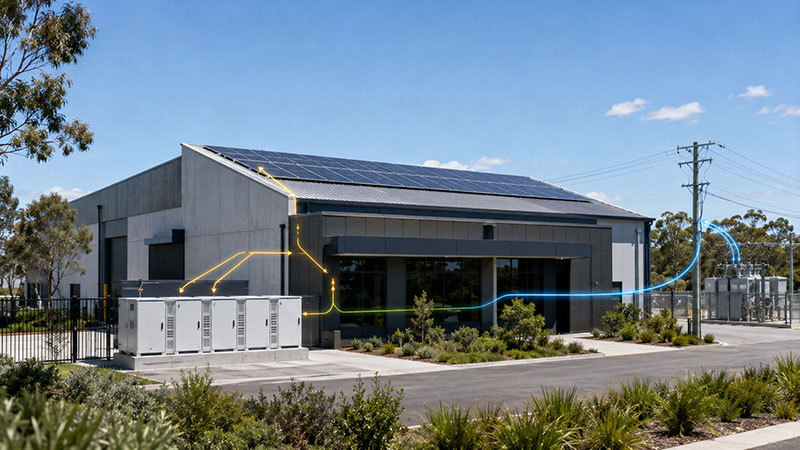
Electricity stopped moving in one direction at many Australian sites a long time ago. A manufacturing plant can draw heavily from the grid at 7am then be exporting surplus solar by 11am. Batteries charge and discharge across the same day. Inverters quietly absorb and supply reactive power under settings most site owners have never looked at.
Standard consumption reporting hides nearly all of this. Four quadrant metering separates active and reactive energy by direction. The result is a clear picture of what a site draws, returns, absorbs and supplies.
Scale is what makes this an Australian problem rather than a theoretical one. Rooftop solar capacity reached 28.3 GW by the end of 2025 across more than 4.3 million households. Distributed generation on that scale reverses power flow at sites that were never designed for it.
Key Points
Four quadrant metering records active and reactive energy in both directions, so imports and exports are captured separately instead of cancelling each other out.
Net figures conceal real activity. A site importing 500 kWh and exporting 200 kWh reports 300 kWh net, which says nothing useful about solar or battery performance.
Reactive energy direction has become a live issue here because AS 4777.2:2020 requires volt-var and volt-watt response modes, so compliant inverters absorb and supply reactive power automatically.
In the National Electricity Market, import and export channel labels are written from the grid’s point of view rather than the customer’s, which regularly confuses site teams reading their own interval data.
Reversed current transformers and incorrect phase association produce data that looks plausible but is wrong, so commissioning discipline matters more than the number of registers a meter offers.
SATEC supplies NMI pattern approved four quadrant meters including the EM133-XM and the BFM136, with Expertpower turning directional data into reporting that site teams can act on.
What Four Quadrant Metering Actually Measures
Active power performs the useful work. It is measured in kilowatts and accumulated as kilowatt hours. Reactive power supports the magnetic fields that motors, transformers and inverters depend on. It is measured in kilovolt amperes reactive and accumulated as kilovolt ampere reactive hours.
A single direction meter records imported active energy and nothing else. A four quadrant meter maintains separate registers for imported active energy, exported active energy and reactive energy flowing each way.
Conventions are not universal. Sign definitions vary between manufacturers, retailers and software platforms. Confirm the register map during commissioning rather than assuming it matches the last site you worked on.
The Four Quadrants In Plain Terms
The quadrants come from the possible combinations of active and reactive power flow. Quadrant one covers imported active power with inductive reactive power. That is a typical factory running motors.
Quadrants two and three appear when active power reverses through solar, a generator or a battery discharge. Quadrant four usually shows imported active power with reactive power flowing the other way. Capacitor banks and inverter settings are the common causes.
Quadrant numbers are shorthand and nothing more. Work from the signed active and reactive values alongside the manufacturer’s register map.
Why Import And Export Must Stay Separate
Net energy is a comfortable number that tells you very little. Consider a Melbourne warehouse with a 200 kW rooftop array. Over a billing month it imports 48,000 kWh and exports 19,000 kWh. The net figure of 29,000 kWh gives no indication of whether the array performed, whether an inverter dropped out for a fortnight or whether the battery cycled as designed.
Separate registers preserve both halves of the energy balance. That supports genuine performance analysis, tenant cost allocation and invoice reconciliation.
The financial case has sharpened recently. Export charges and rebates now apply across several networks including Ausgrid, Endeavour Energy, Essential Energy and SA Power Networks. When exports carry a time dependent price, exported kilowatt hours need to be measured with the same care as imported ones.
Why Reactive Energy Direction Now Matters More
Reactive energy rarely appears as a simple consumption charge. It still affects network capacity, losses, voltage stability and power factor penalties.
What has changed in Australia is the source of the reactive power. AS 4777.2:2020 requires grid connected inverters to operate with volt-var and volt-watt response modes active. Under those settings an inverter absorbs or supplies reactive power in response to the voltage it sees at its terminals. Distribution networks such as Endeavour Energy require both modes to run concurrently.
The practical effect is significant. A site with solar now has equipment that changes its reactive behaviour automatically through the day. Nobody at the site instructed it to do so.
Measuring total reactive energy only will mask this. The absorbed and supplied quantities partially offset each other and the site looks better balanced than it is. Four quadrant measurement separates them, which is what makes it possible to assess power factor correction properly, spot overcorrection and confirm that inverter settings match what the network agreed to.
Where Four Quadrant Metering Belongs
Directional measurement earns its place wherever flow can reverse or reactive behaviour needs examination. Commercial and industrial solar, battery storage, microgrids, embedded networks, water and wastewater sites with regenerative drives and large EV charging hubs all qualify.
Location matters as much as capability. A meter at the grid connection point shows total import and export for the site. Downstream meters are what separate solar generation from battery flow, major loads and individual tenant consumption.
Embedded networks are a particular case. Where a submeter measurement is used to bill a tenant, the meter must hold NMI pattern approval under NMI M 6-1 and be verified in accordance with NITP 14. That requirement covers active energy. Reactive energy registers fall outside pattern approval, which is worth knowing before anyone tries to bill on them.
Getting Installation And Commissioning Right
Directional metering depends entirely on correct voltage and current relationships. A reversed current transformer will make imported energy read as exported energy. Incorrect phase association produces active power, reactive power and power factor values that look completely reasonable and are completely wrong.
This is the part of the job that gets rushed. Registers are cheap. Correct polarity is not.
Commissioning should confirm the current transformer ratio, polarity, phase sequence, voltage references and the import or export sign convention. Verify that the monitoring platform is actually collecting the directional registers rather than the totals.
An energy balance provides the final check. Grid import, onsite generation, storage flow, export and site consumption should reconcile once losses and interval timing are allowed for. If they do not reconcile, the wiring is usually the reason.
Choosing A Meter For Directional Measurement
The right device depends on how many circuits need watching and whether the data will be used for billing.
| Capability | EM133-XM | BFM136 | PM180 |
|---|---|---|---|
| Device type | DIN rail time of use energy meter | Multi circuit branch feeder monitor | Power quality analyser and recorder |
| Four quadrant active and reactive energy | Yes | Yes | Yes |
| Separate import and export registers | Yes, total and per phase | Yes, per submeter | Yes |
| Circuits monitored | One three phase or three single phase | Up to 12 three phase or 36 single phase | Single measurement point |
| Accuracy class | Class 0.5S | Class 0.5S | Class 0.2S energy measurement |
| NMI pattern approved for trade billing | Yes | Yes | No |
| Power quality depth | THD, TDD, K factor to 40th order | Basic power and energy parameters | Class A Edition 3 to IEC 61000-4-30 |
| Best suited to | Grid connection points, tenant billing, embedded networks | Multi tenant switchboards, retrofit projects, submetering at scale | Fault investigation, disturbance analysis, connection point studies |
SATEC Solutions For Four Quadrant Metering
The EM133-XM is an NMI approved DIN rail meter with four quadrant active and reactive energy measurement. It records active, reactive and apparent energy as total and per phase values. Time of use registers, onboard logging and flexible communications let a site compare directional behaviour across tariff periods.
Where a switchboard needs many measurement points, the BFM136 records import and export active energy plus reactive energy for each configured submeter. Up to 12 three phase circuits or 36 single phase circuits can be monitored from one device. High accuracy current sensors can sit up to 200 metres away, which makes retrofit work in crowded switchrooms far less painful.
Expertpower brings that data into a web based platform for reporting, historical analysis, alarms and asset comparison. Where a disturbance needs proper investigation, the PM180 adds Class A Edition 3 power quality analysis, fault recording and waveform capture. Note that it is a monitoring and analysis device, so any measurement point used for billing still requires an NMI pattern approved meter.
Used together, these products show far more than net consumption. Generation, storage, reactive behaviour and changing electrical conditions all become visible.
Building A Clearer Energy Picture
Four quadrant metering stops imports and exports from cancelling each other in the data. It also reveals whether reactive energy is being absorbed or supplied, which matters more each year as inverter response modes become standard across Australian sites.
The reward is a defensible basis for reconciliation, equipment assessment, system control and investment decisions.
Talk to SATEC about your site. If your facility has solar, storage or reactive loads and your reporting still shows a single net consumption figure, you are missing most of the picture. Contact the SATEC Australia team for advice on meter selection, measurement point placement and Expertpower reporting for your site.
FAQs - Four Quadrant Energy Metering In Australia
What is the difference between two quadrant and four quadrant metering?
Two quadrant metering records active energy in both directions but does not separate reactive energy by direction. Four quadrant metering captures both active and reactive energy in each direction, which is necessary at any site with solar, storage or significant reactive loads.
Does my meter need NMI approval to measure export energy?
It depends on how the data is used. Any meter used to bill a customer or tenant for electricity must hold NMI pattern approval under NMI M 6-1 and be verified to NITP 14. Meters used purely for energy management rather than trade are generally exempt.
Why does my site show reactive energy flowing in both directions?
Compliant inverters under AS 4777.2:2020 run volt-var and volt-watt response modes, so they absorb reactive power at high voltage and supply it at low voltage. This produces reactive flow in both directions across a normal day, which is expected behaviour rather than a fault.
Can a reversed current transformer make my solar look like consumption?
Yes, and it is one of the most common commissioning errors. A reversed CT inverts the sign of the measured power, so exported solar energy accumulates in the import register. Checking polarity and phase association at commissioning is the only reliable way to catch it.
Explore related topics:
For Your Industry
Standards & Compliance
- NEM Metering Installation Types Explained: A Complete Guide To Types 1 To 9
- NMI Approved Energy Meter With Ethernet: Why the EM133-XM Changes How You Manage Power
Related Reading
- Advanced Four-Quadrant Revenue Meters for Australia’s Smart Grid
- What Is Power Factor and Why Is It Important?
Trending in Your Sector


