

Power factor is one of the most important measurements in any electrical system yet it is often overlooked until it starts creating problems. If your site is dealing with unexpected energy costs, overloaded equipment or questions about electrical efficiency, understanding power factor can give you a much clearer picture of what is happening.
In simple terms, power factor measures how effectively electrical power is being used. It describes the relationship between the power your equipment needs to do useful work and the total power supplied by the network. When that relationship is strong, your system is running efficiently. When it is weak, your site may be drawing more current than necessary, which can increase losses and place extra strain on infrastructure.
For commercial buildings, industrial facilities and energy managers, it is not just a technical number on a report. It can affect operating costs, system capacity and overall performance. That is why measuring it accurately is a key part of understanding site energy behaviour.
Key Points
Power factor measures how effectively electrical power is being used. A low measurement means your system is drawing more current than necessary to do the same useful work.
In Australia, many commercial and industrial customers are billed on kVA demand tariffs, meaning poor power factor can directly increase your electricity costs.
Inductive loads such as motors, HVAC plant and pumps are the most common cause, particularly when lightly loaded or cycling throughout the day.
Non-linear loads including variable speed drives and UPS systems can introduce harmonic distortion, which affects power quality and requires careful consideration before applying correction.
Continuous monitoring is far more useful than occasional spot checks because power factor can vary significantly across different operating periods and loading conditions.
SATEC’s smart metering solutions provide the accurate, real-time visibility into power factor and power quality that Australian facilities need to manage performance and reduce energy costs.
What Is Power Factor?
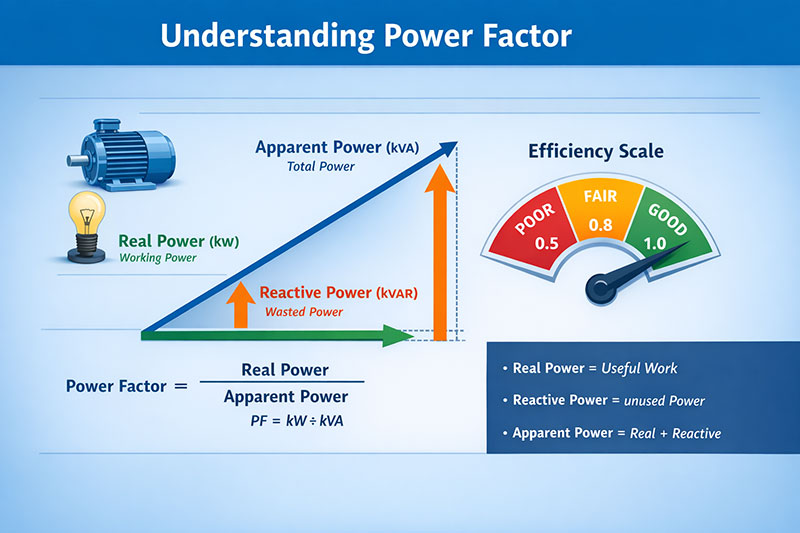
Power factor is the ratio between real power and apparent power in an electrical system. Real power, measured in kilowatts (kW), is the power that actually performs useful work such as running motors, lighting or heating elements. Apparent power, measured in kilovolt-amperes (kVA), is the total power supplied by the source.
It’s expressed as a number between 0 and 1. A factor of 1 means all supplied power is being converted into useful work, which is considered ideal. A lower value means some of that power is not being used effectively.
In AC electrical systems, poor power factor commonly occurs when current and voltage are out of sync. This happens in systems with inductive loads such as motors, transformers, pumps and compressors. These devices require reactive power to create the magnetic fields needed for their operation. Reactive power is necessary but it does not perform useful work on its own. The result is that the system must carry extra current to deliver the same useful output.
Why It Matters
Power factor matters because it directly influences the efficiency of your electrical system. When power factor is low, more current is needed to deliver the same amount of real power. That extra current increases losses in cables and transformers and can reduce the available capacity of your electrical infrastructure.
This can lead to several practical issues. Equipment may run hotter than expected. Voltage drop can become more noticeable. Infrastructure may need to be oversized to cope with demand that is not fully productive.
In Australia, many large commercial and industrial customers are now billed on a kVA demand tariff rather than a kW demand tariff. Since kVA is a measure of apparent power, poor power factor directly inflates your demand charges. Improving power factor reduces the kVA of your installation and therefore reduces what you pay. Some network tariffs may also include reactive energy charges or penalties when power factor falls below a set threshold.
For facility managers and engineers, this makes power factor an important indicator of site performance. It is not only about compliance or billing. It is also about making sure the system is operating as efficiently and reliably as possible.
What Causes Poor Power Factor?
Poor power factor is usually linked to the type of equipment connected to the system. Inductive loads are the most common cause. Motors are a classic example, especially when they are lightly loaded or cycling on and off throughout the day. Older fluorescent lighting systems, welders and large HVAC plant can also be contributors.
Non-linear loads can complicate the picture further. Variable speed drives, uninterruptible power supplies (UPS) and other power electronics may distort the current waveform, increasing what is known as harmonic distortion. This can affect the overall quality of power in the system and means that correction strategies need careful consideration.
In these environments, simply looking at consumption data is not enough. You need detailed metering to see how the site is actually behaving. Load variation also plays a role. A site may have an acceptable power factor during peak production hours and a poor one during periods of light loading. This is why continuous monitoring is far more useful than occasional spot checks.
How is Power Factor Measured?
Power factor is measured by analysing voltage, current and the phase relationship between them. Modern power meters can calculate power factor in real time and show how it changes across different loads, times and operating conditions.
This visibility matters. A poor reading tells you there is an issue but it does not tell you why it is happening or where it is coming from. Accurate metering helps identify which circuits, loads or processes are contributing to the problem. It can also reveal whether the issue is consistent or only appears during certain operating periods.
For larger sites, this level of detail is essential. A single main incomer reading may show that overall power factor is lower than expected but sub-metering can pinpoint the exact source. That makes it much easier to plan corrective action and assess whether solutions such as capacitor banks, load balancing or equipment upgrades are likely to deliver results.
Where harmonics are present, it is also important to distinguish between displacement power factor and true power factor. A site dominated by inductive loads may suit capacitor-based correction. A site with significant harmonic distortion requires a different approach to avoid resonance and potential equipment stress. Good metering will reveal the difference.
Improvement Starts with Visibility
Many organisations focus on correcting power factor only after demand charge increases or capacity issues emerge. A better approach is to monitor it proactively and understand the conditions that drive performance.
Improvement often starts with identifying the loads creating excessive reactive power demand. From there, sites may look at power factor correction equipment, better control strategies or changes to equipment operation. In some cases the issue may be linked to poor maintenance or ageing assets rather than system design.
The common thread is measurement. Without reliable data, power factor remains a guess. With the right metering in place, it becomes a practical metric that supports decision-making across energy management, maintenance and electrical design.
Why SATEC is the Metering Solution
The first step is having energy metering that delivers accurate, actionable insight. That is where SATEC products fit naturally into the picture.
SATEC’s smart metering solutions are designed to give facilities a detailed view of electrical performance, including power factor, real power, reactive power, apparent power, voltage, current, demand and power quality. This allows users to move beyond broad assumptions and see exactly how their system is operating. For sites with complex electrical loads,
SATEC meters help identify where poor power factor is occurring and when it is most likely to happen. That visibility is especially valuable in commercial buildings, industrial sites and retrofit environments where switchboard space is limited and efficient installation matters.
SATEC’s metering range is well suited to these applications, offering compact solutions without sacrificing capability. SATEC also brings added value through power quality analysis and software integration via Expertpower. This gives users a clearer way to track trends, investigate issues and make informed decisions about corrective action. Instead of reacting after problems escalate, site teams can use real data to manage performance more effectively.
SATEC meters have been installed across commercial, industrial, utility and government facilities throughout the country. Their range includes NMI-approved meters suitable for billing and revenue applications as well as high-performance options for detailed power quality monitoring. If you want to understand power factor properly, metering is not optional. It is the foundation. SATEC products provide that foundation with the accuracy and insight needed to support better energy management.
Power Factor as Part of a Smarter Energy Strategy
Power factor is more than a technical concept for electricians and engineers. It is a useful indicator of how efficiently an electrical system is operating and how well infrastructure is being used. Poor values can increase losses, reduce capacity and drive up electricity costs. Strong values support a more efficient and reliable system.
The key is visibility. Once you can measure power factor accurately and track it over time, it becomes much easier to understand what is happening on site and what action will have the biggest impact. For businesses looking to improve electrical performance, that insight is essential.
If your site is serious about efficiency, cost control and power quality, power factor deserves attention. Accurate metering turns it from an abstract concept into a practical tool for smarter energy management.
FAQs - What Is Power Factor?
What is power factor in simple terms?
Power factor measures how efficiently electrical power is being used in a system. A higher power factor means more of the supplied power is doing useful work.
Why is low power factor a problem?
Low power factor means the system draws more current to deliver the same output. This can increase energy losses, reduce available capacity and place extra strain on electrical infrastructure.
How can power factor be improved?
Power factor can be improved by identifying the loads causing inefficiency and applying the right correction methods such as capacitor banks or equipment optimisation. Accurate metering is essential to understand where the issue is occurring.
How do SATEC meters help with power factor?
SATEC meters provide real time visibility into power factor and other key electrical parameters. This helps site teams detect issues earlier and make better decisions about system performance and correction.
Explore related topics:
Standards & Compliance
Related Reading
- Power Factor Correction for VFD Loads: Why Capacitor Banks May Not Solve the Real Problem
- How To Improve Load Factor And Reduce Electricity Demand Charges In Australia
- What Is A Power Energy Data Logger And When Should You Use One?
Trending in Your Sector


