

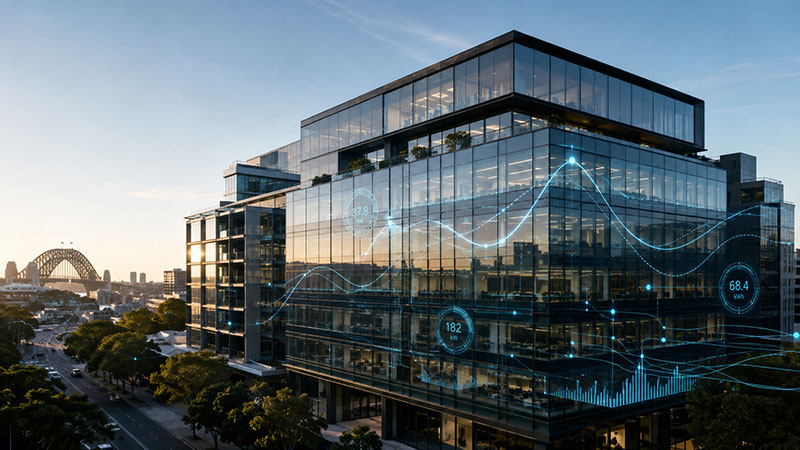
Commercial buildings consume a constant supply of energy. Utility bills show the total cost but they rarely explain where energy was used or why demand changed.
Building energy management analytics turns detailed energy data into information that building owners and facility teams can act on. It helps them understand consumption patterns, identify waste, manage peak demand and verify whether energy improvement projects are delivering the expected results.
For Australian buildings chasing a better NABERS rating or trying to contain demand charges, that visibility is no longer optional.
Key Points
Building energy management analytics converts interval data from meters and submeters into dashboards, alerts and reports that facility teams can act on.
Monthly utility bills hide the patterns that matter most, including overnight base load, equipment left running and short demand peaks that inflate costs.
Demand charges on Australian commercial tariffs are often set by a single peak interval, so identifying which loads caused a spike can deliver lasting savings.
Analytics can detect equipment problems early, such as a pump drawing more current than normal, before they become maintenance failures.
A successful project starts with a clear business objective and a metering design that measures the loads worth measuring, not every circuit in the building.
SATEC meters and Expertpower provide the measurement and analysis foundation, from NMI approved billing meters to compact multi-circuit devices for retrofit switchboards.
What Is Building Energy Management Analytics?
Building energy management analytics is the process of collecting, organising and analysing data from meters and connected building systems. The aim is to reveal how a building uses electricity across different services, areas and periods.
A typical platform receives interval data from the main incoming supply and from submeters installed on major loads. These may include air conditioning, lighting, lifts, central plant, solar generation, battery systems, electric vehicle chargers and individual tenancies.
The platform converts raw readings into dashboards, trends, alarms and reports. Instead of seeing one monthly figure, a facility manager can examine what happened at 2pm last Tuesday and trace the source of an unexpected increase. That level of detail supports faster decisions and far more targeted improvements.
Why Australian Commercial Buildings Need Better Energy Visibility
Energy use in a commercial building changes throughout the day. Occupancy, weather, operating schedules and equipment conditions all influence the result. A building may appear efficient at a monthly level while still wasting energy overnight or creating expensive demand peaks during a hot afternoon in January.
Analytics makes these patterns visible. It can show whether air conditioning starts earlier than required, whether equipment continues operating after occupants leave and whether different floors or tenancies are performing as expected.
There is also a distinctly Australian angle. NABERS ratings now shape leasing decisions for office buildings, and the rating depends on measured energy performance rather than good intentions. Buildings with strong metering and a disciplined review process are consistently the ones that improve their rating year on year.
Shared data improves communication too. When facility managers, contractors and finance teams look at the same trends, an issue gets investigated once instead of being debated three times.
What Can Energy Analytics Reveal?
Base Load
Base load is the electricity a building continues to consume when normal activity is low. A high overnight or weekend base load may point to unnecessary equipment operation, incorrect schedules or systems that have not shut down correctly. In our experience this is where the fastest wins hide. A building that draws 40 per cent of its daytime demand at 3am has a story to tell, and it is rarely a good one.
Abnormal Consumption
Analytics can identify unusual changes in consumption. A pump that begins using more energy than normal may be developing a mechanical problem. A sudden increase in one tenancy could indicate new equipment or extended operating hours. Early detection allows teams to investigate before the issue becomes a larger cost or a maintenance failure.
Power Quality
Voltage variations, harmonics, poor power factor and other electrical conditions can affect equipment performance and site reliability. Combining power quality monitoring with energy analytics provides a more complete picture of the electrical environment, which matters increasingly as buildings add variable speed drives, EV chargers and battery systems.
From Dashboards To Practical Action
A dashboard has little value if nobody knows what to do with the information. Effective analytics should help users move from observation to action.
Useful platforms allow teams to compare current performance with historical patterns, operating schedules or expected baselines. Alerts can highlight abnormal demand, missing data or consumption outside defined limits. Reports can then confirm whether a change produced a lasting improvement rather than a one-week dip.
Successful programmes establish clear responsibilities. Someone needs to review the information regularly, investigate exceptions and coordinate corrective action. Targets should be measurable. Reducing overnight base load by a defined amount, capping monthly peak demand or lowering energy use in a specific building service all qualify. “Use less energy” does not.
Analytics does not replace engineering knowledge. It directs that knowledge towards the areas where it can deliver the greatest value.
Choosing The Right Metering Approach
Different questions require different metering. The table below summarises the main options for a commercial building.
| Metering Approach | Typical Application | What It Reveals | Example SATEC Solution |
|---|---|---|---|
| Whole building metering | Main incoming supply | Total consumption, overall demand profile, base load | EM133 (NMI approved) |
| Submetering | Major services such as HVAC, lighting, lifts, central plant | Which services drive consumption and peaks | EM133 or PM130 series |
| Multi-circuit metering | Tenancies, distribution boards, retrofit switchboards with limited space | Per-circuit consumption across many loads from one compact device | BFM136 |
| Power quality monitoring | Main switchboards, sensitive equipment, sites with harmonics concerns | Voltage events, harmonics, power factor, disturbances | PM175 or PM180 |
Accurate Measurement Starts With The Right Meters
Reliable analytics begins with reliable measurement. If meter data is incomplete, inaccurate or too limited, the software cannot provide a trustworthy view of building performance.
SATEC products form the metering layer that captures the detailed electrical information analytics depends on. The range covers whole building metering, submetering, multi-circuit applications and advanced power quality monitoring.
Where tenants are billed for electricity, Australian law requires pattern approved meters. NMI approved models such as the EM133-XM meet this requirement, which matters for embedded networks and multi-tenant sites.
Compact devices such as the NMI approved BFM136 are particularly valuable in retrofit projects where switchboard space is restricted, since one unit can monitor dozens of circuits.
For facilities that need to monitor harmonics, disturbances or sensitive equipment, advanced instruments including the PM175 and PM180 provide deep power quality analysis.
Metering data can be brought into Expertpower for centralised monitoring. Organisations can view energy information across a single building or an entire portfolio, examine trends, monitor performance and create reports from one consistent data source.
With 50-plus years in electrical measurement behind the hardware, the combination gives building operators far more than a monthly total.
Planning A Successful Analytics Project
A successful project starts with a clear business objective. The priority may be reducing costs, improving visibility across tenancies, managing capacity or identifying inefficient equipment. That objective should guide the metering design and dashboard configuration.
The next step is to identify the loads that need separate measurement. Metering every circuit creates cost and complexity without adding insight. Too little submetering leaves important questions unanswered. The design should focus on major building services and loads that can actually be controlled or improved.
Data quality should be checked during commissioning and reviewed over time. Meter configuration, current transformer ratios, timestamps and communication settings all affect reliability. Clear naming conventions make dashboards easier to understand, especially once the original project team has moved on.
Finally, teams should know how to interpret trends and respond to alerts. Regular reviews keep energy performance visible long after the initial project has finished.
Turning Building Data Into Better Performance
Commercial buildings already produce the information needed to improve energy performance. The challenge is capturing that information accurately and presenting it in a form that supports action.
Building energy management analytics connects measurement with operational decision making. With the right meters, software and management process it can expose hidden waste, reduce demand costs, support maintenance and prove that energy initiatives are working.
Ready to see what your building is really doing? Talk to SATEC about a metering and Expertpower solution designed around your site, your tariff and your objectives. Contact our team for advice on the right configuration for your building.
FAQs - Building Energy Management Analytics: The Complete Guide for Commercial Buildings
What is the difference between energy monitoring and energy analytics?
Monitoring collects and displays energy data while analytics interprets it. Analytics compares consumption against baselines, detects abnormal patterns and helps identify the cause of changes. Monitoring tells you what happened and analytics helps explain why.
Do I need to submeter every circuit in my building?
No. Effective designs focus on major building services and loads that can be controlled or improved, such as HVAC, lighting and central plant. Metering every circuit adds cost and complexity without adding much insight.
Can energy analytics reduce demand charges?
Yes. Interval data shows exactly which loads contributed to a demand peak, allowing schedules to be staggered or loads shifted. On tariffs where one peak sets the charge for months, preventing a single spike can deliver significant savings.
Do tenant billing meters need to be NMI approved in Australia?
Yes. Any meter used to bill a tenant for electricity must be pattern approved under the National Measurement Act. SATEC offers NMI approved models such as the EM133-XM and BFM136 for embedded networks and multi-tenant buildings.
Explore related topics:
For Your Industry
- Commercial HVAC Energy Optimisation: What Meter Data Reveals That Setpoints Don’t
- How Power Monitoring Devices Help Reduce Energy Costs in Commercial Buildings
Standards & Compliance
- NCC J9D3 Sub-Metering Guide: HVAC, Lighting & Lift Compliance for Commercial Buildings
- Green Star Compliant Metering Systems: Complete Guide for Commercial Buildings
Related Reading
Trending in Your Sector


