

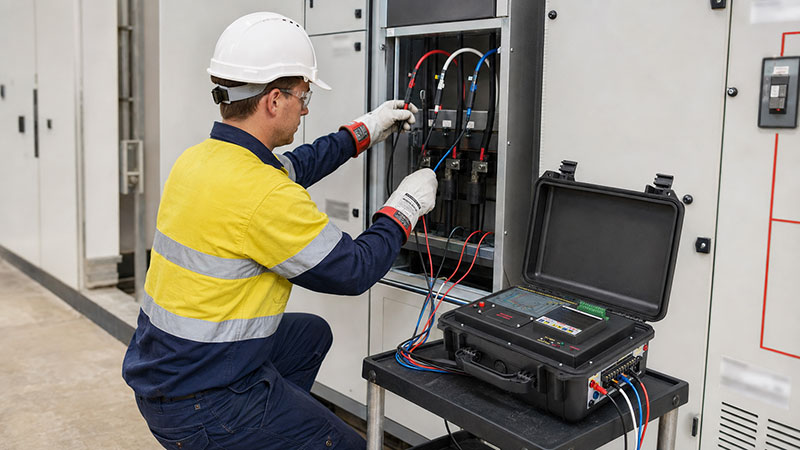
Electrical faults rarely wait for a convenient moment. A motor trips during one particular production cycle. Lights flicker on a Tuesday afternoon and never again. A bill climbs and nobody can say why. A visit with a handheld meter tells you what the site is doing right now, which is often not the thing you need to know.
A power logger closes that gap. It records electrical conditions over time, so contractors, engineers and facility managers can work from measured evidence instead of a theory.
Key Points
A power logger records electrical parameters continuously, so an intermittent problem can be matched to what the site was actually doing at the time.
Common Australian applications include unexplained trips, load profiling ahead of demand charges, capacity checks before new plant or EV chargers and power quality investigation.
Assessing supply voltage against AS 61000.3.100 calls for a Class A instrument recording for at least one week, not a spot reading during a site visit.
Rooftop solar has reshaped daytime voltage and power flow across many low voltage networks, which makes recorded evidence far more valuable than assumption.
Recording duration should match the problem. The interval must be fast enough to catch the event and the period long enough to cover representative operation.
SATEC’s EDL175 Portable Power Analyser covers temporary Class A studies, while EM133-XM, BFM136, PRO Series and PM180 meters feed Expertpower where a site needs continuous visibility.
What Is A Power Energy Logger?
A power logger is a portable instrument that measures and records electrical parameters over a chosen period. It connects to a circuit, switchboard or item of plant and stays in place while the site operates normally.
Depending on the model it records voltage, current, active and reactive power, energy, demand, frequency, power factor and harmonic distortion. More capable instruments also capture dips, swells, interruptions, transients and waveform events.
The difference between a logger and a handheld meter is time. A handheld gives you a number. A logger gives you a history, which shows when conditions changed, how long the disturbance lasted and what else was happening around it.
When Should You Use A Power Logger?
Logging earns its place when a problem is intermittent, load dependent or contested. It also builds the evidence base before you spend money on plant, upgrades or permanent monitoring.
Investigating Unexplained Trips And Equipment Faults
Breakers, drives and control systems often trip when loads change or something happens upstream. Measurements taken afterwards show nothing. Recording captures the seconds before and during the trip, which is usually where the answer sits. That evidence separates a straightforward overload from a voltage dip, a harmonic issue or a fault inside the equipment itself.
Understanding Consumption And Demand Charges
Most Australian commercial and industrial tariffs include a demand component based on maximum demand in a settlement period. A single short peak can set that charge for the month. A logger builds a load profile showing exactly when demand peaks occur and what causes them. Sites frequently discover plant running well outside its scheduled hours, or two large loads starting within minutes of each other for no operational reason.
Checking Capacity Before An Upgrade
Nameplate data describes the switchboard as designed. It rarely describes the site as it runs today. Before adding EV chargers, refrigeration, machinery or extra cooling, a temporary study measures real demand on the existing supply. That number matters when you approach the distributor for a connection alteration, because a documented profile is a stronger position than an estimate.
Diagnosing Power Quality Problems
Flickering lights, warm transformers, nuisance tripping and premature equipment failure all point towards power quality. Australian supply is nominally 230 V with a tolerance of +10% to -6% at the point of supply under AS 60038, giving a range of 216.2 V to 253 V. AS 3000</a then permits a further 5% voltage drop inside the installation. That is a wide window, and equipment sitting near either edge of it will behave differently across a day.
Distributed solar has made this more interesting. Rooftop solar supplied 12.4% of Australia’s electricity generation in 2024, and midday voltage rise on low voltage feeders is now a routine finding rather than an unusual one. Only a recording instrument shows whether your site sits high at noon, low at 6pm or both.
Proving The Effect Of Corrective Work
Log before and after. A baseline established prior to power factor correction, load balancing, harmonic filtering or a plant replacement gives you something to compare against. Without it you are relying on whether the site feels better, which is not evidence anyone can act on.
How Long Should Monitoring Continue?
The problem sets the duration. A predictable motor start can be captured in an afternoon. An intermittent fault may need a fortnight. Energy audits need a full operating cycle including busy days, quiet days and a weekend.
Seasonal loads deserve particular thought in Australia. Air conditioning, refrigeration, irrigation and harvest loads behave very differently in February than in July, so a winter study of a summer problem tells you very little.
There is a regulatory dimension too. Where the question is whether supply voltage complies with AS 61000.3.100, the accepted approach is a Class A instrument recording for a minimum of one week. Shorter studies are useful for diagnosis. They are weak if the matter becomes a dispute with a network business.
In practice the instrument is rarely the hard part. Choosing the right connection point is. Log the wrong board and you will produce a beautiful dataset that answers a question nobody asked.
Portable Logging Or Permanent Monitoring?
Portable instruments suit temporary investigation, commissioning and moving between sites. Fixed meters suit continuous visibility, automated reporting, alarms and long term comparison across circuits and locations.
The two work together more often than they compete. A temporary study locates the problem and builds the business case. Fixed meters then track performance and warn you when the condition returns.
| Consideration | Portable Logging | Permanent Monitoring |
|---|---|---|
| Main purpose | Temporary investigation, diagnosis, load study, commissioning check | Continuous visibility, cost allocation, tenant billing, ongoing compliance |
| Typical duration | Hours to several weeks | Ongoing |
| Installation | Temporary connection using voltage leads and current probes | Fixed switchboard installation by an electrician |
| Data access | Downloaded to analysis software during or after the study | Continuous through dashboards and scheduled reports |
| Power quality detail | Class A recording of dips, swells, harmonics, unbalance and waveforms | Varies by meter, from basic harmonics to Class A analysis |
| Billing and trade use | Not suitable for revenue measurement | NMI approved options available for billing |
| Alerts and reporting | Reports produced after analysis | Automated alarms and long term trending |
| Cost profile | One instrument moved between many sites | Cost applies per measurement point installed |
| Typical SATEC option | EDL175 Portable Power Analyser | EM133-XM, BFM136, PRO Series and PM180 with Expertpower |
SATEC Instruments For Temporary And Permanent Measurement
The EDL175 Portable Power Analyser is built for this style of work. It measures, records and analyses electrical parameters in a transportable package with Class A compliance under IEC 61000-4-30 and built in automatic compliance reporting.
Inside it sits the measurement, logging and power quality capability of the PM175 meter, plus a data backup battery and a choice of current probes to suit different conductors and load ranges. Recorded information downloads into the PAS software for graphing and analysis, which is where a load profile stops being raw data and starts being an argument.
One limitation deserves stating plainly. A portable analyser is a diagnostic instrument, not a trade meter, so its data supports investigation and design decisions rather than billing.
Where a site needs ongoing visibility, fixed meters take over. The EM133-XM is NMI approved and suits billing and tenant cost allocation from a DIN rail. Distribution boards with many circuits are better served by the BFM136, which monitors up to 36 single phase or 12 three phase circuits through HACS sensors.
For continuous power quality analysis at a fixed point, the PM180 provides Class A measurement, although it is not NMI approved so it should not be used for trade measurement. Data from any of these feeds Expertpower for dashboards, reporting and comparison across sites and years.
Turning Recorded Data Into Action
Decide what question the study needs to answer before anyone opens a switchboard door. That decision drives the connection point, the recording interval and the duration. Set those three well and analysis becomes straightforward. Set them poorly and no amount of clever software will rescue the result.
A power logger shows you what happened while nobody was watching. Used at the right moment it shortens investigations, removes guesswork and gives you something defensible when you need to justify capital, challenge a network response or explain a bill.
If you have a fault you cannot pin down, or a supply you suspect is out of range, talk to the SATEC Australia team about a portable study and where a permanent monitoring plan would follow on from it.
FAQs - What Is A Power Energy Data Logger And When Should You Use One?
What is the difference between a power logger and a multimeter?
A multimeter gives an instantaneous reading at the moment you take it. A power logger records continuously over hours, days or weeks, which is the only way to catch an intermittent event or build a load profile.
How long should a power logger stay connected?
It depends on the question. Allow a few hours for a predictable motor start, a full operating cycle including a weekend for an energy audit and a minimum of one week where you need to assess steady state voltage against AS 61000.3.100.
Can logged data be used to raise a supply voltage issue with my network provider?
Yes, provided the instrument is Class A compliant under IEC 61000-4-30 and the recording period is long enough. Data from a lower specification instrument is useful for internal diagnosis but is easier to challenge in a dispute.
Do I still need fixed meters if I own a portable logger?
A portable logger diagnoses. Fixed meters watch continuously, alarm on recurrence and support billing or cost allocation, which a temporary study cannot do.
Explore related topics:
For Your Industry
Related Reading
- What Happened Before The Power Failure? How Historical Energy Data Supports Root Cause Analysis
- Energy Audit vs Energy Monitoring: Why Australian Sites Need Both
- How To Improve Load Factor And Reduce Electricity Demand Charges In Australia
Trending in Your Sector


