

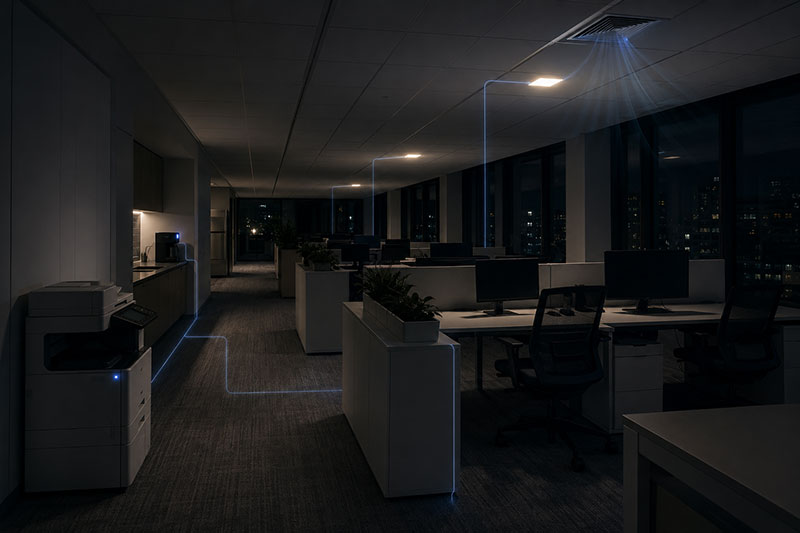
Cutting energy costs starts with knowing where the electricity usage actually goes. Most Australian businesses begin with an energy audit. The audit gives you a structured assessment of a site at one point in time, usually built around bills, operating hours, major plant and a walk through the building. It is a useful exercise. It is also, by design, a photograph rather than a film.
Loads shift due to plant changes, tenants move in/out operating hours based on product demand. Energy monitoring is what captures all of that in the years between audits. These two things are not competing purchases. Used together they let you find opportunities, act on them and then prove the saving stuck.
Key Points
An energy audit is a structured assessment at a single point in time. Australian audits should follow AS 3598, which sets out three audit types with different levels of rigour.
Energy monitoring is continuous measurement from permanently installed meters. It shows when energy is used as well as how much.
Audit findings age. A report written three years ago describes a site that no longer exists in quite the same form.
Continuous data does not diagnose anything on its own. Someone still has to open the plant room door and work out why the pattern is there.
Compliance has caught up with both. NCC 2022 Part J9 sets metering obligations for larger commercial buildings and a NABERS rating depends on twelve months of clean metered data.
SATEC supplies the measurement layer for both jobs, from NMI approved revenue meters through to multi-circuit monitoring and Class A power quality analysers sending data into software such as Expertpower.
What An Energy Audit Involves In Australia
An energy audit reviews how a site consumes energy. The auditor examines bills, operating hours, major plant and patterns of use. Temporary measurements may be taken at switchboards, on machinery or across heating and cooling systems.
Australian audits are not freeform. AS 3598.1 covers commercial buildings, AS 3598.2 covers industrial sites and AS 3598.3 covers transport related activities. The standard defines three audit types. A Type 1 audit is a broad scoping exercise suited to smaller sites or as a precursor to something deeper. A Type 2 audit is the standard site wide assessment with quantified savings and financial analysis. A Type 3 audit goes further again, targeting a specific subsystem such as heating and cooling, compressed air or lighting.
That Type 3 definition matters here. The standard expects onsite measurement over a period long enough to capture the real operating conditions. In other words, the audit standard itself assumes you will be measuring something continuously.
The output should be a prioritised list of actions with indicative costs, savings and payback. Not a list of assumptions.
What Energy Monitoring Does
Energy monitoring means collecting consumption and electrical data continuously through permanently installed meters. The data flows into an energy management platform where daily, weekly and seasonal patterns become visible.
Monitoring answers the timing question that a bill cannot. It exposes overnight loads that nobody authorised, demand spikes that drive network charges, sliding power factor and plant running well outside its schedule. Alerts can flag an unusual condition in hours rather than at the next quarterly bill.
This is more consequential in Australia than it used to be. Demand based network tariffs mean a handful of hot afternoons can shape a large share of the annual bill. Sites with rooftop solar have a second problem, because net consumption at the meter hides what the building itself is doing. Without submetering you cannot separate a genuine efficiency gain from a good week of sunshine.
Energy Audit vs Energy Monitoring At A Glance
| Consideration | Energy Audit | Energy Monitoring |
|---|---|---|
| What it is | A structured assessment of a site at one point in time | Continuous measurement from permanently installed meters |
| Australian framework | AS 3598 Parts 1 to 3, Types 1, 2 and 3 | NCC 2022 Part J9D3 for qualifying buildings, plus NABERS and CBD data requirements |
| Time horizon | Days or weeks of investigation | Ongoing, indefinitely |
| Core question answered | Why is this happening and what should we change | When is it happening, how much is it costing and has it changed |
| Who delivers it | An accredited or suitably competent energy auditor | Metering hardware and an energy management platform |
| Typical output | A prioritised list of measures with costs, savings and payback | Interval data, load profiles, demand records, alarms and reports |
| Cost profile | A one off professional fee, repeated every few years | Capital cost for meters plus ongoing platform cost |
| Main limitation | Ages quickly as the site changes | Shows the symptom without explaining the cause |
| Strongest use case | Deciding what to invest in | Verifying that the investment worked and holding the gain |
Why An Audit On Its Own Has A Short Shelf Life
An audit can only assess what is visible during the review window. Australian sites vary enormously across the year. A Darwin facility and a Hobart facility have almost nothing in common seasonally, and even a Sydney office behaves differently in February than it does in June.
A short measurement period will often miss the event that matters most. The maximum demand interval that sets the network charge might occur across three afternoons in summer. An auditor on site in April will not see it.
Recommendations also drift out of date. New plant arrives. A tenant moves in and starts running a second shift. The chiller that was replaced two years ago quietly loses performance and nobody notices, because there is no baseline to notice against.
None of this diminishes the value of an audit. It simply explains why the audit needs data underneath it, before, during and after.
Why Continuous Data Does Not Solve Anything By Itself
Data describes. It does not diagnose.
A persistent 40 kW overnight load tells you something is running. It does not tell you whether that is refrigeration doing its job, a security system, process equipment on a legitimate cycle or an air compressor that someone left switched on in 2023. Those four answers lead to four completely different decisions.
An auditor supplies the operational and engineering context. They connect the pattern to plant condition, to staff practice, to production requirements and to building controls. That is how a business separates genuine waste from consumption it actually needs.
Monitoring points at where to look. The audit decides what to do about it.
Where The Two Meet In Practice
Start with measurement. Historical interval data lets an auditor understand the normal load profile before setting foot on site, which means the limited hours available get spent on the loads that matter. Submetering separates major systems, departments, production lines or tenancies so their consumption is not buried inside a single site total.
The audit then turns that picture into a set of actions. Once the work is done, the same meters show whether the expected reduction actually arrived. If consumption starts climbing again six months later, you find out in six months rather than at the next audit.
That is the cycle. Data informs the audit, the audit guides the project and monitoring verifies the outcome.
Proving The Saving Actually Happened
Estimated savings and verified savings are different things. Weather, occupancy, production volume and operating hours can all make a project look better or worse than it really was.
Continuous data lets you compare performance before and after an upgrade under similar conditions. You can normalise for degree days. You can confirm whether a new chiller reduced consumption or whether a control change genuinely lowered peak demand rather than shifting it by twenty minutes.
This matters commercially. Verified numbers support internal reporting, NABERS improvement plans, Safeguard Mechanism obligations where they apply and the business case for the next round of capital. Without them an organisation can complete five efficiency projects and have no idea which two delivered.
What Australian Compliance Now Expects
Metering is no longer optional for many buildings. Under NCC 2022, a building or sole-occupancy unit with a floor area of more than 500 m² must have energy meters configured to record time-of-use consumption of gas and electricity. Above 2,500 m², individual time-of-use recording is required for air-conditioning plant, artificial lighting, appliance power, central hot water, internal transport devices such as lifts and on-site energy systems.
There is a second requirement that catches people out. Those meters must be interlinked by a communication system that collates the data to a single interface where it can be stored, analysed and reviewed. Installing meters is not compliance on its own. Adoption timing varies by state and territory, so check what applies in your jurisdiction.
Disclosure adds another layer. Most office space of 1,000 m² or more requires a Building Energy Efficiency Certificate at the point of sale, lease or sublease and that certificate rests on a NABERS Energy for offices rating. A rating needs at least twelve consecutive months of energy consumption data, with base building and tenant supply properly separated. Buildings with poor metering discover this during a transaction, which is the worst possible moment.
Metering That Supports Both The Audit And The Years After It
The measurement layer has to do two jobs. It needs to give an auditor credible evidence during the assessment, then keep working for the facility team long after the report has been filed.
For revenue grade measurement, the EM133-XM is an NMI approved DIN rail meter with Class 0.5S accuracy and time-of-use capability, which suits billing, tenant recovery and baseline establishment. Where a switchboard feeds many loads, the BFM136 handles up to 36 single-phase circuits or 12 three-phase circuits from one device using high accuracy current sensors. That density is what makes circuit level submetering affordable in an existing board rather than a nice idea that dies at the quoting stage.
Sites with harder electrical questions need more than kilowatt hours. The PRO Series PM335 and EM235 are available as Class A Edition 3.1 power quality analysers under IEC 61000-4-30, with waveform capture, EN 50160 reporting and IEEE 519 harmonics analysis. For substations and critical infrastructure the PM180 is a Class A power analyser with fault recording and phasor measurement.
Data from any of these can flow into Expertpower for centralised analysis, reporting and alarming. Users compare periods, examine load profiles, track tenancies and set thresholds that trigger a notification rather than a surprise.
One honest caveat. We supply the meters and the platform, not the audit. Our role is making sure the auditor arrives with real data instead of assumptions and that the facility team can hold onto the result once the auditor leave
Building A Repeatable Energy Management Process
A single audit finds opportunities. The value compounds when the findings become part of an ongoing process rather than a PDF in a shared drive.
Establish a reliable baseline. Install metering that matches the granularity of your decisions. Give someone clear responsibility for reviewing performance each month. AS 3598 suggests repeating an audit every three to five years, or sooner when there is a significant change in plant, tenancy, working practice or energy cost. Monitoring fills the gap in between.
An audit gives you direction. Monitoring gives you continuity. Together they turn energy management from an occasional project into something the business actually controls.
Talk to the SATEC Australia team about the metering your next energy audit will depend on. We can review your switchboard layout, your NCC J9 obligations and your NABERS reporting needs, then recommend a metering approach that serves the audit and the decade after it. Contact us to start the conversation.
FAQs - Energy Audit vs Energy Monitoring
How often should an Australian site have an energy audit?
AS 3598 suggests an audit every three to five years. It also recommends auditing sooner whenever there is a significant change such as new plant, a tenancy change, revised working practices or a substantial shift in energy costs.
Does the National Construction Code require energy monitoring?
NCC 2022 Part J9D3 requires time-of-use energy metering for buildings and sole-occupancy units above 500 m², with individual metering of major services above 2,500 m². The data must also be collated to a single interface where it can be stored and reviewed, so a communications path is part of the requirement.
Can monitoring data replace a site visit by an auditor?
No. Data shows you when and how much, never why. An auditor still needs to inspect plant, talk to operators and apply engineering judgement to turn a suspicious load profile into a costed recommendation.
What metering do I need for a NABERS Energy rating?
You need at least twelve consecutive months of energy consumption data, with base building and tenant supplies clearly separated. Sites that only have a single main meter usually need submetering installed well before a rating or a disclosure obligation falls due.
Explore related topics:
For Your Industry
- How Power Monitoring Devices Help Reduce Energy Costs in Commercial Buildings
- Building Energy Management Analytics: The Complete Guide for Commercial Buildings
Standards & Compliance
- Is Your Building Compliant? NCC J9 Energy Monitoring Requirements Explained
- NCC J9D3 Sub-Metering Guide: HVAC, Lighting & Lift Compliance for Commercial Buildings
Related Reading
Trending in Your Sector


