

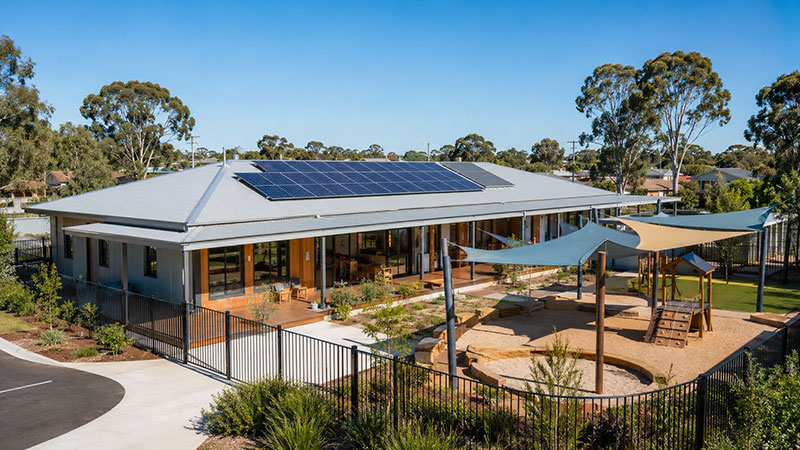
Energy is quietly becoming one of the harder line items in a child care budget. Heating and cooling run to keep rooms comfortable for very small children. Kitchens, laundries, lighting and nappy change facilities all draw power through the day. Electricity prices have not made any of this easier.
NABERS for child care centres gives operators a verified way to see how efficiently a building actually performs. It sets a baseline. It replaces guesswork with measurement. For providers running several sites it also answers a question that is otherwise very difficult to answer honestly: which centre should we fix first?
Key Points
Child care centres are assessed under the NABERS Energy Performance Indicator rather than a dedicated star rating tool.
The rating measures energy and emissions intensity using consumption and rated floor area.
Results appear on a comparison dial, not the familiar six star scale.
Twelve months of energy data and a site visit from a NABERS Accredited Assessor are required.
The rating tells you where you stand. Interval and circuit data tell you why.
SATEC meters including the NMI approved EM133-XM can supply the detailed consumption data that supports assessment preparation and ongoing improvement.
What NABERS Measures in a Child Care Centre
NABERS is the National Australian Built Environment Rating System. It rates buildings on measured operational performance rather than design intent.
Child care centres sit under the NABERS Energy Performance Indicator. This tool was built for smaller building sectors that do not yet have a standalone NABERS Energy rating tool. Gyms, libraries and cinemas sit alongside child care in the same group.
The assessment produces verified energy intensity, verified emissions, a Renewable Energy Indicator score, a certificate and a report.
Why Is There No Star Rating?
Performance is shown against the sector average using a comparison dial. This matters for marketing teams. A dial result is not a five star NABERS rating and should never be promoted as one. Where NABERS does not yet hold enough sector data to build a dial, a building can still be rated, it simply receives its verified intensity figures without the comparison.
Which Services Are Actually Eligible
This is where operators most often trip up. The names services use do not map neatly onto the categories NABERS works from.
More than 18,000 services operate under the National Quality Framework in Australia, and they span long day care, outside school hours care, preschool and kindergarten. A building signed as an early learning centre may be classified differently from one signed as a child care centre.
Before committing to a rating, talk to a NABERS Accredited Assessor. That conversation establishes eligibility and, just as importantly, the rating boundary. The boundary decides which areas, meters, shared services and energy sources belong inside the assessment.
What the Assessment Looks At
The rating covers energy used to operate the premises across the rating period. Operators generally need twelve months of consumption history plus documentation of building size and features.
Coverage can include lighting, general power, hot water, air conditioning, ventilation, kitchen equipment and specialised equipment. Generator fuel may also come into scope.
An Accredited Assessor reviews the evidence and visits the site to confirm data, rated area and meter coverage. Expect requests for electrical diagrams, utility invoices and meter records. Shared facilities almost always require extra investigation, particularly where a centre occupies part of a larger building.
Why a Verified Result Beats a Big Bill
An electricity bill tells you what you spent. It does not tell you whether the building is efficient for its size, or how it compares with the centre two suburbs over.
That context is the real value. A verified result lets you rank sites, prioritise capital, and prove that an air conditioning replacement or a solar install delivered something lasting. Repeat the rating annually and improvement becomes a number rather than an assertion.
The Renewable Energy Indicator adds a second dimension. It shows the share of energy drawn from eligible renewable sources, which gives providers a cleaner way to talk about renewables without overstating the case.
Getting Your Data Ready
Start with completeness. Confirm that energy records cover the full rating period without unexplained gaps, then gather invoices, meter data, floor area documentation and notes on any major operational change.
Check meter coverage against the actual electrical arrangement. Complex sites throw up surprises. Shared air conditioning, landlord supplied services, solar, batteries or a second building on the same title all change what belongs in the assessment.
Then look at interval data if you have it. Overnight loads, equipment starting hours before staff arrive, heating and cooling fighting each other in the same zone. These show up in the data long before anyone notices them on site.
Choosing the Right Level of Metering
Not every centre needs the same approach. Matching the metering to the site is more useful than defaulting to the largest device on the price list.
| Approach | What It Measures | Typical SATEC Fit | Value During a NABERS Assessment | Best Suited To |
|---|---|---|---|---|
| Retailer billing meter only | Total site consumption at billing intervals | Not applicable | Meets the minimum data requirement | Small single tenancy centres with simple supply |
| Site level submeter | Whole of centre consumption independent of the retailer | EM133-XM, NMI approved | Validates invoice data and isolates a centre inside a larger building | Centres in shared or mixed use buildings |
| Selected circuit submetering | Individual loads such as air conditioning, kitchen or hot water | EM132 or EM133 | Explains the result and targets improvement | Operators wanting diagnostic detail without a full board rebuild |
| Multi circuit monitoring | Up to 12 three phase or 36 single phase circuits from one device | BFM136 | Full circuit visibility across a large board | Large centres, multi tenancy sites and campus style facilities |
Where SATEC Metering Fits
Good data is the foundation. Everything else in an assessment rests on it. The EM133-XM is a DIN rail mounted, NMI approved energy meter designed for revenue billing and energy management and its documentation names NABERS and Green Star applications directly.
It also accepts pulse inputs from gas and water meters, which matters when a centre runs gas hot water or gas cooking.
For circuit level diagnostics the EM132 is a cost effective multifunction meter with RS485 communications, well suited to a handful of key loads. Larger sites can consolidate to the BFM136 and monitor many circuits from one compact device.
Data feeds into Expertpower for remote monitoring, reporting and historical analysis. Operators can then investigate a change in consumption within days rather than waiting for the next bill. Consistent metering across a portfolio also makes site to site comparison meaningful instead of anecdotal.
One honest caveat. Submetering does not replace a NABERS Accredited Assessor and does not guarantee a result. Meter placement, accuracy class, data coverage and boundary treatment should all be discussed with your assessor before installation. Well designed metering simply makes the numbers easier to validate.
Turning One Rating Into Ongoing Improvement
The certificate is a starting point, not a trophy.
Interval and circuit level data explain why one centre uses more energy than another of similar size. Early equipment start times. Overnight loads that nobody authorised. Simultaneous heating and cooling in the same room.
Any improvement plan has to protect comfort, health and service quality first. Within that constraint there is usually more room than operators expect. Scheduling, maintenance, efficient equipment and simple staff awareness all contribute. Continued monitoring confirms whether the savings survive a change of season.
NABERS for child care centres gives Australian operators a credible framework for measuring progress. Supported by accurate metering and regular review it can reduce costs, strengthen sustainability reporting and guide investment across a single site or an entire portfolio.
Ready to see what your centres are actually using? Talk to the SATEC Australia team about metering that supports your NABERS preparation and your day to day energy management. Contact us to discuss your site.
FAQs - NABERS Metering for Child Care Centres
Can a child care centre get a NABERS star rating?
No. Child care centres are rated under the Energy Performance Indicator, which reports verified intensity figures and a comparison dial rather than a star score.
How much energy data do I need before starting?
Twelve months of consumption history is the standard requirement, along with floor area documentation and details of the building’s features.
Does submetering replace the retailer’s meter for a NABERS rating?
No. Submeters support validation and diagnostics, and your Accredited Assessor determines which data sources are acceptable for the rating boundary.
Is a rating worth it for a single centre?
It can be, though the return is strongest across a portfolio where the results let you rank sites and direct capital to the worst performers first.
Explore related topics:
For Your Industry
Standards & Compliance
- Is Your Building Compliant? NCC J9 Energy Monitoring Requirements Explained
- NCC J9D3 Sub-Metering Guide: HVAC, Lighting & Lift Compliance for Commercial Buildings
- Green Star Compliant Metering Systems: Complete Guide for Commercial Buildings
Trending in Your Sector


