

Submetering has become the standard way to charge tenants for electricity in apartment buildings, mixed-use developments, data centres and industrial estates. It sounds straightforward: fit a meter to each tenancy and bill what it reads.
In practice, three separate questions sit behind that one meter. Is submetering even permitted at this site? Is the meter itself legally allowed to produce a bill? Would the way costs are split between tenants survive a dispute? Get any of these wrong and the bill itself becomes the problem, not the electricity cost it was meant to recover.
NSW has just added a fourth layer. The Energy Legislation Amendment Act 2025 received assent on 26 November 2025 and brings new disclosure and pricing obligations into force from 1 July 2026, tightening a framework that operators across Australia already need to get right.
This guide works through each question in turn, then looks at how a single NMI-approved multi-circuit device changes the economics of metering a whole building properly.
Key Points
Submetering is only lawful under a valid retail exemption or a state-based embedded network framework, with prices held to what a standard local retailer would charge.
Any meter used to raise a bill needs NMI pattern approval under NMI M 6-1 and verification under NITP 14; MID-approved meters do not meet this standard in Australia.
Fair cost allocation means billing tenants on actual measured consumption rather than floor-area estimates or equal splits.
The most common compliance failures are unapproved or unverified meters, prices that drift above the cap and gaps in disclosure as new obligations take effect.
NSW’s Energy Legislation Amendment Act 2025 adds mandatory ombudsman membership and public pricing disclosure from 1 July 2026, with enforceable maximum prices to follow.
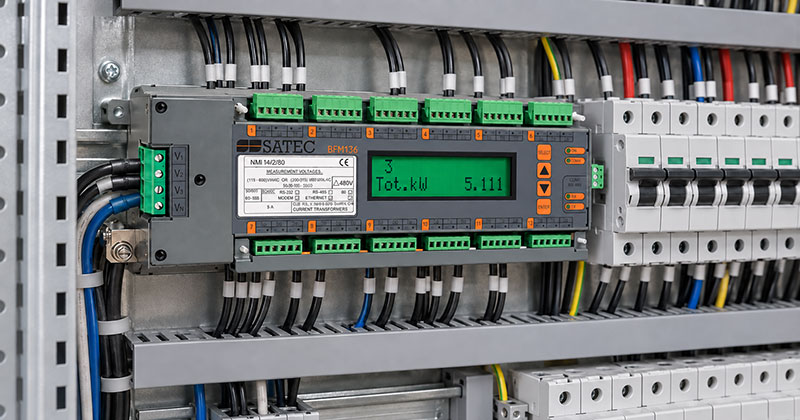
A single NMI-approved multi-circuit device, such as SATEC’s BFM136, can meter dozens of tenancies from one approved instrument, making full compliance affordable even in a retrofit with limited switchboard space.
When Is Submetering Allowed in Australia?
On-selling electricity to tenants is a regulated activity, not something an owner or operator can simply start doing. In New South Wales, Queensland, South Australia, Tasmania and the ACT, embedded networks operate under the Australian Energy Regulator’s retail exemption framework.
Many commercial sites qualify for a deemed class exemption where every customer has given informed consent, while residential embedded networks, such as apartment buildings and retirement villages, generally need an individual exemption from the AER regardless of tenant consent.
Victoria and Western Australia run their own state-based approval frameworks for embedded networks. The starting point therefore differs slightly outside the National Energy Customer Framework. The underlying principle holds everywhere: exempt sellers must keep prices in line with what a standard retailer would charge in the area, join the relevant energy ombudsman scheme and give tenants clear information about the arrangement before they sign a lease.
NSW’s Energy Legislation Amendment Act 2025 sharpens this further. From 1 July 2026, embedded network sellers must belong to the Energy & Water Ombudsman NSW and publish their services, pricing and the premises they supply.
Enforceable maximum prices, benchmarked to the median of the lowest market offers in each distribution area, are expected to follow once the Independent Pricing and Regulatory Tribunal sets the detail.
What Approval Does a Meter Need Before It Can Bill?
Before a reading can appear on a tenant’s invoice, the meter itself has to be legal for trade measurement. Since January 2013, the National Measurement Act 1960 has required any meter used to bill for electricity to hold pattern approval from the National Measurement Institute, tested against NMI M 6-1 and verified under NITP 14.
This is a separate requirement from electrical safety certification. A meter can be perfectly safe to install and still be unlawful to bill from if it lacks NMI approval. MID (Measurement Instruments Directive) certification, common on European-manufactured meters, is a compliance framework built for the EU market and carries no legal standing for Australian trade measurement. A MID label on a datasheet is not a substitute for NMI pattern approval.
An operator who bills tenants from an unapproved meter is exposed twice over. The charge itself may not be legally recoverable. Any dispute referred to an ombudsman starts from a position where the underlying measurement can be challenged before the amount is even discussed.
Getting Cost Allocation Right
Fair allocation depends on the same approval sitting behind it. Estimating each tenant’s share by floor area or headcount was common before submetering became affordable. That approach consistently over-charges or under-charges anyone whose usage differs from the average. It also leaves tenants with no way to verify what they are being asked to pay.
NMI-approved meters replace estimation with actual measured consumption, recorded at the accuracy class the meter is rated for. The EM133-XM, for example, holds Class 0.5S accuracy, well ahead of the baseline NMI M 6-1 requirement.
Landlords and body corporates that move to measured billing should apply network charges and environmental costs, such as LGC surrender costs, on the same transparent basis they use for consumption itself. A bill a tenant cannot reconstruct is one of the most common triggers for a complaint.
Where Compliance Most Often Breaks Down
The failures that show up most often in embedded networks are consistent across states. Meters that were never NMI approved or that have drifted out of verification remain the single biggest risk, since any figure they produce can be challenged.
Prices that quietly creep above what a standard retailer would charge are the second most common issue, often the result of network and environmental charges being added without checking the total against the cap.
Disclosure gaps round out the list. The Energy & Water Ombudsman NSW regularly hears from residents who were never told they were moving into an embedded network, who receive confusing dual bills from a retailer and a network operator or who find they cannot switch to a retailer of their choice.
NSW’s 2025 reforms respond directly to this: failing to publish required pricing and premises information, charging above the applicable maximum price or falling short of new billing standards will all carry penalties once the new regime is in force.
How a Multi-Circuit NMI Approved Device Changes the Economics
For a site with dozens of tenancies, per-tenant metering has historically meant a matching number of individual meters. Each one needs switchboard space, its own wiring run and a separate verification record, which adds up fast on a retrofit where board space was never designed for it.
A multi-circuit device that is itself NMI approved changes that arithmetic. Instead of one approved meter per tenant, a single approved instrument reads many circuits at once, cutting the hardware count, the installation time and the switchboard footprint. Every circuit it reads still produces a measurement that is legally billable. Nothing is traded away to get there.
That shift matters most in exactly the situations landlords find hardest: a retrofit where switchboard space is the real constraint or a larger mixed-use site where the gap between what is compliant and what is affordable often decided whether proper submetering happened at all.
The SATEC Approach
This is exactly the gap SATEC’s meter range is built to close. The EM133-XM is NMI approved to Class 0.5S accuracy under certificate 14/2/72, making it a defensible choice for straightforward CT-connected tenant billing.
For sites with many circuits to cover, the BFM136 is a NMI-approved multi-circuit monitor available in Australia, certified under 14/2/80 and reading up to 36 single-phase or 12 three-phase circuits from one approved device.
Both feed data into the Expertpower platform, where landlords and facility managers can generate transparent, per-tenant statements and set network and environmental charges on a consistent basis across a site.
Residents get their own view of usage through the eXpertConnect app, without visibility into common-area consumption that is not theirs to see. Matching the two meters to a site comes down to circuit count and available switchboard space, which the comparison below sets out.
| Meter | NMI Approval | Circuits Covered | Best Suited For |
|---|---|---|---|
| EM133-XM | Yes — certificate 14/2/72, Class 0.5S | One circuit per device | Single-tenancy or straightforward CT-connected billing |
| BFM136 | Yes — certificate 14/2/80, Class 1.0 when combined with HACS solution. | Up to 36 single-phase or 12 three-phase circuits | Multi-tenant sites and retrofits with limited switchboard space |
Talk to SATEC
Getting submetering right is what stands between a bill that holds up and one that turns into a dispute. If you are planning tenant metering for a new development or retrofitting an ageing switchboard, talk to SATEC about matching NMI-approved meters to your site’s circuit count.
For larger sites, explore the BFM136 and SATEC’s other multi-channel metering solutions. For the billing and reporting side, see how the Expertpower platform brings measured data, cost allocation and tenant visibility together in one place.
FAQs - Multi-Tenant Submetering in Australia
Do I need approval before submetering a multi-tenant building in Australia?
In most states, yes. Sites in NSW, Queensland, South Australia, Tasmania and the ACT generally need a retail exemption from the AER, either a deemed class exemption for fully consenting commercial tenants or an individual exemption for residential buildings. Victoria and Western Australia run their own separate approval processes for embedded networks.
Can any smart meter be used to bill tenants?
No. Only meters with NMI pattern approval under NMI M 6-1, verified to NITP 14, can legally be used to raise a bill in Australia. A meter with European MID certification or general electrical safety approval does not meet this requirement.
What is the fairest way to split electricity costs between tenants?
Billing on actual measured consumption from an NMI-approved meter is the fairest and most defensible method, since it reflects what each tenant genuinely used. Floor-area or headcount estimates cannot be verified by the tenant and tend to over-charge or under-charge anyone whose usage differs from the average.
What happens if tenants have already been billed from a non-approved meter?
The charges may not be legally enforceable. The operator is also exposed if a tenant disputes the bill through an energy ombudsman scheme. The practical fix is to replace the meter with an NMI-approved device and correct future billing from that point, while taking advice on how to handle the disputed period.


