

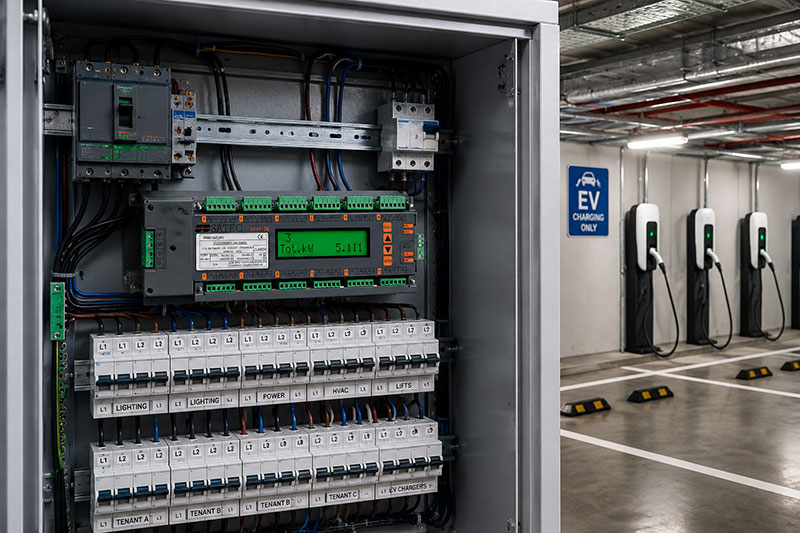
Electric vehicles are no longer a future consideration for Australian building owners, facility managers, strata committees and developers. They are arriving now and the electrical infrastructure behind most existing buildings was not designed with them in mind.
Future proofing for EV adoption is not only about installing chargers. It is about understanding how much electrical capacity is available, how energy use changes when vehicles plug in and how the site can manage growing demand without unnecessary upgrades. A successful EV charging strategy starts well before the first charger is mounted on the wall. It starts at the switchboard, continues with accurate metering and depends on intelligent load management.
Australia’s EV market is accelerating rapidly. Battery EV sales exceeded 103,000 units in 2025, representing 8.3 per cent of all new car sales. By May 2026, EVs had reached a record 20 per cent monthly market share. The Electric Vehicle Council reported over 410,000 EVs in the national fleet as of mid-2025, with fast-charging locations growing 22 per cent year-on-year to more than 1,272 sites. Buildings that are not ready for this shift may face capacity issues, higher upgrade costs and frustrated occupants.
Key Points
Most Australian buildings were not designed for EV charging loads, making early electrical planning essential
The switchboard is the first place to assess when preparing a site for EV charging infrastructure
Accurate metering is the foundation for understanding capacity, tracking usage and allocating costs fairly
Load management allows more charging points to operate within existing supply limits, deferring expensive network upgrades
A staged infrastructure approach helps buildings scale charging capacity as EV adoption grows on site
SATEC’s NMI-approved meters and Expertpower platform give building owners and managers the billing-grade accuracy and energy visibility needed to plan and manage EV charging with confidence
Why EV Charging Changes The Electrical Conversation
Most Australian buildings were not originally designed with large-scale EV charging in mind. A commercial building, apartment complex or mixed-use development may already have lifts, HVAC systems, lighting, appliances, common area loads and tenant loads all competing for available electrical capacity.
Adding EV chargers introduces a new and flexible load that can vary significantly depending on charging times, charger type and user behaviour. A single charger may appear manageable. Several chargers operating simultaneously can create a very different load profile. This is where planning becomes critical.
Future proofing for EV adoption means looking beyond the first few charging bays and asking what the site may need in five, ten or fifteen years. The goal is not always to install the maximum number of chargers immediately. It is to create an electrical strategy that allows the site to scale in a controlled and cost-effective way.
Start With The Switchboard
The switchboard is one of the first areas to assess when preparing for EV charging. It determines how electrical circuits are distributed, protected and monitored across the site. If the switchboard is already close to capacity, adding EV charging without a proper assessment can increase the risk of overloads, nuisance tripping and expensive remedial works.
A switchboard review should consider:
- Available capacity and spare ways
- Protection requirements and cable routes
- Compliance with Australian Standards, including AS 3000 (Wiring Rules)
- Whether the existing arrangement can support future expansion
In older Australian buildings, space inside or around the switchboard is often a significant constraint. This is especially common in retrofit projects where physical space is limited and infrastructure has grown over time. Planning should also consider whether EV charging will be connected to common power, individual tenant supply or a dedicated supply. Each option has implications for billing, responsibility, monitoring and future upgrades.
A well-planned switchboard strategy helps avoid short-term decisions that limit future flexibility. It also supports safer and more transparent energy management as charging demand increases.
Metering Is The Foundation Of Good Decision-Making
Accurate metering is essential for future proofing for EV adoption. Without reliable data, it is difficult to know how much capacity is available, when demand peaks occur or how EV charging interacts with the rest of the building load.
Metering provides visibility. It helps identify existing demand patterns, supports fair allocation of energy costs and gives building managers the information needed to plan future charging stages. In Australian strata and multi-tenant environments, metering also supports accountability and compliance by making it clear who is using energy and when.
It is worth noting that in Australia, meters used for tenant billing or trade measurement must be approved by the National Measurement Institute (NMI) and supplied with NITP-14 test verification certification. Using non-compliant meters can create legal and commercial risk for site owners. Good metering can also help avoid overinvestment. Instead of assuming the site needs a costly supply upgrade immediately, building managers can use energy data to understand whether smarter control strategies could make better use of existing capacity.
This is particularly important for sites where EV demand will grow gradually. The right metering solution allows a building to monitor real usage and expand charging infrastructure based on evidence rather than guesswork.
Load Management Protects Capacity
Load management is the control layer that helps balance EV charging demand with the site’s available electrical capacity. Rather than allowing every charger to draw maximum power at the same time, load management adjusts charging levels based on demand, priority and capacity limits. This matters because EVs are often parked for long periods.
In workplaces, vehicles may sit for an entire business day. In apartment buildings, they may remain connected overnight. Most vehicles do not need to charge at full power for the entire duration they are plugged in.
A smart load management strategy can:
- Reduce peak demand and associated network charges
- Help defer costly network upgrades
- Allow more charging points to operate within the limits of the existing supply
- Protect the building from overload while still giving users a practical charging experience
For many Australian buildings, the best strategy is not simply to source more power. It is to use better control over the power that is already available.
Planning For Growth, Not Just Installation
The first EV charging project should be treated as the beginning of a longer infrastructure journey. Future proofing for EV adoption means considering how the system can grow without requiring repeated redesigns or disruptive works. This includes planning cable pathways, switchboard space, communications infrastructure, metering points and software integration.
It also means thinking about how energy data will be collected, reported and used over time. For new developments in Australia, EV readiness should be incorporated during design. For existing buildings, it should form part of a broader electrical infrastructure review. Either way, the objective is the same: build a framework that can adapt as adoption increases.
| Building Type | Primary EV Charging Driver | Key Metering Need | Load Management Priority | Billing Complexity |
|---|---|---|---|---|
| Strata / Apartment | Resident demand and owners corporation obligations | NMI-approved individual or multi-circuit metering | High — shared supply, competing loads | High — individual cost allocation required |
| Commercial Office | Tenant attraction and sustainability targets | Demand profiling and tenant sub-metering | Medium — business hours concentration of load | Medium — may be bundled into tenancy costs |
| Retail / Shopping Centre | Visitor experience and dwell time | Usage tracking and revenue metering | High — large car parks with many simultaneous users | High — pay-per-use or session billing |
| Industrial / Fleet | Fleet electrification and operational cost control | High-resolution demand and power quality monitoring | Very high — large simultaneous charging loads | Low to medium — often single operator |
| Mixed-Use Development | Resident, tenant and visitor access | Multi-circuit metering with zone separation | High — multiple user groups on shared infrastructure | Very high — multiple cost allocation requirements |
Scalable planning is especially important for commercial properties seeking to remain attractive to tenants, retail centres looking to support visitor charging, industrial sites planning for fleet electrification and apartment buildings responding to growing resident demand.
SATEC Metering For EV Charging Readiness
Reliable metering is at the centre of any credible EV charging strategy and SATEC’s range of smart energy meters and energy management solutions are well suited to that role in the Australian context.
NMI-approved energy meters from SATEC, including the EM133-XM and the BFM136 multi-circuit energy monitor, are designed for the accuracy and compliance requirements that apply when electricity is being allocated or billed to tenants, residents or EV users in Australia. The BFM136 is particularly relevant for apartment buildings and multi-tenant sites because it is the only multi-circuit energy monitor covered under NMI M 6-1 in Australia, allowing multiple EV charging circuits to be monitored from a single compact device.
Power quality monitoring is another capability that matters in EV charging environments. High-power chargers, particularly DC fast chargers, can affect voltage stability and introduce harmonics that affect other equipment on site. Having visibility over these effects helps building managers and electrical contractors identify and address issues before they become operational problems.
The Expertpower software platform extends the value of metering by giving building owners, strata managers and facility teams a clear view of energy consumption patterns across the site. When metering data is connected to Expertpower, it becomes possible to understand peak demand windows, track EV charging growth over time and plan future expansion based on actual data rather than estimates.
For strata and multi-tenant sites, this level of transparency also supports fair cost allocation and clearer communication with residents, tenants and owners corporations. When a billing dispute arises, verified metering data provides the evidence needed to resolve it quickly and clearly.
Avoiding Common EV Readiness Mistakes
One common mistake is installing chargers before understanding the building’s electrical limits. Another is assuming that a supply upgrade is unavoidable. In many cases, better metering and load management can reveal more efficient ways to use existing infrastructure.
Failing to plan for billing and cost allocation is a further issue. This can create disputes in strata and multi-tenant sites where energy costs need to be shared fairly. Energy metering should be considered early so the charging model is transparent from the start. It is also important to avoid designing only for today’s demand. EV adoption in Australia is growing quickly and a system that works for two chargers may not work for twenty. Infrastructure should be planned in stages with a clear path for expansion.
Finally, building managers should check that any meters selected for revenue or billing purposes carry NMI approval. Using non-compliant meters for cost allocation or tenant charging is a legal and commercial risk that is entirely avoidable with the right advice upfront.
A Practical Path Forward
Preparing for EV adoption does not need to happen all at once. A staged approach often works best. Start by assessing the existing switchboard and site electrical capacity. Add NMI-approved smart metering to establish accurate energy data. Use that data to design a load management strategy that makes the most of existing supply. Then install charging infrastructure in a way that allows future growth without repeated redesigns.
Future proofing for EV adoption is about making smart decisions before demand becomes urgent. The buildings that prepare now will be better placed to manage electrical capacity, control costs and meet the expectations of EV drivers. With the right switchboard planning, metering solution and load management strategy, EV charging can become a scalable and well-managed part of a building’s energy infrastructure rather than a source of ongoing pressure.
FAQs - Future Proofing For EV Adoption
Do I need to upgrade my electrical supply before installing EV chargers?
Not necessarily. In many cases, accurate metering combined with a smart load management strategy can make better use of existing electrical capacity, deferring or avoiding a costly supply upgrade altogether.
What is NMI approval and why does it matter for EV charging?
NMI (National Measurement Institute) approval is a legal requirement in Australia for any meter used to bill tenants, residents or EV users for electricity consumption. Using a non-approved meter for cost allocation or billing purposes creates legal and commercial risk for the building owner or operator.
Can one metering device monitor multiple EV charging circuits?
Yes. A multi-circuit energy monitor such as the SATEC BFM136 can monitor multiple EV charging circuits from a single compact device and is the only multi-circuit energy monitor covered under NMI M 6-1 in Australia, making it a practical solution for apartment buildings and multi-tenant sites.
How do I plan for future EV charging demand without overbuilding now?
A staged approach works best. Start by assessing switchboard capacity and installing accurate metering to capture real energy data, then use that data to guide each future stage of charging infrastructure rather than designing for a peak demand figure that may be years away.
Explore related topics:
For Your Industry
Standards & Compliance
Related Reading
- Energy Measurement For Retrofit Projects: How To Add Meters When Space Is Tight
- Your Meter, Your Data, Your Platform: Why Energy Metering Should Work With Third-Party Software
Trending in Your Sector


