

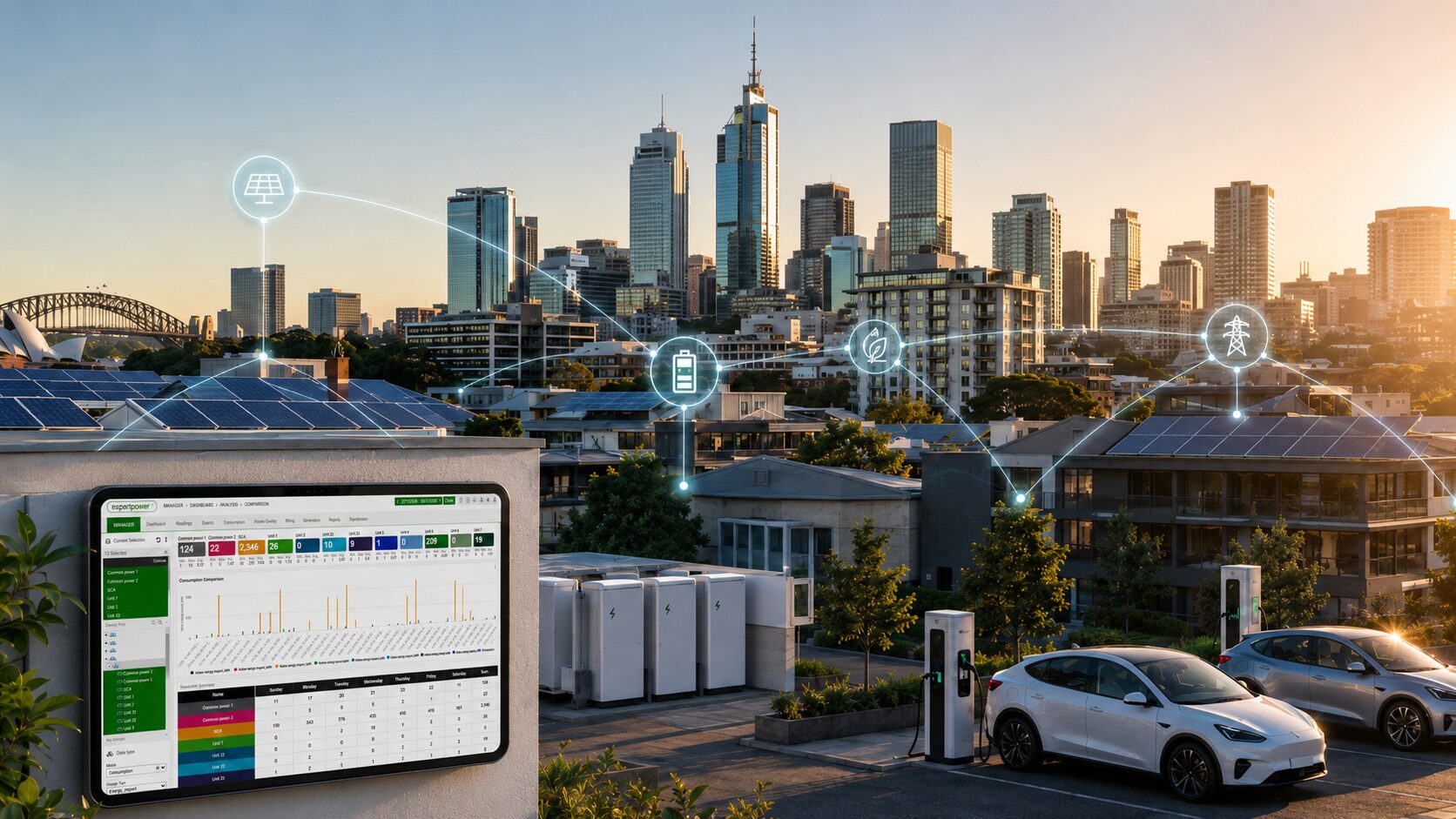
Australian cities are at an energy crossroads. For decades, electricity moved in one direction, from large regional power stations, through transmission and distribution networks, to homes, businesses and public infrastructure. That model is changing fast.
Rooftop solar, batteries, electric vehicles, smart buildings and flexible demand management are reshaping the grid from the inside out. Cities are no longer just consumers of electricity. Increasingly, they are producers, storers and managers of it.
This shift is what makes Urban Renewable Energy Zones, or UREZs, one of the most significant ideas emerging in Australian energy planning right now.
Key Points
Australia had 28.3 GW of rooftop solar installed by the end of 2025, more capacity than the entire coal-fired fleet, yet much of this distributed energy remains poorly coordinated at a precinct level.
UREZs provide a framework for combining rooftop solar, batteries, EV charging and smart energy management across buildings and precincts in urban areas.
Unlike traditional Renewable Energy Zones (REZs) in regional Australia, UREZs are designed for complex, data-intensive urban environments where assets are often owned by many different parties.
Accurate, real-time metering is the foundation of any successful UREZ. Without reliable energy data, coordinated management across a precinct is not possible.
Australian councils, developers and building owners can use UREZs to demonstrate measurable progress on emissions reduction as decarbonisation pressure grows.
SATEC’s NMI-approved meters and Expertpower software are well suited to the multi-tenant, mixed-use environments that characterise Australian UREZs.
What Is an Urban Renewable Energy Zone (UREZ)?
A UREZ is an area within a city or built-up environment where renewable energy generation, storage and smart energy management are coordinated at scale. The concept takes the Renewable Energy Zone idea, already well established in Australia’s energy policy and applies it to urban settings where rooftops, car parks, commercial buildings, apartment blocks, schools, hospitals and transport infrastructure can all play a role in producing, storing and managing electricity.
The distinction matters. Traditional Renewable Energy Zones are built around large-scale solar farms, wind farms and high-voltage transmission infrastructure, typically in regional areas with space for major generation projects. A UREZ, by contrast, operates within an existing urban fabric. Instead of one large solar farm, it might involve thousands of rooftop solar systems spread across commercial, industrial and residential buildings, connected through embedded networks, supported by community batteries and integrated with EV charging and demand management systems.
New South Wales has become the first Australian jurisdiction to formally advance the concept. The Illawarra region, south of Sydney, has been declared NSW’s first urban-focused REZ, with EnergyCo and distribution network operator Endeavour Energy working together to develop innovative network and battery solutions within the zone. The intended network capacity is 1 gigawatt, with near-term projects targeting delivery by 2030.
The focus is squarely on integrating consumer and community-scale assets – rooftop solar, household and community batteries, publicly owned land and large commercial rooftops, rather than utility-scale generation infrastructure. This is precisely the model that UREZs are designed to support. Rather than relying only on new regional generation capacity, UREZs recognise that Australian cities already contain significant untapped energy potential.
The challenge is not simply generating more renewable electricity but measuring it, managing it and using it intelligently close to where it is produced.
Why UREZs Matter For Australian Cities Right Now
The timing is not coincidental. By the end of 2025, Australians had installed 28.3 GW of rooftop solar across approximately 4.3 million homes and businesses, surpassing the total output of the country’s entire coal-fired generator fleet of 22.5 GW. Battery uptake has accelerated sharply alongside this, with a record 183,245 home battery systems installed in the second half of 2025 alone, four times the number installed in the same period the year before.
Australia’s cities, in other words, already have an enormous amount of distributed renewable energy capacity. What they often lack is the coordination layer to make that capacity work as a coherent local energy system rather than a collection of unconnected individual assets. At the same time, urban energy demand is rising. Electrification is accelerating as buildings move away from gas, transport shifts towards electric vehicles and businesses work to reduce emissions.
AEMO forecasts that future energy consumption from the NEM will rise by approximately 108% by 2050, driven largely by the electrification of transport, residential heating and industrial processes. Much of that new demand will land in cities. Commercial buildings often consume large amounts of power during the day, which aligns well with solar generation. Residential buildings face evening peaks that can be supported by batteries and demand management but only if those assets are visible and coordinated.
Resilience has also sharpened the case for UREZs. Extreme weather events in 2025, including Cyclone Alfred and significant flooding across Queensland and New South Wales, caused widespread outages and highlighted the vulnerability of communities reliant on centralised power supply. A well-planned UREZ gives cities a degree of local energy capability that reduces that exposure, not by disconnecting from the grid but by being better equipped to support it.
For councils, developers and building owners, UREZs also offer a practical path to demonstrating measurable emissions reduction. As decarbonisation pressure grows across the property, infrastructure and local government sectors, having a coordinated precinct-wide energy framework is increasingly more useful than isolated building-level upgrades.
The Building Blocks Of A UREZ
Understanding what a UREZ actually contains helps explain why coordination and metering matter so much. Rooftop solar is typically the generation backbone. Installed across commercial buildings, warehouses, apartment complexes and public facilities, it provides clean electricity close to where it is needed.
Batteries extend the value of that generation by storing excess energy and releasing it when demand is higher or solar output has dropped. Together, they form the foundation of a local energy system that can reduce reliance on the grid during peak periods. EV charging infrastructure adds another layer of complexity. As electric vehicles become more common across Australian cities, charging demand will become a significant factor in urban electricity planning.
Left unmanaged, widespread EV charging can add considerable load pressure at exactly the wrong times. Integrated within a UREZ, however, EV charging can be scheduled to align with solar generation, draw from local battery storage and respond to grid signals, turning a potential problem into a flexible asset. Energy management software then provides the intelligence that makes all of this work together.
A UREZ spans many sites, often owned and operated by different parties. Without software capable of monitoring demand, identifying patterns, responding to peak events and optimising asset dispatch across that distributed landscape, the individual components remain disconnected. This is particularly important in mixed-use precincts where offices, retail spaces, apartments and public facilities each have very different energy profiles and usage cycles. What connects all of these components is data and data begins with the meter.
Why Energy Metering Is The Foundation of a UREZ
In a traditional electricity model, metering is largely a billing function. In a UREZ, it becomes the foundation of everything. Without accurate, real-time data on what is being generated, consumed, exported, stored or wasted across a precinct, it is not possible to manage a UREZ effectively.
You cannot coordinate what you cannot see. Smart meters provide the visibility needed to understand how energy flows through a site or building at any given moment. They identify peak demand events, reveal load patterns, flag power quality issues and surface opportunities for optimisation that would otherwise remain invisible. This is the data that informs decisions about solar sizing, battery operation, EV charging schedules and demand response participation.
Power quality is a particular concern in urban renewable environments. As more solar systems, batteries and EV chargers connect to urban networks, voltage fluctuations, harmonics and other electrical disturbances become more common. These disturbances can affect equipment performance and shorten asset lifespans, costs that often go undetected until they become significant.
Metering that captures power quality data, not just consumption, gives building owners and facility managers the early warning they need. For multi-tenant buildings and embedded networks, which are central to how UREZs operate in practice, metering also carries legal obligations. In Australia, any meter used for billing or trade measurement must hold National Measurement Institute (NMI) pattern approval under NMI M 6-1. This requirement has applied since 2013 and covers residential, commercial and other business environments.
NMI-approved metering provides the defensible billing foundation that embedded network operators and tenants both depend on.
How SATEC Supports Urban Renewable Energy Environments
Matching the right metering solution to a UREZ environment is not straightforward. Urban precincts involve retrofit constraints, multiple tenants, complex electrical infrastructure and the need for data that goes well beyond basic consumption figures. This is where SATEC’s experience in the Australian market becomes relevant.
With over 50 years of energy management expertise, the SATEC range includes NMI-approved energy meters designed specifically for the multi-tenant, space-constrained environments that characterise Australian urban buildings. The EM133-XM, for example, is an NMI-approved DIN rail meter offering Class 0.5S accuracy, 8MB of data logging and flexible communications, compact enough for dense switchboard installations yet capable of supporting sub-metering, billing, shared solar and EV charging integration across an entire site.
The BFM136 multi-circuit energy monitor extends this further, providing NMI-approved metering across up to 12 three-phase circuits or 36 single-phase circuits from a single device, making it well suited to apartment buildings, shopping centres and office towers where many circuits need to be measured efficiently.
Power quality monitoring across the SATEC range adds a further layer of value in a UREZ context. Voltage fluctuations, harmonics and other disturbances that accompany the integration of solar, batteries and EV chargers can be detected and managed before they cause costly damage or downtime. For building owners and facility managers, this kind of proactive visibility is increasingly important as urban electrical environments grow more complex.
Expertpower, SATEC’s energy management software, brings together the data from these meters into a platform built for decision-making rather than simply record-keeping. Available as a cloud-based SaaS solution or standalone installation, Expertpower supports energy management, billing, demand response, power quality analysis and meter data management across sites of any scale. It integrates with third-party systems including BMS, SCADA and ERP platforms and can scale from a single building to a multi-site precinct as a UREZ grows.
For NMI compliance, Expertpower also supports NABERS certification reporting, an important consideration for commercial buildings seeking to demonstrate measurable energy performance. Taken together, SATEC’s meters and Expertpower give building owners, councils, developers and energy managers the measurement and management capability that a functioning UREZ demands.
Comparing Traditional REZs And UREZs
The table below outlines the key differences between traditional Renewable Energy Zones and UREZs in the Australian context.
| Feature | Traditional REZ | UREZ |
|---|---|---|
| Location | Regional and rural areas | Cities and built-up suburbs |
| Scale of generation | Utility-scale solar and wind farms | Distributed rooftop solar across many sites |
| Primary infrastructure | High-voltage transmission lines, large BESS | Embedded networks, community batteries, EV charging |
| Asset ownership | Typically single developers or utilities | Multiple owners — councils, businesses, residents |
| Data complexity | Centralised metering of fewer, larger assets | Distributed metering across many smaller assets |
| Metering requirements | Grid-level interval metering | NMI-approved sub-metering, power quality monitoring |
| Australian examples | Central-West Orana REZ (NSW), South West REZ (NSW) | Illawarra UREZ (NSW) — near-term projects targeting 2030 |
| Key enabler | Transmission capacity and grid connection | Smart metering, energy management software and coordination |
Where UREZs Fit In The Broader Energy Transition
UREZs do not exist in isolation. They are one part of a much larger shift in how Australia’s electricity system is being rebuilt, away from centralised fossil fuel generation and towards a distributed, renewable and digitally managed grid. For this transition to work in cities, the coordination layer has to catch up with the generation layer.
Australia has demonstrated it can put solar panels on rooftops at extraordinary scale. What it now needs to demonstrate is that all of that distributed capacity can be managed intelligently, responding to grid signals, supporting local demand, managing peaks and contributing to a more resilient urban energy environment. UREZs provide the framework for doing exactly that.
For councils, they support community energy goals and emissions reduction commitments. For developers, they add long-term value to precincts by improving energy performance and resilience. For building owners and facility managers, they create practical opportunities to reduce costs, manage demand and prepare assets for the energy requirements ahead.
The most effective UREZs will combine solar, storage, EV charging, smart metering and capable software within a collaborative planning framework that brings together network operators, governments, property owners and energy users. None of those elements works as well in isolation as it does as part of a coordinated whole. Australia’s cities already have the generation. Building the coordination layer, starting with accurate measurement, is the work now underway.
FAQs - What Are Urban Renewable Energy Zones (UREZs)?
What is the difference between a traditional REZ and a UREZ?
A traditional REZ focuses on large-scale generation such as wind and solar farms in regional areas, connected to population centres via transmission lines. A UREZ is based within urban environments and draws on distributed assets like rooftop solar, community batteries and EV charging infrastructure.
Does Australia have any UREZs?
Yes. The Illawarra in NSW has been declared Australia’s first UREZ, with initial options targeted for delivery by 2030 and a planned network capacity of 1 gigawatt.
Why does metering matter so much in a UREZ?
A UREZ involves many distributed assets owned by different parties, so accurate metering is essential for understanding how energy flows across buildings, precincts and the grid. Without reliable data, it is impossible to manage generation, storage, demand and billing effectively.
What role do NMI-approved meters play in urban energy precincts?
In embedded networks and multi-tenant buildings, any meter used for billing must hold NMI pattern approval under Australian law. NMI-approved meters ensure energy data is accurate, legally compliant and suitable for tenant cost allocation and energy reporting.
Explore related topics:
For Your Industry
- How Solar, Batteries And EV Charging Work Within An Embedded Electricity Network
- What Is an Embedded Electricity Network? Parent Meters, Child Meters and Tenant Billing Explained
Standards & Compliance
Related Reading
- Whole-Building Power Monitoring Devices: What They Are and Why They Matter
- Smart Electricity Energy Meter vs Traditional Meter: What Is the Difference?
Trending in Your Sector


