

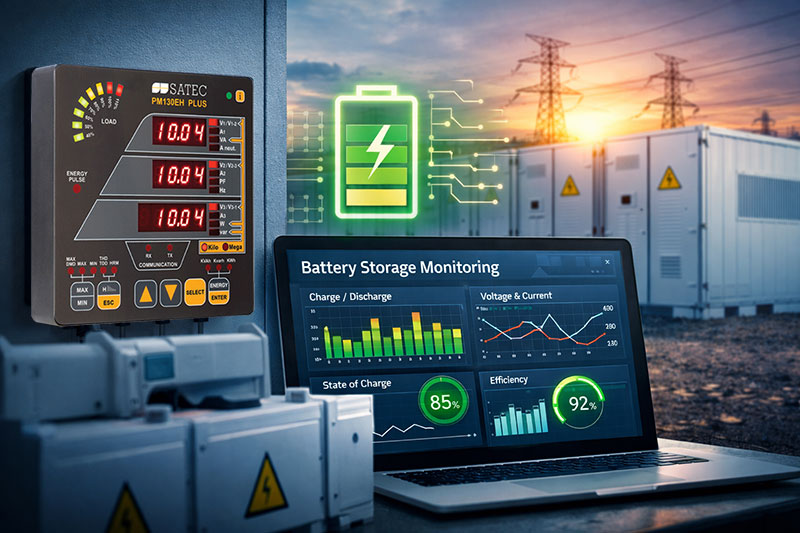
Battery Energy Storage Systems (BESS) are becoming a cornerstone of Australia’s energy future. Across commercial, industrial and utility-scale projects, they help manage renewable generation, improve site resilience and support smarter control over electricity use.
As Australia’s battery storage market continues its extraordinary growth, the need for accurate monitoring is rising alongside it. This brings a practical question for asset owners, engineers and facility managers: can a DC meter support battery storage monitoring? The answer is yes.
In many applications, a DC meter is a highly effective tool for monitoring battery performance. Since batteries store and discharge energy as direct current, measuring energy on the DC side of the system gives the most direct and accurate picture of what is happening inside the battery itself.
AC metering still plays an important role, particularly where energy flows to and from the grid. Even so, AC data alone does not always reveal the full story of battery operation. A DC meter fills that gap.
Key Points
Battery energy storage systems are expanding rapidly across Australia and accurate DC-side monitoring is essential to ensure they perform as designed.
A DC meter measures energy where the battery actually operates, providing direct visibility into charging and discharging activity that AC metering alone cannot deliver.
Monitoring only on the AC side makes it difficult to separate battery performance from inverter losses or other system influences.
DC metering helps operators identify efficiency losses, troubleshoot underperformance and build a stronger evidence base for long-term performance analysis.
An appropriate DC meter for battery storage should offer high measurement accuracy, relevant international standard compliance and open communication protocols for seamless system integration.
SATEC’s DC metering range, combined with Expertpower energy management software, gives Australian battery storage operators a complete solution for accurate measurement, performance visibility and operational control.
Why Australia's Battery Storage Growth Makes Monitoring More Important
Australia has become one of the world’s fastest-growing battery storage markets. In 2025 alone, the Clean Energy Council reported that as many battery energy storage systems were commissioned as in the previous eight years combined. Grid-scale investment, state government incentive programmes and the expansion of solar-plus-storage projects at a residential and commercial level are all driving rapid deployment.
With this growth comes greater scrutiny of performance. Asset owners want confidence that their systems are delivering the returns they were designed for. Operators need fast, reliable data to respond to changing site or grid conditions. Engineers need accurate measurement to validate system behaviour over time.
A DC meter directly supports all of these needs by providing visibility at the point where a battery actually operates.
Why DC-Side Monitoring Matters
A battery storage system operates natively on direct current. It charges and discharges as DC energy before that power is converted to AC for use or export. Monitoring only on the AC side means you are always looking at what comes out after conversion, not what is happening at the battery itself.
A DC meter changes that. It captures electrical values on the direct current side of the system, giving operators a clear view of charging energy, discharging energy, voltage, current and overall energy flow at the battery level. This distinction matters because it allows operators to separate battery-side performance from conversion losses and other influences that occur within the inverter or downstream loads.
For solar-plus-storage projects, this is particularly useful. Energy moves from generation into storage and then from storage into use or export. A DC meter provides accurate measurement at a critical point in that energy path, helping operators track the full journey of energy through the system.
What DC Metering Can Reveal
With DC-side measurement in place, operators can build a much more accurate picture of battery behaviour over time. Some of the most useful insights include:
- How much energy is entering and leaving the battery during each charge and discharge cycle
- Whether actual performance matches modelled or expected results
- Where efficiency losses may be occurring within the system
- Whether the battery is behaving consistently across different operating conditions
This level of detail becomes especially valuable when troubleshooting. If a battery system is underperforming, a DC meter helps narrow down whether the issue lies on the battery side or elsewhere in the installation. It also strengthens reporting, supports ongoing optimisation and provides a stronger evidence base for performance analysis over the asset’s life.
Why AC Metering Alone Is Not Always Enough
AC metering remains important in battery storage projects. It supports billing, grid interaction monitoring and measurement of what is ultimately delivered to the wider electrical system. However, relying on AC data alone leaves important questions unanswered.
When monitoring is limited to the AC side, it becomes difficult to determine whether a change in performance is caused by the battery, the inverter or another system component. You are measuring the outcome of conversion, not the source. A DC meter adds another layer of insight by capturing what is happening before that conversion takes place.
This is particularly relevant in Australian solar-plus-storage installations, where the movement of energy from generation to storage and then from storage to load or export needs to be clearly understood. Without DC-side measurement, some of that clarity is lost.
What to Look for in a DC Meter for Battery Storage
Choosing the right DC meter for battery storage monitoring involves more than confirming it can measure current and voltage. Battery storage applications require precise measurement because even small inaccuracies can affect performance reporting, operational decisions and long-term analysis.
Accuracy class is an important consideration. For applications involving billing or settlement purposes, Class 0.5 is typically recommended. For system monitoring applications, Class 1.0 may be appropriate depending on the project requirements. The meter should also conform to relevant international standards such as AS IEC 62053-41 and AS 62052-11, which establish performance requirements for static DC energy meters.
Communication capability matters too. Metering data is most valuable when it can be integrated into a broader monitoring or energy management platform. Look for meters that support open protocols such as Modbus RTU, DNP3 or IEC 60870-5-101/104, allowing data to flow cleanly into SCADA, building management systems or energy management software.
Physical design is also worth considering. In many installations, panel space is limited and system architecture is complex. A compact, well-designed DC meter makes integration more straightforward while still delivering the measurement detail that meaningful battery monitoring requires.
How SATEC Supports DC Battery Monitoring in Australia
SATEC has an established presence in Australia and brings over 40 years of experience in energy management solutions to the local market. Their DC metering products are designed specifically for demanding energy environments including renewable energy projects, battery storage systems and industrial applications.
For battery storage monitoring, SATEC’s DC metering range provides high-accuracy measurement of the key parameters needed to understand energy flow on the battery side of the system. The PM130 DC, for example, is a compact multifunction DC energy meter designed for up to three-channel DC metering and is suitable for use in renewable energy systems, industrial applications and SCADA environments. It supports communication via RS-485, Ethernet, 4G Modem and open protocols including Modbus RTU, DNP3.0 and IEC 60870-5-101/104.
For more advanced monitoring requirements, SATEC’s PRO Series meters offer both AC and DC input capability in a single device, along with high-accuracy measurement, 16GB of onboard memory for data logging and a range of communication protocols. This flexibility makes them well suited to complex battery storage installations where measurement needs to span multiple points in the system.
SATEC’s value becomes stronger when metering is combined with Expertpower energy management cloud software platform. Expertpower collects, archives and analyses data from SATEC meters and other Modbus-compatible devices, presenting it through a web-based interface that requires no specialist client software.
For battery storage projects, this means DC metering data can be used for more than simple measurement. It becomes part of a broader strategy for performance visibility, operational reporting and energy management decision-making. The combination of accurate DC metering hardware and a capable software platform matters. A DC meter on its own provides critical data. Expertpower turns that data into something operators can act on.
Meeting the Demands of a Rapidly Expanding Market
Australia’s battery storage sector is expanding rapidly across residential, commercial and utility-scale applications. The performance expectations being placed on these assets are rising with that expansion.
Accurate monitoring is no longer an afterthought. It is an essential part of ensuring that battery systems deliver the outcomes they were designed for. DC metering supports that goal by providing visibility at the point in the system where the battery actually operates. It helps operators understand what their battery is doing, identify issues earlier and build confidence in performance data over the long term.
For any organisation investing in battery storage in Australia, a DC meter should be considered an important component of the overall monitoring strategy. When paired with SATEC’s metering solutions and Expertpower software, it becomes part of a complete approach to energy visibility and control.
FAQs - Can a DC Meter Support Battery Storage Monitoring?
What is a DC meter used for in a battery storage system?
A DC meter measures the direct current energy flowing into and out of the battery. This helps operators monitor charging discharging and overall battery performance more accurately.
Why is a DC meter important for battery storage monitoring?
A DC meter gives visibility on the DC side where the battery actually stores and releases energy. This helps provide a clearer picture of system performance than AC monitoring alone.
Can a DC meter improve battery system efficiency monitoring?
Yes. A DC meter helps identify energy flow patterns and possible losses which makes it easier to assess efficiency and spot performance issues.
How do SATEC products support battery storage monitoring?
SATEC offers DC metering solutions for battery systems and combines them with Expertpower software for broader monitoring and energy management. This gives users both accurate measurement and better visibility across the system.
Explore related topics:
For Your Industry
Related Reading
- Four Quadrant Energy Metering In Australia: How To Measure Import, Export And Reactive Energy
- Solar Energy Monitoring vs Inverter Monitoring: What’s the Difference?
- Solar Data Logger + Metering: How to Build a Monitoring System You Can Trust
Trending in Your Sector


