

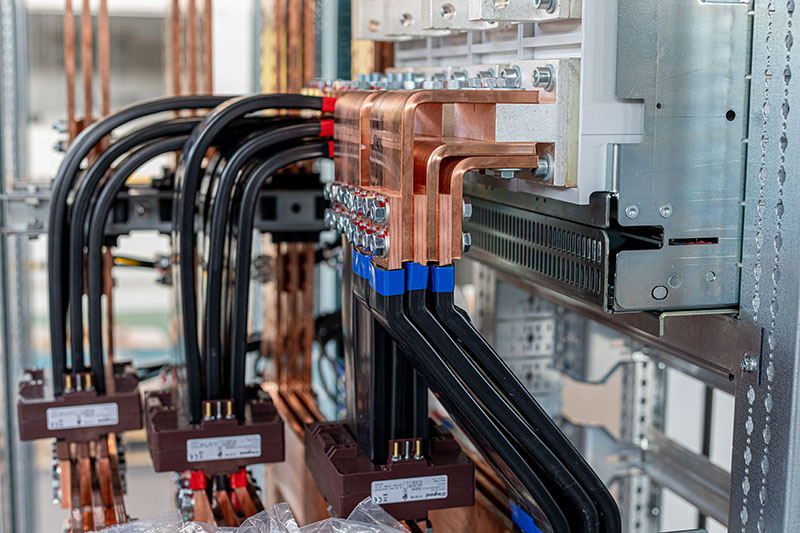
When people talk about Current Transformers (CT) meter performance, accuracy is usually at the centre of the conversation. A CT meter is only as useful as the quality of the data it produces. If the readings are off, every decision that follows can be affected. That includes billing, load analysis, energy management, equipment diagnostics and power quality investigations.
CT’s in conjunction with electrical metering are sized based on the electrical load and/or circuit breaker size. The technical language for specifications surrounding current transformers can be somewhat confusing. Terms like ratio, class and burden appear in specifications all the time. They are important concepts and they are often misunderstood. Once you understand what they mean, it becomes much easier to choose the right metering setup and avoid costly measurement errors.
Accuracy performance on current transformers can vary subject to being a solid core or a split core CT.
Key Points
CT meters are essential for measuring high currents safely in commercial and industrial installations, but their accuracy depends on the entire measurement system, not just the meter itself.
The CT ratio must be correctly matched to the expected load profile and accurately programmed into the meter, as a mismatch is one of the most common causes of measurement errors.
Accuracy class, governed in Australia by AS 61869-2, defines how closely a CT performs against the true current and should be selected based on how the data will be used.
Burden, the total load on the CT secondary circuit, is one of the most overlooked factors in CT meter accuracy and must be carefully managed, particularly where cable runs are long.
Ratio, class and burden are interconnected, and a well-designed metering system must consider all three together to deliver reliable, trustworthy data.
SATEC’s advanced metering solutions, including the Expertpower software platform, are designed to meet Australian standards and give commercial and industrial sites the measurement confidence they need.
Why CT Meter Accuracy Matters
A CT meter measures current indirectly by pairing a meter with current transformers (CTs). This is common in commercial and industrial installations across Australia where currents are too high to measure directly with a standard meter. The CT reduces the current to a known level that the meter can safely measure.
Accuracy matters for a straightforward reason. Your CT meter data is often used to make operational and financial decisions. Site managers may rely on it to understand peak demand. Consultants may use it to identify inefficiencies. Building owners may use it to allocate energy consumption across tenancies. Maintenance teams may use it to detect abnormal load patterns before equipment fails.
If the CTs and meter are not matched correctly, the readings can drift away from the true current. Even a small percentage error can become significant over time, especially on high load circuits or sites with multiple monitored assets. That is why understanding the key factors behind CT meter accuracy is essential.
What CT Ratio Really Means
The CT ratio tells you how the transformer scales down primary current to a smaller secondary current that the meter can read. For example, a 200/5A CT means that when 200 amps flow on the primary conductor, 5 amps flow on the secondary side. Other installations such as renewable energy platforms may use 1A CT secondary output.
This matters because the CT meter must be configured for the correct ratio. If the wrong ratio is entered into the meter, the displayed energy and power values will be incorrect even if the installation itself is physically sound. A mismatch between the installed CT and the programmed settings is one of the most common causes of inaccurate data.
Choosing the right ratio is also important. If the ratio is too high for the actual load, the CT meter may lose accuracy at the lower end of the measurement range, although, this depends on the accuracy class of the CT (Class 0.2, Class 0.2S, Class 0.5, Class 0.5S, Class 1.0, Class 2.0 and Class 3.0). If the ratio is too low, the CT may saturate or operate outside its intended range during higher current conditions. The goal is to select a CT ratio that suits the expected load profile rather than just the maximum theoretical load. This could be overcome with the use of dual ratio CT’s 5A/10A secondary output which must be sized up with the appropriate energy meter for this input range.
As a general guide, sizing the CT so that normal operating current sits at around 60 to 80 per cent of the CT’s rated primary current gives the best accuracy within the linear range. A well-chosen ratio gives the CT meter enough range to handle normal operating conditions while still delivering meaningful resolution and accuracy.
Understanding Accuracy Class
Accuracy class refers to how closely the CT performs compared with the true current under specified conditions. In Australia, current transformers for metering applications are specified under AS 61869-2, which aligns with the AS 61869 series.
Accuracy classes for metering CTs are expressed as a percentage and commonly include Class 0.2, Class 0.2S, Class 0.5, Class 0.5S, Class 1.0, Class 2.0 and Class 3.0. The lower the number, the tighter the tolerance. For example, a Class 0.5 CT has a maximum ratio error of 0.5 per cent under rated conditions, while a Class 0.5S CT will operate accurately at a lower range. That does not mean every installation needs the most precise class available. The right class depends on how the CT meter data will be used.
If the meter is being used for general monitoring and trend analysis, a moderate accuracy class may be perfectly acceptable. If the data is being used for billing, compliance or high value energy performance reporting, tighter accuracy will likely be necessary. This is where many projects go wrong. People sometimes focus only on the meter itself and assume the CTs are a secondary consideration.
In reality, the total system accuracy depends on both the CT meter and the CTs working together. If you pair a Class 0.5 meter with a Class 1.0 CT, the combined measurement error at that point can reach plus or minus 1.5 per cent. Accuracy class is also tied to the operating range of the CT. A CT might only achieve its stated class when installed and loaded within certain parameters. That is why the class rating should never be viewed in isolation. It must be considered alongside ratio, burden, installation quality and the meter’s own specifications.
What Burden Means and Why It Affects Performance
Burden is one of the most overlooked parts of CT meter accuracy. In simple terms, burden is the load placed on the CT secondary circuit. This includes the meter input, the resistance of the wiring and any other connected devices.
Every CT is designed to operate accurately up to a certain burden, expressed in volt-amperes (VA). Standard burden ratings include 1, 2.5, 5, 10 and 15 VA. If the total burden in a circuit exceeds the CT’s rating, measurement accuracy will suffer. In some cases the CT may no longer perform within its stated class. That can lead to under-reading or distorted results, especially where cable runs are long or the wiring cross-section is inadequate.
Burden becomes particularly important in retrofit sites where the meter is installed some distance from the switchboard or monitored circuit. Longer secondary cable runs increase resistance and therefore increase burden. Modern electronic meters tend to have a very low burden of around 0.1 to 0.5 VA, which helps considerably. However a system that looks fine on paper can still produce unreliable results if secondary cabling is not accounted for during design.
This is why a quality CT meter installation involves more than selecting a meter and clipping on CTs. The entire measurement chain needs to be considered carefully. Proper CT selection, appropriate conductor sizing, sound wiring practices and correct meter configuration all play a role.
Why System Design Matters More Than One Specification
Ratio, class and burden are often discussed as separate technical terms yet they are closely connected. A CT meter can only deliver dependable data when all three are considered together. A high accuracy meter will not fix a poorly selected CT ratio. A premium class CT will not perform as expected if the burden is too high. A correctly sized CT can still produce misleading readings if the meter is configured with the wrong ratio.
Accuracy is not created by one component alone. It comes from a well-designed metering system. This is especially important in Australian commercial and industrial projects where the metering data may support tenant billing, load studies, generator performance, energy efficiency planning and power quality analysis. In those environments, confidence in the numbers really matters.
How SATEC Delivers the Right Metering Solution
When accuracy matters, the answer is not simply installing any CT meter. The real solution is choosing a metering platform designed for reliable performance in demanding environments.
SATEC provides advanced metering and energy management solutions for commercial and industrial applications where dependable data is essential. Their range of instruments complies with IEC 61869 standards and AS 61869-2, making them well-suited to the Australian regulatory environment.
SATEC meters support CT-based installations and deliver the level of visibility needed for serious energy monitoring, power analysis and operational decision making. For customers, this means more than just reading current. It means having access to a complete metering solution that can help track consumption, monitor electrical performance and support better management of site loads.
SATEC’s offering is especially valuable in projects where space is limited, retrofit conditions are challenging or data quality needs to support deeper analysis. SATEC also stands out for combining hardware with software capability. With Expertpower, users can turn CT meter data into useful insight across a site or portfolio. That creates a practical pathway from accurate measurement to informed action.
Instead of simply collecting numbers, building owners and facility teams can use the data to identify trends, detect issues and improve performance over time.
Choosing a CT Meter With Confidence
Understanding ratio, class and burden makes it much easier to evaluate CT meter options and avoid common mistakes. These three factors shape how accurately current is measured and how trustworthy the final data will be.
A CT meter is not just a device on a panel. It is part of a measurement system that needs to be designed properly from the start. When the CT ratio suits the load, the accuracy class matches the application and the burden stays within limits, the result is data you can rely on.
That is exactly why metering quality matters. Accurate measurement supports better decisions, stronger operational visibility and more effective energy management. For Australian sites that need dependable CT-based metering, SATEC offers a solution built to deliver that confidence.
FAQs - CT Meter Accuracy
What is a CT meter?
A CT meter is a meter that works with current transformers to measure electrical current in circuits where the load is too high for direct measurement. It is commonly used in commercial and industrial installations.
Why is CT ratio important in a CT meter?
The CT ratio determines how the primary current is scaled down for the meter to read accurately. If the wrong ratio is selected or programmed, the CT meter readings will be incorrect.
What does accuracy class mean for a CT meter?
Accuracy class shows how closely the CT performs compared to the true current under specified conditions. A lower class number generally means higher accuracy.
How does burden affect CT meter accuracy?
Burden is the total load on the CT secondary circuit including the meter and wiring. If the burden is too high, the CT meter may not perform within its stated accuracy.


