

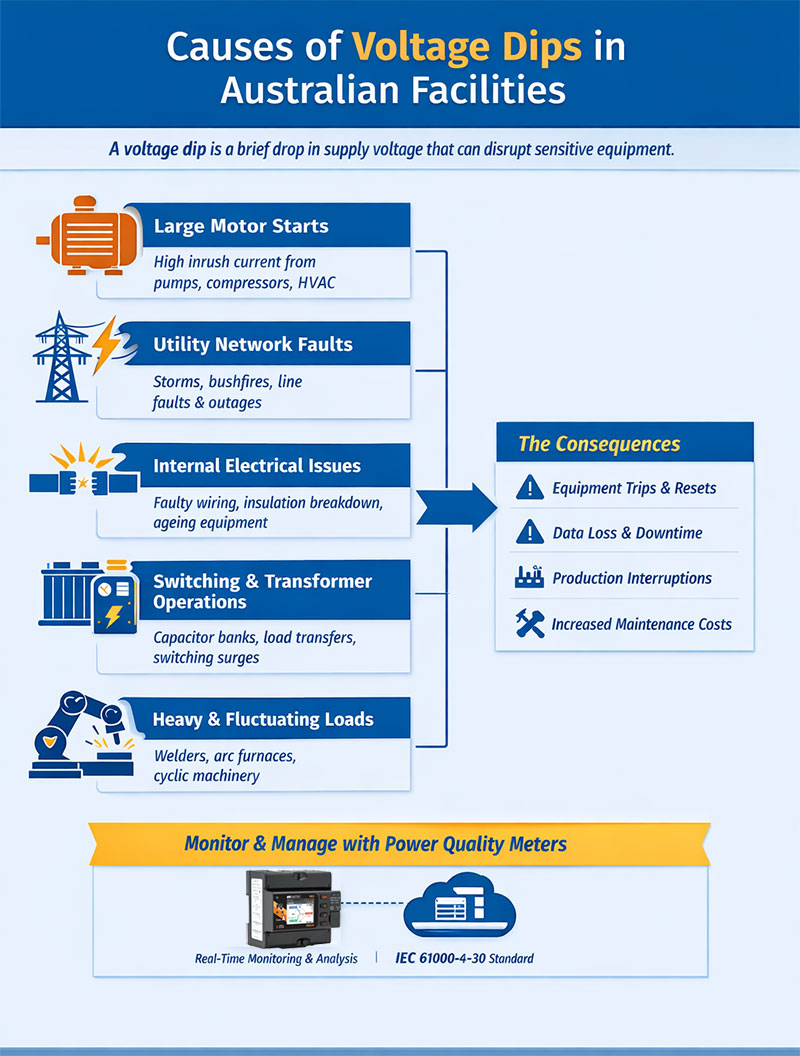
In Australian facilities of all kinds, power quality is not just a technical concern. It has a direct effect on uptime, equipment reliability, maintenance costs and operational continuity. One of the most common and disruptive power quality events is the voltage dip. Even a short drop in voltage can interrupt automated processes, trip sensitive equipment and create costly delays that ripple across an entire operation.
Understanding what causes voltage dips is the first step toward reducing their impact. In many cases, the dip itself is brief. The consequences, however, can last far longer. Lost data, reset systems, unplanned shutdowns and troubleshooting time can all follow a single event that lasts only a fraction of a second.
Key Points
Voltage dips are short-duration reductions in supply voltage that can trip sensitive equipment, interrupt operations and cause costly disruptions — even when the event lasts only milliseconds.
Large motor starts are one of the most common internal causes of voltage dips, particularly in facilities with pumps, compressors, crushers or HVAC plant drawing high inrush current on startup.
External utility network faults are a significant cause of voltage dips in Australia, where overhead distribution lines in regional and rural areas are exposed to storms, bushfires, extreme heat and high winds.
Internal electrical issues such as insulation breakdown, ageing components, loose terminations and failing switchgear can produce intermittent voltage dips that are easy to overlook but signal a system in need of attention.
Rapidly changing loads from welding equipment, arc furnaces, presses and other heavy cyclic plant place fluctuating demands on the network that can cause recurring voltage dips, particularly as facilities become more electrified.
SATEC’s IEC 61000-4-30 compliant power quality meters, combined with the Expertpower energy management platform, give facilities the real-time visibility and event data needed to identify the source of voltage dips and take targeted action.
What Are Voltage Dips?
A voltage dip is a short-duration reduction in supply voltage. As defined under the IEC 61000-4-30 standard, which forms the basis of power quality measurement practice in Australia, a dip occurs when the RMS voltage falls 10% or more below the normal level for a period ranging from a few milliseconds up to one minute.
Most events are considerably shorter than that. In Australia, the nominal supply voltage is 230V, with an allowable range of +10% to -6% under AS 60038 and AS 61000.3.100. When voltage falls outside that window, even briefly, the effects on sensitive equipment can be immediate and significant.
The range of facilities affected is broad. Industrial plants, commercial office buildings, hospitals, aged care facilities, data centres, educational campuses and retail environments all rely on equipment that may not need a complete power failure to stop working.
Programmable logic controllers, building management systems, medical devices, server infrastructure, point-of-sale systems and process automation can all be disrupted by a temporary drop in voltage. A dip can be enough to trigger a fault, restart equipment or interrupt a sequence that was running normally just moments before.
Large Motor Starting Currents
One of the most common internal causes of voltage dips is the starting of large motors. When a motor starts, it draws a much higher inrush current than it does during normal operation. That sudden demand can pull voltage down across the network, especially if the electrical system is already heavily loaded or not adequately sized.
This is frequently seen in facilities with large pumps, compressors, conveyors, fans or HVAC plant. Hospitals and aged care facilities, for example, often run complex HVAC systems where multiple large motors may start in sequence. Commercial buildings with centralised chiller plant, car park ventilation or lift systems face similar dynamics.
If multiple motors start at the same time, the effect on voltage can be more pronounced. Facilities with older infrastructure or long internal cable runs may be more vulnerable, as the network impedance can worsen the voltage drop. Soft starters and variable speed drives can help reduce inrush current. Even so, without proper monitoring in place, many sites do not realise that motor starts are linked to repeated voltage dips affecting other parts of their operation.
Faults on the Utility Network
Not all voltage dips originate inside a facility. External network faults are another major cause. A short circuit on the utility network, lightning activity, switching events or faults caused by weather, vegetation contact or vehicle impact can all lead to a temporary reduction in the voltage reaching the site. This is a particularly relevant issue in Australia, where a large proportion of the distribution network relies on overhead lines, especially in regional and rural areas.
Storms, bushfires, extreme heat and high winds can all affect transmission and distribution infrastructure. The Energy Networks Australia Customer Guide to Electricity Supply notes that very short-term voltage excursions of this kind are categorised as power quality events distinct from outages, even though they can cause similar problems for customers.
Even urban facilities are not immune. While central business district areas generally benefit from more robust underground infrastructure, suburban commercial and industrial precincts connected to overhead feeders remain exposed. Sites located further from substations or in areas with weaker grid infrastructure typically have greater exposure to these kinds of events.
This is one reason why facilities often struggle to determine whether a problem is internal or external. Operators know equipment has tripped but without event recording and timestamped data, it is difficult to establish whether the disturbance came from within the site or from the network.
Internal Faults and Equipment Issues
Electrical faults within a facility can also trigger voltage dips. Insulation breakdown, cable faults, transformer issues, failing switchgear and poor connections can all create short-duration disturbances. In some cases, the fault is obvious. In others, it may be intermittent and harder to identify.
Loose terminations, ageing components and overloaded circuits can produce localised problems that affect specific areas of a building or plant. These issues may not cause a complete outage, which makes them easier to overlook. Over time, repeated voltage dips can become a warning sign that parts of the electrical system need attention.
This applies across facility types. In a hospital, a failing connection on a critical distribution board may affect imaging equipment or monitoring devices in ways that are difficult to trace without proper data. In a commercial office building, ageing switchgear may cause intermittent resets in IT systems or building management equipment.
Facilities with complex distribution systems often need detailed monitoring at more than one point in the network. Looking only at the main incomer may not reveal what is happening downstream on critical sub-boards or at key loads.
Transformer and Switching Operations
Switching operations are another common contributor to voltage dips. When transformers are energised, they can draw a high magnetising inrush current. This can temporarily depress voltage, especially in systems with limited capacity or where multiple switching actions occur close together.
Capacitor bank switching and transfers between supply sources can also create disturbances. In facilities where standby systems, load transfers or frequent switching are part of normal operation, including hospitals with emergency generator changeover, data centres with UPS transfers and commercial buildings with peak demand management systems, these events can become a recurring source of power quality problems.
Switching-related dips often happen very quickly. Staff may notice nuisance trips or unexplained resets without ever witnessing the event itself. That is why capturing waveform data and event logs is so important when diagnosing the root cause.
Heavy or Rapidly Changing Loads
Some operations naturally place fluctuating demands on the electrical network. In industrial settings, welding equipment, arc furnaces, crushers and heavy cyclic machinery can create sudden changes in current demand. In healthcare facilities, large imaging equipment such as MRI scanners and X-ray systems can draw significant power intermittently, creating brief but measurable voltage disturbances on the local network.
In data centres, the rapid ramping of compute loads, particularly those supporting artificial intelligence workloads, can create unpredictable current demand that affects power quality for other connected equipment. These rapid load variations can result in voltage dips, particularly where the supply system has limited capacity to absorb them.
As Australian facilities become more electrified and digitally dependent, this issue is growing in relevance. New production lines, electric heating, larger automation systems and more sophisticated control equipment all increase the need for stable voltage. Many sites are also adding energy efficiency upgrades, solar generation and battery storage without fully assessing how their network will respond under dynamic conditions.
The result is a more complex operating environment where power quality can no longer be treated as a secondary concern. It needs to be measured and understood as part of normal operational performance.
Why Voltage Dips Are So Disruptive
The severity of a voltage dip is not defined only by how far the voltage falls. It also depends on how long the event lasts and how sensitive the connected equipment is. One piece of equipment may ride through a dip with no issue while another faults instantly.
The consequences vary by facility type but are significant across all of them. In industrial and manufacturing environments, the impact typically includes production stoppages, rejected product and unplanned maintenance. In hospitals and aged care facilities, voltage dips can affect medical devices, monitoring equipment and building management systems, with patient safety implications if critical equipment is disrupted.
In data centres and commercial office environments, even a brief dip can cause server faults, data loss or application failures that take considerable time to recover from. In retail environments, point-of-sale systems, refrigeration controls and electronic security systems can all be affected.
That is why many organisations underestimate the true cost of voltage dips. The event itself may be over in seconds. The operational and financial impact can stretch much further.
How SATEC Metering Solutions Help
To manage voltage dips effectively, facilities need more than assumptions. They need clear, accurate data that shows when events occur, how severe they are and where they originate. SATEC Australia offers a comprehensive range of energy and power quality meters designed to give operators a detailed view of network performance.
Rather than relying on guesswork after an equipment trip, sites can monitor voltage behaviour in real time and capture the events that matter. This makes it far easier to identify whether dips are linked to motor starts, switching operations, internal faults or upstream utility disturbances.
Our power quality analysers comply with IEC 61000-4-30 Class A and Class S measurement standards and are suited to the full range of Australian facility types, from industrial plants and commercial buildings through to hospitals, data centres and aged care facilities.
For billing and revenue applications, we also supply NMI-approved energy meters that meet National Measurement Institute requirements under NITP-14. By installing meters at the main incomer and at critical points across the distribution network, facilities can build a clearer picture of what is happening throughout the site.
Expertpower, SATEC’s cloud-based energy management software platform, adds another layer of value by helping teams view, analyse and report on power quality and energy performance data in one place. Instead of isolated data points, operators gain actionable insight into recurring patterns and event history. That turns voltage dips from a frustrating mystery into a measurable issue that can be addressed with confidence.
For facilities that want to improve resilience, reduce nuisance trips and protect sensitive equipment, SATEC’s metering and monitoring solutions provide a practical path forward.
A Smarter Approach to Reducing Voltage Dips
There is no single cause of voltage dips in Australian facilities. They can be triggered by large motors, heavy or rapidly changing loads, utility faults, switching operations or internal electrical issues. What they all have in common is that they are difficult to solve without reliable data.
When facilities can see exactly when and where dips are happening, they are in a far better position to respond. That may involve changing motor starting methods, upgrading infrastructure, adjusting protection settings or working with the utility on external supply issues. The right strategy depends on the cause and the cause is only clear when the site is properly monitored.
In today’s environment, power quality visibility is essential for facilities of all types and sizes. Voltage dips may be short in duration yet their impact can be significant. With the right metering solution in place, facilities can move from reacting to disruptions toward preventing them.
FAQs - What Causes Voltage Dips in Australian Facilities?
What is the difference between a voltage dip and a power outage?
A voltage dip is a temporary reduction in supply voltage that recovers automatically, typically lasting from a few milliseconds up to one minute. Unlike a full outage, the supply is never completely lost but the drop can still be enough to disrupt or trip sensitive equipment.
How do I know if voltage dips are causing equipment problems in my facility?
Common signs include unexplained equipment trips, control system resets, nuisance faults and process interruptions that staff cannot easily explain. Installing a power quality meter at key points in your distribution network will confirm whether voltage dips are the cause and pinpoint when and where they are occurring.
Are Australian facilities more exposed to voltage dips than those in other countries?
Australia’s heavy reliance on overhead distribution lines, particularly in regional and rural areas, combined with exposure to bushfires, storms and extreme heat, makes external network-related voltage dips a more common risk than in countries with predominantly underground infrastructure. Urban facilities on overhead feeders are also exposed, though generally to a lesser degree.
Can voltage dips damage equipment permanently?
Repeated voltage dips can accelerate wear on motors, drives and electronic components over time, even when each individual event does not cause an immediate failure. In some cases a single severe dip can damage sensitive equipment directly, making power quality monitoring an important part of any asset protection and maintenance strategy.
Explore related topics:
For Your Industry
Standards & Compliance
Related Reading
- Voltage Sags and Swells: Causes, Impacts and Fixes
- Power Quality Forensics: How PAS Helps Reconstruct What Happened Before an Electrical Event
- What Happened Before The Power Failure? How Historical Energy Data Supports Root Cause Analysis
Trending in Your Sector


