

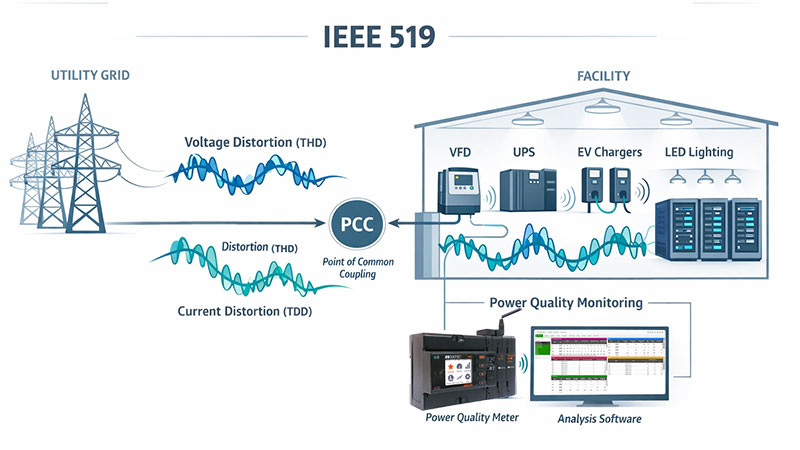
Power quality has become a significant concern in buildings and industrial sites across Australia. Variable speed drives (VSD), UPS systems, LED lighting, data centres, EV chargers and other non-linear loads all improve efficiency and control. They also introduce harmonics into the electrical system.
If you hear IEEE 519 mentioned in discussions about harmonic filters, power quality analysers or compliance reports, it is easy to assume it is simply a pass or fail rulebook. In practice it is more useful than that. It gives engineers, consultants and facility teams a shared framework for understanding harmonic distortion and managing it at the point where a site connects to the network.
Understanding the intent of IEEE 519 helps you make better decisions about measurement, mitigation and ongoing monitoring. It also helps avoid one of the most common mistakes in power quality work, which is chasing distortion numbers inside a facility without first understanding where the standard actually applies.
Key Points
IEEE 519-2022 is the current edition of the harmonic control standard and provides a shared framework for managing distortion at the point where a site connects to the network.
Non-linear loads such as variable speed drives, EV chargers, LED lighting and UPS systems all introduce harmonics that can cause overheating, nuisance tripping and reduced equipment life.
The point of common coupling (PCC) is where IEEE 519 compliance is assessed and measuring at the wrong location is one of the most common mistakes in power quality work.
THD and TDD are different metrics and using the wrong one for current distortion can lead to misleading conclusions about a site’s harmonic performance.
Harmonic behaviour changes as a site evolves so a single spot reading is rarely enough and ongoing monitoring across different load conditions is essential.
SATEC power meters and analysers including the PM180 and PRO Series support IEEE 519-2022 harmonic analysis and give facilities the visibility they need to move from reactive troubleshooting to informed power quality management.
What Is IEEE 519?
IEEE 519 is a widely used standard for harmonic control in electric power systems. Its purpose is to limit the impact of harmonic distortion on the wider electrical network and to reduce the risk of equipment problems linked to poor power quality. The current edition is IEEE 519-2022, which superseded the 2014 version in December 2022 and introduced updated guidance for sites with mixed loads and inverter-based resources such as solar and battery storage.
Harmonics are voltage or current waveforms that occur at multiples of the fundamental frequency. In Australia that fundamental frequency is 50 Hz. These harmonics are created by non-linear electrical loads. When they build up they can contribute to overheating in transformers and cables, nuisance tripping, reduced equipment life and unstable system performance.
IEEE 519 sets recommended limits for harmonic distortion. It addresses both voltage distortion and current distortion and places strong emphasis on where those values are measured. In Australia, the complementary standard for voltage distortion at the network boundary is AS 61000.3.6, which is broadly compatible with IEEE 519 recommendations. The maximum total harmonic voltage distortion permitted in Australia for low voltage systems is 8%.
Why IEEE 519 Matters for Australian Sites
The standard matters because harmonic problems are rarely isolated to one piece of equipment. A harmonic-producing load in one part of a site can affect transformers, switchboards, generators, protective devices and sensitive electronics elsewhere in the system.
Facilities with growing levels of power electronics can run into issues that are expensive to diagnose after the fact. Harmonics may not cause an immediate failure. Instead they often show up as heat, unexplained alarms, poor generator performance or repeated operational headaches that are difficult to trace.
IEEE 519 gives project teams a practical reference point. It helps define what acceptable distortion looks like and supports more consistent decisions during design, commissioning and troubleshooting. This is increasingly relevant in Australia as sites take on more rooftop solar, battery energy storage, EV charging infrastructure and variable speed drives across commercial and industrial applications.
The Importance of the Point of Common Coupling
One of the most misunderstood parts of IEEE 519 is the point of common coupling, usually referred to as the PCC. The PCC is the point where the utility and the customer interface in a way that matters for harmonic assessment. In practical terms it is the point at which your installation connects to the wider supply system.
This matters because IEEE 519 is primarily concerned with distortion at that shared boundary rather than at every internal panel or individual load. That distinction changes how you interpret measurement results. A drive panel inside a plant may show high distortion locally. That does not automatically mean the site is failing IEEE 519.
Harmonic currents can be high near non-linear loads and still be acceptable at the PCC depending on the system design and the available short circuit strength. This is why a good harmonic study always starts with the measurement location. If you measure in the wrong place you can end up solving the wrong problem.
THD and TDD Are Not the Same Thing
Another common source of confusion is the difference between THD and TDD. THD stands for Total Harmonic Distortion and is typically used when discussing voltage distortion. It expresses the harmonic content relative to the fundamental waveform at that moment.
TDD stands for Total Demand Distortion. It is used for current distortion and compares harmonic current to the site’s maximum demand current rather than only the present operating current. This distinction is important. A site can appear worse or better depending on which value is used.
Looking only at THD for current can lead to misleading conclusions about how a facility performs under IEEE 519. That is why engineers assessing compliance need to focus on the right metric for the right purpose.
Measurement and Interpretation Matter as Much as the Limits
IEEE 519 is not just a table of limits. It is also about how distortion is measured and interpreted over time. IEEE 519-2022 adopts the statistical measurement approach from IEC 61000-4-7, requiring harmonic assessments to be aggregated over very short time (3-second) and short time (10-minute) intervals. A single spot reading rarely tells the full story.
That is especially relevant in Australian buildings and sites where load profiles shift throughout the day. A hospital, shopping centre, industrial plant or commercial tower may look stable during one operating window and very different during another. The same applies to facilities with backup generation, solar integration, battery storage or large motor control systems.
Reliable metering and quality data are therefore essential. Engineers need enough visibility to identify when harmonics occur, where they are being driven from and whether the issue is steady state or event based.
Common Mistakes When Applying IEEE 519
Understanding the standard is one thing. Applying it correctly is another. Several mistakes come up repeatedly in power quality work:
Assuming every high harmonic reading means non-compliance. Context matters and the PCC matters even more.
Relying on limited data. Short snapshots can miss operating conditions that produce the worst distortion.
Treating mitigation as the first step instead of measurement. Active filters, passive filters and reactor strategies can all have a place but none of them should be selected without data to support the decision.
Forgetting that harmonic behaviour changes as a site evolves. A system that performed well at practical completion may behave differently after tenancy changes, equipment upgrades or EV charging expansion.
Why Metering Is Central to IEEE 519 Compliance
You cannot manage what you cannot see. That is especially true for harmonics. IEEE 519 depends on accurate visibility into voltage and current distortion, load patterns and disturbance events over time.
Good metering makes harmonic issues measurable rather than theoretical. It helps engineers verify conditions at the PCC, trend distortion under different load scenarios and separate persistent issues from short-term anomalies. It also supports better communication between facility owners, consultants and electrical contractors because decisions are based on real data instead of assumptions.
For many Australian organisations the challenge is not understanding that harmonics matter. The challenge is having the right instrumentation in place to monitor them consistently and interpret the results with confidence.
How SATEC Supports the Metering Side of IEEE 519
This is where SATEC’s solution set fits naturally. For sites that need to understand and manage harmonic performance, SATEC offers metering and power quality tools that help turn IEEE 519 from a design concept into an ongoing measurement strategy.
SATEC’s power meters and analysers are well suited to this role. The PM180 is a power quality analyser and is IEC 61000-4-30 Class A (Edition 3) certified, providing high-accuracy harmonic analysis including THD, TDD and individual harmonics up to the 63rd order. The PRO Series meters, including the PM335 PRO and EM235 PRO, are also Class A Edition 3.1 compliant and include IEEE 519-2022 harmonic analysis, waveform recording and 16 GB of on-board storage. These devices can give facilities detailed visibility into harmonics, power quality events and electrical performance across commercial and industrial applications.
Expertpower extends that capability by bringing meter data into one environment for monitoring, analysis and reporting. Instead of relying on isolated readings at the switchboard, teams can build a more complete view of what the electrical system is doing over time. That is valuable when you need to compare operating periods, investigate recurring complaints or support consultants with better historical data.
In practical terms, SATEC’s products help answer the questions that matter most in an IEEE 519 discussion.
- Where are harmonics occurring?
- When do they increase?
- Are they linked to specific loads or operating modes?
- Is the issue local or system wide?
That kind of insight is what allows a site to move from reactive troubleshooting to informed power quality management.
A Smarter Approach to IEEE 519
IEEE 519 should not be seen as a document that only matters when a project is already in trouble. It is more useful as a framework for planning, verifying and continuously understanding power quality in modern electrical systems.
As Australian sites become more dependent on electronic loads and distributed energy technologies, harmonic visibility becomes more important. Facilities that invest in proper metering and informed analysis are in a much better position to diagnose issues early, protect equipment and make sound decisions about mitigation.
IEEE 519 is not only about limits. It is about knowing what is happening on your system and having the data to respond intelligently. That is why metering is not an afterthought in harmonic management. It is the foundation.
FAQs - IEEE 519 Explained: A Guide to Harmonics
What is IEEE 519?
IEEE 519 is a standard that provides recommended limits for harmonic distortion in electrical power systems. It helps reduce the impact of harmonics on equipment performance and overall power quality.
What does IEEE 519 apply to?
IEEE 519 applies to voltage and current distortion in power systems, especially at the point of common coupling between a facility and the utility network. It is used as a guide for assessing and managing harmonic performance.
Why is IEEE 519 important for commercial and industrial sites?
IEEE 519 is important because excessive harmonics can lead to overheating, nuisance tripping and reduced equipment life. It gives engineers and facility managers a framework for identifying and managing these risks.
How can a site monitor compliance with IEEE 519?
A site can monitor IEEE 519 by using power quality meters and analysers to measure harmonic distortion over time at key points in the electrical network. Ongoing metering and software analysis make it easier to identify trends and respond to issues early.
Explore related topics:
For Your Industry
Standards & Compliance
- EN 50160 Power Quality: Frequency, Voltage Variations, Flicker, Unbalance, Harmonics
- Understanding the Difference with IEC 61000-4-30 Between Class A and Class S
- Harmonics Monitoring: Power Quality Compliance & Uptime Protection for Australian Facilities
Related Reading


