

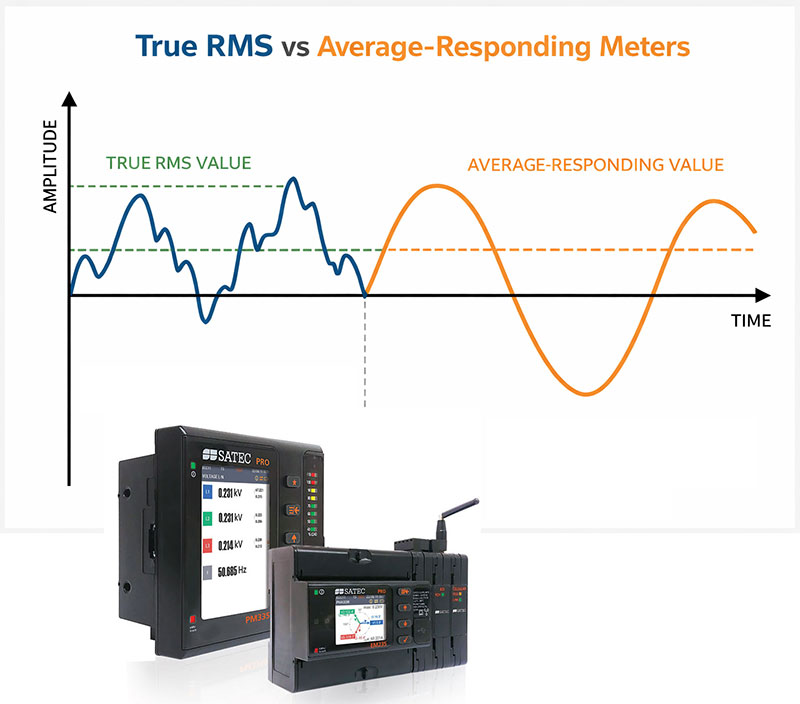
If you have ever measured the same circuit with two different meters and obtained two different results, you are not imagining things. The mismatch often shows up on modern electrical loads where the waveform is no longer a smooth sine wave. LED lighting drivers, variable speed drives, UPS systems, EV chargers, switch-mode power supplies and solar inverters all reshape current and voltage in ways that confuse instruments designed for simpler times.
This is where true RMS measurement becomes the difference between “close enough” and “actually correct.” Understanding why the readings diverge helps you choose the right meter, interpret data confidently and avoid expensive misdiagnoses.
Key Points
Two meters measuring the same circuit can give different readings and on modern electrical loads, one of them is likely wrong.
Average-responding meters apply a sine-wave correction factor that only holds true for pure sine-wave conditions, which are increasingly rare in modern Australian buildings.
Non-linear loads such as LED drivers, VFDs, EV chargers and solar inverters distort the current waveform in ways that cause average-responding meters to misread significantly.
True RMS meters follow the actual heating effect of a waveform rather than assuming its shape, keeping readings accurate regardless of distortion.
Under-reading or over-reading current due to the wrong measurement method can lead to undersized protection, missed overheating risks or unnecessary corrective work.
SATEC’s true RMS metering solutions are designed for the distorted waveform conditions found on modern Australian sites, giving engineering teams and facility managers data they can trust.
What RMS Really Means (And Why It Matters)
RMS stands for root mean square. In practical terms, RMS expresses the effective value of an AC waveform as though it were a DC value delivering the same heating effect in a resistive load. That “heating equivalence” matters because so many real-world impacts track with it: thermal stress, conductor heating, nuisance trips, transformer loading and losses.
A meter that calculates true RMS does not assume the waveform is a sine wave. It analyses the actual waveform and performs the full RMS calculation so the result stays valid even when the waveform is distorted.
What An Average-Responding Meter Is Actually Doing
Many general-purpose meters are “average responding” and are often described as “RMS calibrated.” That wording sounds reassuring yet it hides a key limitation. An average-responding meter typically measures the average value of a rectified waveform and then multiplies it by a fixed factor that only holds true for a pure sine wave.
The method works well on stable linear loads where current and voltage remain close to sinusoidal. The modern grid inside Australian commercial and industrial buildings has shifted heavily toward non-linear loads that draw current in pulses. Those pulses break the relationship between average and RMS. Modern loads create waveforms with peaks, flat tops, chopped segments and harmonic content.
An average-responding meter applies a sine-wave correction factor to a waveform that is not sine-shaped. The result can be significantly wrong even when the wiring and the load are functioning exactly as expected.
Why Modern Loads Trip Up Average Calculations
Non-linear loads pull current in short bursts rather than smoothly over the cycle. A switch-mode power supply is a classic example. It charges a capacitor near the peaks of the voltage waveform, which creates narrow high-current pulses. A variable frequency drive (VFD) introduces harmonics and switching effects that distort the waveform further. LED drivers and EV chargers each add their own signatures.
These waveforms often have a higher crest factor, meaning the peak value is large relative to the RMS value. Average-responding instruments tend to misread these shapes because their internal assumption is that the rectified waveform resembles a sine wave. Real waveforms do not cooperate.
Measurement errors tend to show up in a few recognisable patterns. A reading looks unexpectedly low even though the load is clearly significant. Two meters disagree and neither looks obviously faulty. Power factor or energy calculations look inconsistent with actual site behaviour. Troubleshooting feels like guesswork rather than engineering.
The risk is not academic. Under-reading current can lead to undersized protection or missed overheating risk. Over-reading can trigger unnecessary corrective work or lead to incorrect conclusions about load growth.
A Simple Way To Think About It
Picture two waveforms that deliver similar heating effect over time. One is a clean sine wave. The other is a spiky waveform with high peaks and long quiet intervals. The average level of the spiky waveform can be much lower than the sine wave even when the RMS heating effect is similar.
Average-responding methods follow the average level rather than the heating effect so they drift away from the number you actually need. A true RMS algorithm follows the heating effect by design. That is why it stays accurate across waveform shapes, within the frequency and crest-factor limits of the instrument.
When You Will Notice The Difference Most
The mismatch between true RMS and average-responding readings is most visible when the waveform is distorted. This is increasingly common across Australian sites, including:
- Buildings with large LED lighting retrofits Mechanical services using VFDs on pumps, fans and air handling units
- Facilities with UPS systems protecting critical loads
- Car parks and commercial premises with EV charging infrastructure
- Data centres and offices with heavy switch-mode power supply loads
- Sites with rooftop solar and battery inverters connected to the same distribution board
Australia’s rapid uptake of rooftop solar, EV charging and energy-efficient lighting means that non-sinusoidal conditions are now the norm rather than the exception on many commercial and industrial sites. Older rules of thumb were built around linear loads. That baseline no longer applies.
What To Look For In A Meter Or Metering System
Accuracy claims can be misleading unless you understand what they are tied to. A useful specification set focuses on how the device behaves under distortion.
Look for true RMS measurement support across the expected frequency range, crest factor capability aligned to your load profile and sampling and calculation transparency for logged data. Compliance with relevant Australian metering standards is important where required, as is stable performance under harmonics and non-sinusoidal conditions.
A handheld meter may be sufficient for spot checks. A permanent metering system is better for trending, event capture and ongoing verification. Power quality work in Australian facilities often requires more than a single reading on a screen.
Troubleshooting With Confidence Using True RMS Data
Accurate measurements change troubleshooting from opinion to evidence. True RMS current and voltage data helps you separate real issues from measurement artefacts.
Practical examples include validating whether a circuit is actually near capacity, confirming whether a nuisance trip correlates with a genuine rise in RMS current, comparing phases fairly when loads are non-linear and assessing whether neutral heating is plausible given harmonic-rich current profiles.
True RMS does not replace full power quality analysis but it prevents a common trap: diagnosing the meter instead of diagnosing the installation.
How SATEC Provides The Metering Solution
Modern Australian sites need accurate measurement under distortion plus reliable data you can trust over time. That is where SATEC’s metering and monitoring solutions fit.
SATEC’s metering portfolio is designed for real-world electrical environments where power electronics are everywhere. Accurate measurement and robust logging help engineering teams, facility managers and contractors move beyond one-off checks and into consistent visibility across switchboards, feeders and critical loads.
A practical metering solution also needs to be deployable. Many projects are retrofits with limited space and minimal outage windows. SATEC products are well suited to installations where compact form factor and straightforward integration matter. The goal is not only to measure once but to measure continuously so you can detect drift, confirm changes after upgrades and back decisions with evidence.
SATEC also supports turning measurements into actions through software. Expertpower brings monitoring and reporting together so teams can view trends, compare periods and share clear outputs with stakeholders. This is especially valuable when modern loads create intermittent patterns that are easy to miss with spot measurements.
Reliable data supports better maintenance planning, capacity management and energy optimisation. If your facility includes VFDs, LED retrofits, UPS systems or EV charging infrastructure, SATEC metering helps ensure the values you rely on are grounded in the waveform reality of the site.
Choosing The Right Approach For Your Next Measurement
Average-responding meters are not inherently flawed. They are designed around assumptions that hold best in sinusoidal conditions. Many modern Australian installations violate those assumptions every day. True RMS measurement closes that gap and reduces the chance of chasing phantom problems created by the instrument rather than the system.
If you are seeing inconsistent readings on modern loads it is worth treating the waveform as the prime suspect. Once the measurement method matches the electrical reality of the site, the rest of the troubleshooting process becomes calmer, faster and more accurate.
FAQs - True RMS vs Average-Responding Meters
What does true RMS mean in a meter?
True RMS means the meter calculates the effective value of the actual waveform so readings stay accurate even when the voltage or current is distorted.
Why do two meters show different readings on the same circuit?
One meter may be average-responding and assumes a sine wave while the other uses true RMS which handles non-sinusoidal waveforms created by modern loads.
When do I need true RMS instead of an average-responding meter?
True RMS is recommended when measuring circuits with VFDs, LED drivers, UPS systems, EV chargers, inverters or any load that draws current in pulses.
Can true RMS solve power quality problems by itself?
True RMS improves measurement accuracy but diagnosing issues like harmonics, sags or transients may still require power quality monitoring and logging.
Explore related topics:
For Your Industry
Standards & Compliance
Related Reading
- Power Factor Correction for VFD Loads: Why Capacitor Banks May Not Solve the Real Problem
- Electrical Power Meter with Harmonic Measurements
- CT Meter Accuracy Explained: What Ratio, Class and Burden Really Mean
Trending in Your Sector


