

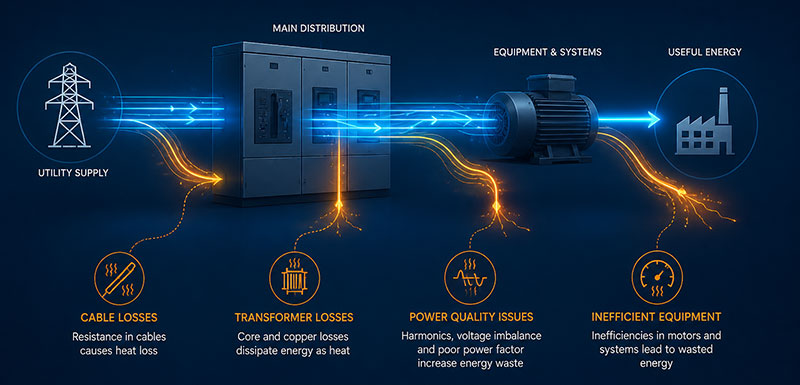
Energy costs continue to rise across Australia’s commercial and industrial sectors. Yet many businesses are still paying for electricity that delivers no productive value. Energy losses often go unnoticed because they rarely surface in day-to-day operations. Over time these inefficiencies add up to significant financial waste and reduced system performance.
Understanding how to identify hidden energy losses is the first step toward improving efficiency, lowering operational costs and strengthening overall energy management.
Key Points
Hidden energy losses occur within your own electrical infrastructure and your business is billed for energy that delivers no useful value to operations.
Australian commercial and industrial businesses pay some of the highest electricity prices in the world making energy efficiency a direct bottom-line priority.
The most common sources of hidden losses are electrical distribution systems, motors and power quality issues such as harmonics and voltage imbalance.
Sub-metering at key points within your electrical network is one of the most effective ways to isolate where energy losses are occurring.
Real-time monitoring enables facility managers to detect anomalies as they happen and take action before inefficiencies escalate.
SATEC’s NMI-approved meters and Expertpower software provide Australian businesses with the precision measurement and actionable data needed to uncover and address hidden energy losses.
What Are Hidden Energy Losses?
Energy losses refer to the portion of electrical energy that is consumed by your infrastructure but never delivered as useful output. Some level of loss is expected in any electrical network. Others are avoidable and often remain hidden without proper monitoring.
These hidden losses typically occur within your internal electrical infrastructure rather than at the utility level. This means your business is paying for energy it is not effectively using. Common examples include heat losses in cables and transformers, inefficient equipment operation and power quality issues such as harmonics and voltage imbalance.
Why Hidden Energy Losses Matter in Australia
Energy losses are not just a technical concern. They have a direct impact on your bottom line. Australian businesses pay some of the highest electricity prices in the world. Even a modest percentage of wasted energy across a large facility can translate into thousands of dollars each year.
The commercial building sector accounts for around 25% of Australia’s overall electricity use and approximately 10% of total carbon emissions. With energy costs continuing to rise and regulatory expectations tightening, the financial case for identifying and reducing losses has never been stronger. There are also significant operational risks.
Poor power quality and inefficient energy use reduce equipment lifespan and increase maintenance requirements. In some cases undetected losses can lead to overheating or system instability. From a sustainability perspective, energy losses generate higher emissions for no productive output.
Reducing these inefficiencies supports broader Environmental Social & Governance (ESG) objectives and aligns with Australia’s national trajectory toward more efficient and lower-emission buildings.
Where Energy Losses Typically Occur
Identifying energy losses starts with understanding where they are most likely to appear within your facility.
Electrical Distribution Systems
Losses can occur in transformers, switchboards and cabling due to resistance, inefficiencies in design or ageing infrastructure. These losses are often gradual and go unnoticed without granular monitoring in place.
Motors and Mechanical Systems
Equipment that is oversized, poorly maintained or running outside optimal conditions often consumes more energy than necessary. This is a common source of avoidable loss in manufacturing and industrial environments.
Power Quality Issues
Harmonics, voltage imbalance and poor power factor can all lead to wasted energy and reduced system efficiency. In Australia, the relevant standard for harmonic voltage distortion is AS 61000.3.6 which sets limits at the point of common coupling.
Operational Practices
Equipment left running unnecessarily or systems operating outside scheduled hours create hidden losses that are difficult to detect without proper visibility. These are often the easiest inefficiencies to address once they are identified.
Signs You May Have Hidden Energy Losses
Many facilities operate without realising the extent of their inefficiencies. There are several warning signs that suggest energy losses may be present. Unexpected increases in electricity bills without a clear change in usage patterns are often the first indicator.
Equipment that frequently overheats or fails prematurely can also point to underlying electrical issues. Inconsistent performance across similar systems or areas of a facility may indicate uneven energy distribution or power quality problems. A low power factor or unexplained spikes in demand charges are additional red flags. These symptoms highlight the need for deeper analysis rather than surface-level monitoring of utility bills.
How to Identify Energy Losses Effectively
Identifying hidden energy losses requires more than reviewing monthly utility bills. It involves gaining detailed visibility into how energy is used across your facility in real time.
Establish a Baseline
Understanding your normal energy consumption patterns allows you to detect anomalies and inefficiencies. This baseline should include load profiles, peak demand periods and typical operating conditions across different shifts and seasons.
Install Sub-Meters at Key Points
Installing meters at key points within your electrical network provides granular data on where energy is being consumed and where losses may be occurring. This level of detail helps isolate problem areas that would otherwise remain hidden behind a single utility meter reading.
Conduct Power Quality Monitoring
Measuring parameters such as harmonics, voltage imbalance and frequency variations can reveal issues that contribute directly to energy losses. These problems often go undetected with basic metering systems that only record kilowatt-hours.
Analyse Data Over Time
Reviewing trends over time allows you to identify patterns such as equipment running outside scheduled hours or gradual increases in consumption that indicate developing inefficiencies. A single data point rarely tells the full story.
Undertake a Structured Energy Audit
A formal energy audit evaluates equipment performance, system design and operational practices to uncover opportunities for improvement. It is particularly useful for facilities that have not previously undertaken detailed energy analysis.
Monitoring Approaches: A Comparison
The table below summarises how different monitoring approaches compare when it comes to identifying hidden energy losses.
| Feature | Utility Metering | Sub-Metering | Power Quality Monitoring | Real-Time Monitoring (SATEC + Expertpower) |
|---|---|---|---|---|
| Energy Usage Visibility | Whole-facility total only | By circuit or area | By circuit or area | Multi-point, granular and real-time |
| Power Quality Analysis | Basic | Subject to meter type | Yes – harmonics, voltage imbalance, power factor | Comprehensive – Class A/Class S compliance capable |
| Real-Time Alerts | Basic | Some systems only | Depends on platform | Yes – configurable alerts and event logging |
| Data Granularity | Monthly billing data only | Interval data by circuit, subject to meter type | Detailed waveform and parameter data | High-resolution interval and waveform data across multiple meters |
| NMI Approved (Australia) | Typically yes (utility meter) | Varies by product | Varies by product | Yes – NMI-approved meters available |
| Loss Detection Capability | Low – cannot isolate losses | Moderate – identifies areas of high use | High – reveals power quality-related losses | Very High – integrates consumption and power quality data for actionable insight |
| Reporting and Analytics | Utility bill only | Basic reporting | Technical reports | Customisable dashboards, trend visualisation and automated reporting via Expertpower |
The Role of Real-Time Monitoring
Static data is useful but it often lacks the immediacy needed to address energy losses quickly. Real-time monitoring changes this by providing continuous visibility into your electrical systems.
With real-time data, facility managers can detect anomalies as they occur. Sudden spikes in consumption, unusual load patterns or power quality disturbances can be identified and addressed before they escalate into costly problems. This proactive approach reduces both energy waste and the risk of equipment damage. It also enables more informed decision making when planning upgrades or maintenance schedules.
How SATEC Provides the Metering Solution
Accurate and reliable metering is essential for identifying and reducing energy losses. With more than 50 years of experience in power metering and power quality analysis, the range of solutions available from SATEC is specifically designed to meet the demands of Australian commercial and industrial facilities.
Smart meters across the product range deliver high-precision measurement across a wide range of electrical parameters. The EM133-XM and BFM136 carry National Measurement Institute (NMI) pattern approval under NMI M 6-1, meeting the technical and legal standards required for revenue metering in Australia.
The range spans compact DIN-rail meters through to advanced power quality analysers suited to large commercial and industrial sites. Detailed insights into energy consumption, power quality and system performance are available at multiple points within a facility. The ability to monitor harmonics, voltage levels and power factor supports a much deeper understanding of how energy is being used and where it is being wasted.
Expertpower enhances this capability by transforming raw data into actionable insights. The software enables users to visualise trends, set alerts for abnormal conditions and generate reports that support ongoing optimisation. Seamless automatic data collection from electricity, water and gas meters can be integrated into a single web-based platform with no additional software installation required.
Together, the advanced metering hardware and the Expertpower platform create a comprehensive solution for managing energy losses. Facility managers can move from reactive troubleshooting to proactive energy management with confidence.
Turning Insights Into Action
Identifying energy losses is only part of the process. The next step is taking action to reduce them. Once problem areas are identified, targeted solutions can be implemented. This may include upgrading inefficient equipment, improving power factor correction or addressing power quality issues such as harmonic distortion.
Operational changes can also deliver immediate benefits. Adjusting run schedules, eliminating unnecessary loads and improving maintenance practices all contribute to reducing losses without requiring capital expenditure. Continuous monitoring ensures that improvements are sustained over time and helps identify new inefficiencies as systems evolve and loads change.
Building a More Efficient Facility
Energy losses are often hidden in plain sight, quietly increasing costs and reducing system performance. With the right approach these inefficiencies can be uncovered and addressed before they become significant financial burdens. A combination of detailed metering, real-time monitoring and data-driven analysis provides the visibility needed to identify where energy is being lost.
Solutions like SATEC’s meters and Expertpower software enable Australian businesses to take control of their energy use and drive meaningful improvements across their operations. Reducing energy losses is not just about cutting costs. It is about building a more efficient, reliable and sustainable facility that performs at its best.
FAQs - How to Identify Hidden Energy Losses in Your Facility
What are hidden energy losses and why can’t I see them on my electricity bill?
Hidden energy losses occur within your own electrical infrastructure through issues such as heat loss in cables, harmonic distortion and poor power factor. Your utility bill shows total consumption only, so losses are absorbed into the overall figure without revealing where or why they are occurring.
How do I know if my facility has a power quality problem?
Common warning signs include equipment that overheats or fails prematurely, unexplained increases in your electricity bill and unexplained spikes in demand charges. A power quality meter can measure parameters such as harmonics and voltage imbalance to confirm whether a problem exists and where it is coming from.
What is the difference between a standard electricity meter and a sub-meter?
A standard utility meter records total energy consumption for your entire facility in one reading. A sub-meter is installed at specific points within your electrical network to provide circuit-level or area-level data, making it possible to isolate inefficiencies that a single meter cannot detect.
Is real-time energy monitoring suitable for small and medium-sized businesses as well as large facilities?
Yes. Scalable solutions such as SATEC’s meter range and the Expertpower platform can be configured to suit facilities of varying sizes, from a single building through to a multi-site national portfolio. The investment in monitoring is often recovered quickly through the energy savings and reduced maintenance costs it helps identify.
Explore related topics:
For Your Industry
- Energy Usage in Data Centres: What’s Driving It, How to Measure It and How to Control It
- Energy Monitoring for Shopping Centres: How to Cut Costs, Reduce Risk and Future-Proof Operations
Standards & Compliance
Related Reading
- How To Find Phantom Loads Using Smart Metering Data
- How To Use An Energy Consumption Monitor To Find Hidden Energy Waste
Trending in Your Sector


