
Australian businesses are facing electricity costs that have become far less predictable and manageable as an overhead. Small business customers on the Default Market Offer experienced significant price increases of 14.7% to 28.9% from 1 July 2023, varying by region.
Looking ahead, the AER’s draft determination for 2026–27 (effective 1 July 2026) proposes notable decreases of 7.6% to 21.2% for small businesses, depending on the distribution zone. Against this volatile backdrop, the ability to monitor and respond to energy use in real time has shifted from a convenience to a financial necessity for many small businesses.
Data logger power technology gives businesses the visibility to understand exactly how and when energy is being consumed. That clarity creates the opportunity for immediate action and measurable cost reduction.
Key Points
Data logger power technology continuously records electrical data including voltage, current, demand and energy consumption, giving businesses real-time insight rather than waiting for a monthly bill.
In Australia’s National Electricity Market, electricity billing is complex, incorporating usage charges, demand charges, time-of-use tariffs and power quality factors that all contribute to the final cost.
Real-time monitoring enables businesses to identify energy waste quickly, including equipment running outside operating hours or loads drawing more power than expected.
Peak demand charges are a significant cost driver for commercial and industrial customers across Australia, and real-time data logging allows operators to act before a costly peak is recorded.
Poor power quality, including voltage fluctuations and harmonics, drives up energy costs and accelerates equipment wear; integrated meters that capture power quality data help address this before it escalates.
SATEC’s Australian-based metering solutions, including the PRO Series power meters and the Expertpower energy management platform, provide a complete data logging and analytics solution tailored to local grid conditions and compliance requirements.
What Is Data Logger Power Technology?
At its core, data logger power technology refers to systems that continuously record electrical data such as voltage, current, power demand and energy consumption. These systems capture information at frequent intervals and store it for analysis.
Traditional approaches often involved separate devices for metering and logging. Today, advanced power meters integrate both functions. A single device can measure energy usage, log data and communicate with software platforms in real time. This shift removes complexity and gives businesses faster access to the insights they need to make decisions.
Why Real-Time Data Matters for Australian Energy Costs
Electricity billing in Australia is not simply about how much energy is used. It also depends on when and how that energy is consumed. Peak demand charges are fees based on the highest level of electricity demand a site reaches during a billing period. Rather than charging only for total consumption, distributors and in some cases retailers also look at the maximum power drawn at any given time.
In Australia, this is typically measured over 15 or 30-minute intervals, depending on the meter type. In NSW alone, a demand charge from a retailer can add as little as $10 or more than $800 to an annual electricity bill, depending on the plan. NSW Commercial and industrial customers across the National Electricity Market (NEM) are also exposed to time-of-use tariffs and penalties for poor power quality, costs that are almost impossible to control without real-time visibility.
By the time a problem appears on a monthly bill, the opportunity to fix it has already passed. Data logger power systems change this dynamic entirely.
Identifying Energy Waste Instantly
One of the fastest ways to reduce costs is by identifying waste. Real-time data logging makes this achievable at a granular level. A facility might discover that equipment is running outside operating hours or that certain systems are consuming more power than expected. These inefficiencies frequently go unnoticed when teams rely on monthly data alone.
With continuous monitoring, patterns become clear and facilities teams can pinpoint exactly where energy is being wasted and take corrective action promptly. Even modest adjustments, such as shutting down idle equipment or optimising operating schedules, can deliver meaningful savings over a billing period and compound significantly across a year.
Managing Peak Demand and Avoiding Penalties
Peak demand charges represent a significant portion of the electricity bill for many Australian commercial and industrial sites. Since these charges are based on the highest level of power drawn during a billing period, a single avoidable spike can set a high demand benchmark that flows through for months. Data logger power technology allows businesses to track demand in real time.
When usage approaches a critical threshold, alerts can be triggered so operators have the chance to reduce load before a costly peak is recorded. Facilities can also shift non-essential loads to off-peak periods or stagger equipment start times. Over time, this leads to a lower demand profile and a sustained reduction in charges. The ability to act in the moment is what makes the difference. Without real-time data, demand spikes often go unnoticed until it is too late.
Improving Power Quality to Prevent Hidden Costs
Energy costs in Australia extend beyond consumption and demand charges. Poor power quality can lead to operational inefficiencies, equipment damage and unplanned downtime, all of which carry a financial cost.
Voltage fluctuations, harmonics and transient events affect how efficiently systems operate and can result in both higher energy use and increased maintenance expenditure. These issues are particularly relevant across industrial and manufacturing environments connected to the National Electricity Market where grid conditions can vary significantly.
Modern data logger power systems capture detailed power quality data alongside energy metrics. This allows facilities to identify and address problems before they escalate. Resolving power quality issues improves system performance and extends equipment life, both of which contribute to long-term cost reduction.
Enabling Smarter Operational Decisions
Access to real-time data transforms how organisations manage energy. Instead of relying on assumptions or outdated averages, decisions can be based on actual performance data from the site.
Facilities managers can compare energy use across different areas, identify consumption trends and evaluate the impact of operational changes. This leads to more informed decision-making and more effective resource allocation.
Over time, this data-driven approach helps build a culture of ongoing energy efficiency. Energy management becomes an active, continuous process rather than a reactive response to unexpected bills.
Integrating Data with Energy Management Software
The full value of data logger power technology is unlocked when it is combined with purpose-built software platforms. Raw data becomes actionable when it is translated into dashboards, reports and alerts that give a clear view of energy performance across a site or portfolio. Users can track key metrics, set thresholds and receive notifications when something falls outside expected parameters.
This level of visibility makes it significantly easier to maintain control over energy costs. Integration also supports long-term analysis, with historical data used to identify trends, forecast usage and inform strategic planning.
Why Integrated Metering Matters
Not all data logging solutions are equal. Some rely on separate devices for measurement and logging, adding complexity, cost and potential points of failure. Integrated solutions simplify the process considerably.
A single device can measure, log and communicate data without the need for additional hardware. This reduces installation time, improves reliability and ensures data is captured accurately and consistently. For businesses looking to scale their energy monitoring across multiple circuits or sites, integrated systems provide a far more efficient foundation.
The Comparison: Reactive vs Real-Time Energy Management
The table below summarises the practical difference between a reactive approach to energy management and one supported by real-time data logging technology.
| Factor | Reactive (Monthly Billing Only) | Real-Time Data Logging |
|---|---|---|
| Visibility of consumption | End of billing period only | Continuous, interval-level data |
| Response to demand spikes | After the fact — costs already incurred | Real-time alerts allow pre-emptive load reduction |
| Energy waste detection | Difficult — no granular data available | Patterns visible across circuits and time periods |
| Power quality monitoring | Not captured — issues go undetected | Voltage, harmonics and events recorded continuously |
| Time-of-use optimisation | Limited — no visibility of when costs peak | Loads can be scheduled to align with off-peak tariffs |
| Reporting and compliance | Manual, error-prone, minimal detail | Automated reports, NABERS-compatible data pathways |
| Strategic planning | Based on estimates and historical averages | Informed by accurate trend data and forecasting tools |
SATEC's Approach to Data Logger Power in Australia
SATEC has over 50 years energy metering experience, bringing together local expertise and a global product range suited to the demands of the National Electricity Market. The PRO Series is a cost-effective line of power meters for advanced power monitoring applications across both AC and DC current, with waveform recording capabilities, 16GB of storage and Class A, Ed. 3.1 power quality analysis per IEC 61000-4-30.
Designed for industrial, commercial and utility applications, the PRO Series meters combine high-accuracy measurement with built-in data logging and multiple communication protocols including IEC 61850, DNP3 and dual-port ethernet. Importantly, the functionality of a dedicated data logger is embedded directly within the meter. There is no requirement for a separate logging device, which reduces installation complexity and improves the reliability of data capture across the full operating period.
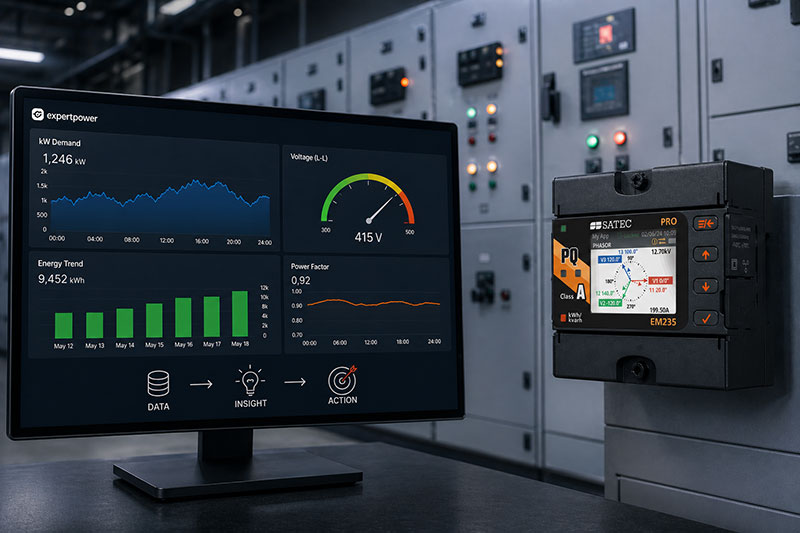
When paired with Expertpower, SATEC’s energy management software, users gain a central platform for monitoring and analysing metering data. The platform collects interval data from connected meters and presents it through customisable dashboards, giving operators real-time visibility into consumption, demand trends and power quality.
The combination of metering hardware and software also supports NABERS energy reporting pathways and benchmarking across building portfolios, areas that are increasingly important for Australian commercial property owners and facility managers. Expertpower’s scalable architecture allows organisations to start with smaller installations and expand as their monitoring needs grow.
Turning Insight Into Action
Having access to data is only the first step. The real value comes from acting on it promptly and systematically. Organisations that successfully reduce energy costs use real-time insights to guide operational decisions. They adjust processes, optimise equipment scheduling and address inefficiencies as soon as they appear, rather than discovering them after a billing cycle has closed.
Data logger power systems provide the visibility that makes this possible, turning energy from a passive overhead into something that can be actively measured and managed.
A Smarter Way to Control Energy Costs
Australian businesses that rely on monthly billing data to manage energy costs are working with a significant blind spot. Real-time monitoring offers a more effective and increasingly necessary approach.
By deploying data logger power technology, organisations gain immediate visibility into their energy use and the ability to respond with precision. The result extends beyond lower electricity bills, it is a more efficient, better-informed operation equipped to handle the volatility and complexity of Australia’s evolving energy market.
FAQs - How Data Logger Power Technology Reduces Energy Costs in Real Time
What is data logger power technology?
Data logger power technology refers to systems that continuously record and store electrical data such as energy usage, demand and power quality for analysis and optimisation.
How does data logger power help reduce energy costs?
It provides real time visibility into energy usage, allowing businesses to identify waste, manage peak demand, and take immediate action to reduce costs.
Do I need a separate data logger device?
Not always. Many modern power meters, including SATEC solutions, have built-in data logging capabilities which eliminate the need for additional hardware.
Can data logger power systems integrate with energy management software?
Yes. These systems can connect with platforms like Expertpower to provide dashboards, alerts and deeper insights for better energy decision making.
Explore related topics:
For Your Industry
- How Power Monitoring Devices Help Reduce Energy Costs in Commercial Buildings
- Building Energy Management Analytics: The Complete Guide for Commercial Buildings
Standards & Compliance
Related Reading
- How To Improve Load Factor And Reduce Electricity Demand Charges In Australia
- How To Find Phantom Loads Using Smart Metering Data
Trending in Your Sector


