

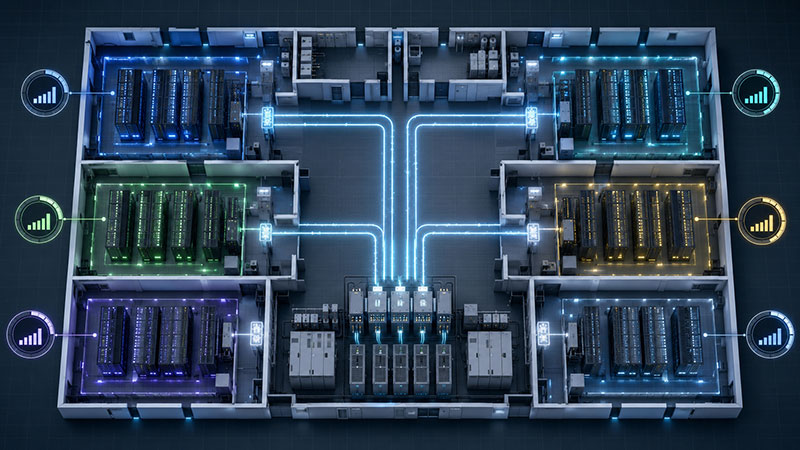
Australia’s colocation data centre sector is expanding at a remarkable pace. With 145 operational facilities across the country and 37 more in active development, operators are competing harder than ever for tenants who are asking sharper questions about what they are actually paying for.
Energy is now at the centre of those questions. Electricity is no longer just a cost bundled quietly into a service agreement. It is one of the most commercially significant factors in the colocation relationship.
Tenants want to understand what they are consuming, operators need to recover costs fairly and both sides benefit from accurate, verifiable data. This is where tenant energy billing is becoming a genuine point of difference.
Key Points
Australia’s colocation market is growing rapidly, putting pressure on operators to compete on more than uptime and connectivity alone.
Traditional pricing models that bundle or estimate energy costs are becoming difficult to sustain as tenant load profiles grow more diverse.
Energy transparency is now part of the customer experience, particularly for enterprise tenants with sustainability and ESG reporting obligations.
AI and high-density computing workloads are intensifying the need for accurate, tenant-level energy data.
In Australia, any electricity meter used for billing must hold National Measurement Institute (NMI) pattern approval under trade measurement law.
SATEC’s NMI-approved meters and Expertpower energy management platform give colocation operators a practical, compliant foundation for tenant energy billing.
Why Colocation Energy Models Are Changing
Traditional colocation pricing has often been built around rack space, contracted capacity and agreed power allocations. For some facilities and tenants, that model still works. The challenge is that modern data centre loads are becoming far more diverse.
One tenant may run relatively stable enterprise IT equipment. Another may operate high-performance computing, AI infrastructure or GPU clusters that draw considerably more power and produce more heat. Two customers with the same physical footprint can have very different energy profiles.
When electricity costs are bundled or estimated, this creates a commercial problem. Lower-consuming tenants may feel they are absorbing costs generated by heavier users. Higher-consuming tenants may want more granular detail to understand their own internal costs. Operators may struggle to identify where demand is growing and whether available capacity is genuinely being used.
Tenant energy billing helps address this by linking energy charges to measured consumption. It moves the data centre operator away from assumptions and towards evidence-based billing.
Power Transparency Is Now Part Of The Customer Experience
Colocation customers are becoming more sophisticated in how they evaluate providers. They are not only asking about uptime, redundancy and network options. They are also asking how energy is measured, how costs are allocated and what reporting is available.
This is especially important for enterprise customers with internal sustainability targets, cost allocation requirements or carbon reporting obligations. If a tenant is responsible for reporting the energy impact of its IT infrastructure, a simple monthly invoice may not be enough. Interval data, usage history and clear evidence of how electricity consumption was calculated may all be required.
Tenant energy billing supports this shift. It gives operators a way to provide clearer reporting and a better customer experience. Instead of treating energy as an opaque charge, it becomes a visible and measurable part of the service.
For the operator, this can reduce billing disputes and improve confidence in the commercial relationship. For the tenant, it creates a clearer link between operational decisions and energy cost.
AI Workloads Are Raising The Stakes
The rise of AI is putting renewed pressure on data centre infrastructure across Australia. High-density racks, variable compute loads and more demanding cooling requirements are changing the way power is planned and managed. It is not unusual for AI racks to push 30kW to 60 kW and beyond, compared to traditional racks that typically draw 7kW to 15 kW.
In this environment, average energy usage is only part of the story. Operators need to understand when demand peaks, how loads vary and whether tenant consumption patterns are shifting over time. A customer running AI training may have a very different load profile from a customer running steady storage or business applications.
Tenant energy billing becomes more valuable as these differences grow. It helps ensure that energy costs are allocated to the tenants driving the demand. It also supports better planning by showing which tenants are approaching contracted capacity and where future upgrades may be required.
Without accurate metering, operators may be forced to rely on conservative assumptions. That can lead to over-allocated capacity, under-recovered costs or missed opportunities to optimise existing infrastructure.
A Compliance Requirement, Not Just A Commercial Choice
In Australia, tenant energy billing is not simply a commercial decision. It is a legal one. Under the National Measurement Act 1960 and Australia’s trade measurement framework, any electricity meter used to determine the amount a tenant pays must hold NMI pattern approval and be verified under NITP-14 test verification requirements.
This requirement has applied since January 2013 and covers sub-meters used in embedded networks, colocation facilities and other multi-tenant arrangements. Using a meter that does not meet these requirements in a billing application exposes operators to disputes and regulatory risk.
Colocation operators billing tenants for electricity need meters that are pattern approved under NMI M 6, NMI M 13 or NMI R 46 standards as applicable. This is not a discretionary standard. It is part of the foundation of a defensible billing process.
Fairer Billing Can Become A Point Of Difference
Energy transparency can be a genuine competitive advantage for colocation providers. In a market where customers are comparing facilities closely, the ability to offer clear tenant-level billing can distinguish one operator from another.
Fair billing is not just about price. It is about confidence. Customers want to know that charges are based on actual data. They want to see how their usage changes over time and they want to understand the impact of growth, consolidation or efficiency projects.
A colocation provider that can offer this level of visibility may be seen as more professional, more transparent and easier to work with. It can also help attract customers with stronger governance requirements, including corporates, government agencies, technology companies and organisations with ESG reporting obligations.
In practical terms, tenant energy billing can support:
- More accurate electricity cost recovery
- Clearer tenant reporting and usage history
- Better conversations around capacity and growth
- Reduced billing disputes
- Improved planning for future power demand
The value is not only in the invoice. The value is in the data behind it.
What Makes Tenant Energy Billing Work
Successful tenant energy billing depends on accurate metering architecture. The data centre needs to be able to separate tenant loads from shared infrastructure such as cooling, lighting, security systems and common services.
Metering design must be planned carefully. Depending on the facility, meters may be installed at switchboards, distribution boards, tenant supply points, power distribution units or other key points in the electrical network. The aim is to capture reliable usage data at the right level of detail.
Accuracy is essential. If energy charges are being allocated to tenants, the data needs to be dependable and defensible. Poor metering, incomplete data or unclear allocation methods can quickly undermine trust and create commercial disputes.
Software also plays a major role. Metering data needs to be collected, stored, analysed and presented in a way that is useful for both the operator and the tenant. Operators need dashboards, reports, alerts, billing outputs and historical records that support commercial decisions.
Bundled Vs Metered Tenant Energy Billing
| Feature | Bundled Energy Billing | Metered Tenant Energy Billing |
|---|---|---|
| Basis of charge | Estimated or flat allocation | Measured consumption |
| Compliance (Australia) | No NMI metering required | NMI pattern-approved meters required |
| Cost fairness | Tenants may subsidise heavy users | Costs allocated to the tenant driving demand |
| Tenant reporting | Limited or none | Interval data, usage history, demand profiles |
| Billing disputes | Higher risk | Reduced through auditable data |
| ESG and sustainability reporting | Difficult to support | Clear consumption data to support reporting |
| Capacity planning | Based on assumptions | Based on measured load data |
| AI and high-density workloads | Cost recovery difficult | Accurately captured and allocated |
| Operator revenue confidence | Lower | Higher |
| Customer trust | Limited transparency | Greater confidence in charges |
SATEC Meters And Expertpower: Metering Solutions For Colocation Tenant Billing
With over 50 years of energy management expertise, SATEC provides metering and energy management solutions that are well matched to the needs of Australian colocation data centres.
For colocation facilities that need billing-grade measurement, the BFM136 is an NMI pattern-approved multi-circuit energy meter approved under NMI M 6-1 for trade measurement across multiple circuits. It delivers Class 0.5S accuracy and supports up to 36 current inputs in a compact footprint, making it well suited to environments where switchboard space and installation efficiency are both important. The BFM136 also supports time-of-use tariff recording and provides the audit-ready billing records that Australian operators need.
Where individual tenant supply points need to be measured in more constrained spaces, the EM133-XM is an NMI-approved DIN rail meter offering Class 0.5S accuracy and flexible Ethernet communications. Both meters exceed the accuracy requirements set out in Australian Standard AS 62053-22 and are supplied with NITP-14 test verification certification in line with Australian trade measurement requirements.
Power quality monitoring is an important part of the picture in data centre environments. The PM180 is a Class A power quality analyser designed for mission-critical settings, combining advanced power quality analysis with multifunction monitoring. AI and GPU loads can introduce harmonic distortion and poor power factor. The PM180 helps operators track these conditions and identify issues before they affect performance, reliability or equipment life.
Metering data from SATEC meters can be brought into Expertpower, SATEC’s cloud-based energy management platform. Expertpower turns raw meter data into dashboards, reporting, alerts and billing insights. For colocation operators, this supports tenant usage reporting, cost allocation, time-of-use analysis and long-term energy visibility from a single platform. The combination of NMI-compliant hardware and purpose-built software gives operators a complete, auditable foundation for tenant energy billing.
From Cost Recovery To Customer Value
The strongest case for tenant energy billing is not only that it helps recover costs. It also helps build a better commercial model for the future of colocation.
Power is becoming more valuable. Grid connections are more constrained. AI and high-density computing are changing load profiles. Customers are asking sharper questions about energy use, sustainability and cost transparency.
Colocation providers that can answer those questions with accurate, verifiable data are in a stronger position. They can bill more fairly, plan more confidently and give tenants better information to support their own operational and reporting needs.
Energy is no longer part of the background. It is central to the value proposition. Tenant energy billing gives Australian data centre operators a practical way to turn energy data into a commercial advantage. The operators that can give tenants confidence in their energy data will be better placed to compete in a market where every kilowatt counts.
FAQs - Colocation Data Centres: Why Tenant Energy Billing Is Becoming A Competitive Advantage
Do Australian colocation operators legally need NMI-approved meters for tenant billing?
Yes. Under Australia’s trade measurement framework, any electricity meter used to bill a tenant for consumption must hold NMI pattern approval and be verified under NITP-14 requirements. This obligation has applied since January 2013 and covers sub-meters used in colocation and multi-tenant arrangements.
What is the difference between bundled energy billing and metered tenant energy billing in a colocation facility?
Bundled billing allocates energy costs based on estimates or contracted capacity rather than measured usage, whereas metered billing links charges directly to each tenant’s actual consumption. Metered billing is fairer, more transparent and better suited to the diverse load profiles found in modern data centres.
How does tenant energy billing support ESG and sustainability reporting for colocation customers?
Metered tenant billing provides interval consumption data, usage history and demand profiles that tenants can use directly in their sustainability reporting. Without this level of detail, tenants relying solely on a monthly invoice may struggle to accurately calculate and report their IT infrastructure’s energy footprint.
Why is accurate tenant energy billing more important as AI workloads grow?
AI and GPU workloads can draw significantly more power than traditional IT equipment and create sharp demand peaks. Without accurate metering, the energy costs associated with these workloads may be distributed across tenants rather than attributed to those generating the demand, creating cost recovery problems for operators and fairness concerns for other tenants.
Explore related topics:
For Your Industry
- Colocation Energy Billing Solutions: Advanced Metering for Multi-Tenant Data Centres
- Energy Metering for Data Centres and the AI Boom
- How AI Data Centre Load Monitoring Helps Detect Noisy Racks, Pods and Tenants
Standards & Compliance
Related Reading
Trending in Your Sector


