

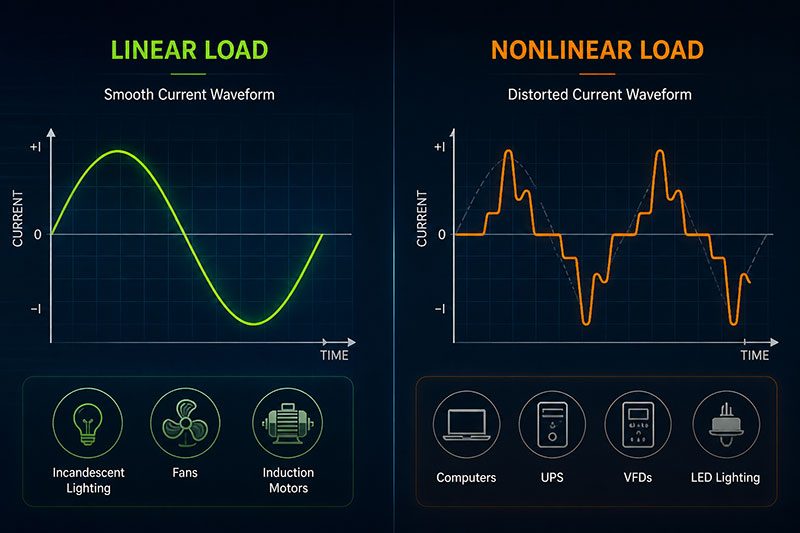
Australian facilities are filled with devices designed to improve efficiency, comfort and control. LED lighting, variable speed drives, data centre equipment and EV chargers have become essential to daily operations. Many of them share one important characteristic. They are nonlinear loads.
Knowing how to identify nonlinear loads is critical. It helps you maintain power quality, protect equipment and avoid hidden costs. These loads are increasingly common across commercial and industrial environments but their impact is often misunderstood or overlooked.
Key Points
Nonlinear loads are now standard in modern Australian facilities. They include LED lighting, IT equipment, variable speed drives, solar inverters and EV chargers.
These loads draw current in irregular pulses. This generates harmonic distortion that can degrade power quality across your entire electrical system.
Common warning signs include overheating transformers, unexplained energy bill increases, nuisance circuit breaker tripping and lighting flicker.
Australian harmonic standards apply to many facilities. Power quality compliance is both an operational and a regulatory concern under AS 61000.3.6 and IEC 61000-2-2.
Accurate identification requires power quality meters capable of measuring current waveforms, total harmonic distortion and individual harmonic spectra.
SATEC smart meters measure individual harmonics up to the 63rd order and integrate with Expertpower software to turn complex electrical data into actionable insights.
What Are Nonlinear Loads?
Nonlinear loads are electrical devices that do not draw current in a smooth and consistent waveform. Instead of following the same sinusoidal shape as the voltage supply, they draw current in pulses or irregular patterns. This behaviour creates distortion in the electrical system known as harmonics. Harmonics can lead to overheating, inefficiencies and premature equipment failure if they are not managed.
Common examples include computers, servers, LED lighting, uninterruptible power supplies, variable frequency drives and solar inverters. As Australian facilities become more digitised and electrified, the proportion of nonlinear loads continues to grow. Australia operates on a 50Hz alternating current network.
Harmonic distortion appears at multiples of this fundamental frequency. The 3rd, 5th and 7th harmonics are typically encountered and the ones most likely to cause problems in commercial and industrial settings.
Why Identifying Nonlinear Loads Matters
Facilities that rely heavily on nonlinear loads often experience power quality issues without realising the cause. These issues tend to appear gradually. They may be mistaken for normal wear and tear.
The most common consequences include overheating transformers, nuisance circuit breaker tripping, reduced efficiency and increased energy losses. Sensitive equipment may malfunction or experience a shorter operational lifespan.
In Australia, harmonic voltage distortion is assessed against specific standards. For low voltage public networks, a total harmonic distortion (THD) voltage level of 8% is widely referenced as a compatibility level under IEC 61000-2-2. For medium and high voltage systems, the relevant Australian standard is AS 61000.3.6.
Exceeding applicable thresholds can create compliance obligations with your network service provider. Identifying nonlinear loads is the first step in managing these risks. It allows facility managers and engineers to take targeted action rather than applying broad and often ineffective fixes.
Warning Signs in Your Facility
In many cases, nonlinear loads are already present in a facility even if they have not been formally identified. Certain warning signs can point to their presence. Electrical equipment that runs hotter than expected is a common indicator. Transformers and neutral conductors are particularly susceptible to overheating due to harmonic currents.
Under highly distorted conditions, neutral current can reach up to 180% of the nominal phase current. This creates significant thermal stress on conductors that are often undersized for such loads. Frequent tripping of protective devices can also suggest distorted current waveforms. This occurs when equipment responds to peak currents rather than average load conditions.
Another sign is unexplained increases in energy consumption. Harmonics reduce overall system efficiency and can lead to higher electricity costs without a clear operational reason. Lighting flicker and interference with communication systems may also be linked to poor power quality caused by nonlinear loads.
Where Nonlinear Loads Are Typically Found
Nonlinear loads are not confined to a single area of a facility. They tend to cluster wherever electronic equipment is concentrated. Data centres and server rooms are among the most significant sources. These environments rely heavily on IT infrastructure and backup power systems, which introduce harmonic distortion. Office spaces filled with computers, monitors and modern lighting also contribute. Even small devices can collectively create a noticeable impact when operating at scale.
Industrial environments often include variable speed drives and automation systems. These are major contributors to nonlinear load conditions. Australia’s rapidly expanding EV charging network is adding a new layer of complexity for facility managers. The number of high-power public EV charging locations grew by 90% between mid-2023 and mid-2024. Workplace and commercial EV charging is following a similar trajectory. EV chargers introduce harmonics, voltage fluctuations and phase imbalance into a site’s electrical system. Standard energy monitoring often cannot detect these issues.
The rapid uptake of rooftop solar and battery storage systems also introduces nonlinear loads through inverter technology. As these technologies become embedded across Australian buildings and operations, the harmonic profile of many facilities is shifting in ways that require active monitoring.
How to Identify Nonlinear Loads Accurately
Visual inspection and experience can provide clues but accurate identification requires measurement and analysis. The most reliable approach is to monitor electrical parameters such as current waveforms, total harmonic distortion and power factor. These indicators reveal whether loads are behaving in a linear or nonlinear manner.
Power quality meters play a crucial role in this process. They provide detailed insights into how electricity is being consumed and where distortions are occurring.
The Role of Measurement and Data
Analysing harmonic spectra helps pinpoint specific sources within a facility. Different types of equipment generate characteristic harmonic patterns that can be traced back to their origin. Three-phase variable speed drives typically generate 5th and 7th harmonic currents.
Single-phase switch-mode power supplies found in office equipment are a common source of 3rd harmonic distortion. The table below summarises common nonlinear load types found in Australian facilities, their typical locations and the key risks they present.
| Load Type | Common Location | Key Risk |
|---|---|---|
| Variable Speed Drives | Industrial plant, HVAC systems, water treatment, mining operations | Transformer overheating, voltage distortion, interference with control systems |
| Computers and IT Equipment | Offices, data centres, server rooms | Neutral conductor overloading, nuisance circuit breaker tripping, reduced equipment lifespan |
| LED Lighting Systems | Commercial buildings, warehouses, retail spaces | Lighting flicker, elevated THD levels, interference with sensitive equipment |
| Uninterruptible Power Supplies (UPS) | Data centres, healthcare facilities, critical infrastructure | Increased energy losses, transformer stress, power factor degradation |
| Solar Inverters | Commercial rooftops, industrial sites, carparks | Grid instability, distortion injection during peak generation periods |
| EV Chargers | Car parks, retail and commercial sites, workplaces | Voltage fluctuations, phase imbalance, cumulative THD exceedance at site level |
Continuous monitoring is particularly valuable. It allows facilities to detect changes over time as new equipment is added or operating conditions shift. Identifying nonlinear loads is not a one-time task.
Facilities are constantly evolving and new technologies are introduced regularly. Access to real-time and historical data makes it possible to track trends and respond proactively. Rather than reacting to equipment failures, facility teams can identify emerging issues early and take corrective action.
Data also supports better decision making when planning upgrades or expansions. Understanding the existing load profile ensures that new equipment is integrated without compromising power quality.
How SATEC Metering Solutions Help
Effective identification of nonlinear loads depends on having the right tools in place. Advanced energy metering solutions from SATEC provide clear advantages for Australian facility managers working to understand and control harmonic distortion. Our smart meters deliver detailed power quality analysis, including harmonic measurement and total harmonic distortion tracking.
Individual harmonics are measured up to the 63rd order. This allows facilities to move well beyond basic energy monitoring and gain a deeper understanding of how their electrical systems are performing.
With high-accuracy data capture and real-time monitoring capabilities, the meters enable users to pinpoint the presence and impact of nonlinear loads with confidence. This level of insight is essential for diagnosing issues that would otherwise remain hidden. The range also supports compliance monitoring against internationally recognised standards including IEEE 519 and IEC 61000-4-30 Class A. This is particularly relevant for Australian facilities managing harmonic levels under AS 61000.3.6.
Expertpower enhances this capability by providing a powerful software platform for visualising and analysing power quality data. Users can access intuitive dashboards, generate reports and identify trends across multiple sites or systems. This makes it easier to translate complex electrical data into actionable insights.
These solutions are particularly valuable in environments where power quality is critical, such as data centres, healthcare facilities and commercial buildings with high digital loads. They support proactive maintenance strategies and help prevent costly disruptions. By combining advanced metering hardware with intelligent software, organisations gain a comprehensive solution for identifying and managing nonlinear loads effectively.
Taking Control of Your Electrical System
Nonlinear loads are now a standard part of modern Australian facilities. Their presence is not a problem in itself. The challenge lies in understanding and managing their impact.
Facilities that invest in accurate monitoring and data-driven insights are better positioned to maintain reliability, improve efficiency and extend the life of their equipment. Identifying nonlinear loads is the foundation of this approach. With the right visibility and tools, what was once a hidden issue becomes a manageable and controllable aspect of your electrical system.
FAQs - How to Identify Nonlinear Loads in Your Facility
What is the difference between a linear and a nonlinear load?
A linear load draws current in a smooth, consistent waveform that mirrors the voltage supply. A nonlinear load draws current in irregular pulses, which introduces harmonic distortion into the electrical system.
How do I know if harmonics are causing problems in my facility?
Common indicators include transformers running hotter than expected, circuit breakers tripping without a clear cause and unexplained increases in your energy bills. Lighting flicker and interference with communication systems can also point to poor power quality.
What Australian standards apply to harmonic distortion?
For low voltage public networks, a THD voltage level of 8% is referenced as a compatibility level under IEC 61000-2-2. For medium and high voltage systems, the relevant Australian standard is AS 61000.3.6.
Can a standard energy meter detect nonlinear loads?
Standard energy meters measure consumption but do not capture harmonic distortion or current waveform behaviour. A dedicated power quality meter is required to accurately identify and analyse nonlinear loads.
Explore related topics:
For Your Industry
Related Reading
- How to Reduce Harmonic Distortion: Filters, Monitoring and Best Practices
- How To Diagnose Nuisance Tripping In Electrical Systems
- How to Identify Hidden Energy Losses in Your Facility
Trending in Your Sector


