

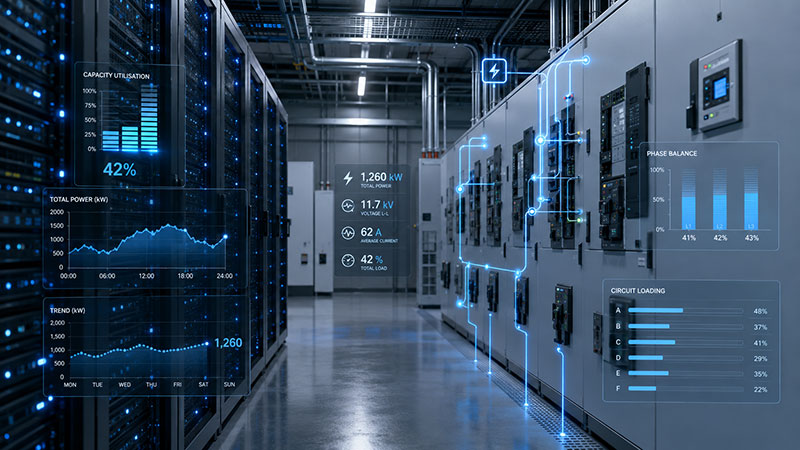
Australia’s data centre sector is growing at a remarkable pace. Demand for capacity is outpacing supply for the first time on record, and operators are under pressure to make changes to the electrical infrastructure, deploy faster, manage costs and secure increasingly constrained grid connections. Yet many facilities already have electrical capacity that exists on paper but cannot be confidently used.
This is the challenge of data centre stranded capacity. It is not always a design failure. In many cases, it is a visibility problem. Without accurate electrical data, operators are left working from estimates, nameplate ratings and worst-case assumptions. Those methods can hide usable capacity and lead to unnecessary investment.
Key Points
Stranded capacity in data centres occurs when power or infrastructure exists in theory but cannot be confidently used due to poor visibility, uneven load distribution or outdated assumptions.
Building-level energy data alone is not sufficient. Operators need granular insight at the transformer, switchboard, feeder and circuit level to make accurate capacity decisions.
Poor power quality, including harmonics, voltage imbalance and low power factor, can reduce how much available capacity can safely be used and must be monitored alongside load levels.
Retrofit and space-constrained environments face the greatest challenges, as legacy metering and limited documentation make it harder to locate genuine headroom.
Power visibility supports safer decision-making by helping operators protect redundancy, identify underutilised assets and target investment where it is genuinely needed.
SATEC’s metering solutions, including the PM180, BFM-II, BFM136 and EM133-XM, along with Expertpower energy management software, provide the electrical insight data centres need to unlock stranded capacity.
The Scale of Australia's Data Centre Pressure
Australia’s data centre sector has grown from 37 MW of total occupancy in 2005 to approximately 1.3 GW by 2025. Capacity is projected to more than double again by 2030, requiring around $26 billion in investment. At the same time, demand is already outstripping supply. The average time required to fully lease available IT capacity has fallen from 40 months in 2020 to just 13 months in 2024.
Against this backdrop, the pressure on operators is significant. Tenants want faster deployment. Energy costs are rising. Grid connections in major markets are harder to secure. For many facilities, the fastest path to more usable capacity is not a new build or a network upgrade. It is a clearer view of what already exists.
Why Stranded Capacity Happens
Electrical infrastructure in a data centre is designed around resilience. Redundancy is essential, particularly where uptime is critical. The challenge is that capacity planning often relies on assumptions that become outdated as loads change over time.
A room may have spare capacity on paper while one phase is operating close to its limit. A switchboard may show headroom overall while individual circuits are unevenly loaded. A UPS may appear underutilised yet risk margins prevent additional load from being connected. These situations do not reflect a poorly designed facility. They reflect the reality of operating complex electrical systems without granular, real-time data.
In retrofit environments, the issue becomes even more complex. Older electrical rooms may have limited space for expansion. Existing metering may only provide a broad site-level view. Documentation may not fully reflect current conditions. In these sites, unlocking stranded capacity depends on knowing exactly where headroom exists and where the real constraints sit.
The Visibility Gap
A data centre can have sophisticated infrastructure and still lack usable power intelligence. Building-level energy data is valuable but it does not show what is happening at each transformer, switchboard, feeder, circuit or tenant load. Monthly billing data is too slow to support operational decisions. Spot checks are useful but they do not capture short peaks, changing load profiles or recurring imbalance.
This visibility gap leads to overly cautious planning. Operators may avoid adding load simply because they cannot demonstrate that capacity is available. They may invest in new infrastructure before confirming whether existing assets are fully utilised. They may also miss early warning signs such as phase imbalance, poor power factor, harmonic distortion or voltage variation.
The result is straightforward. Capacity remains stranded and decisions become more expensive than they need to be.
How Power Visibility Unlocks Capacity
Power visibility gives operators a clearer view of what is available, what is constrained and what can be optimised. With the right metering architecture, facilities teams can see load patterns over time rather than relying on a single reading. They can compare demand across phases, circuits and equipment. They can identify underutilised assets and detect areas that need attention before capacity is reassigned.
This does not mean pushing infrastructure beyond safe limits. Better visibility supports safer decision-making. It helps operators protect redundancy, manage risk and make evidence-based choices about capacity allocation.
Consider a practical example. A data centre may discover that one section of the electrical system is operating close to its limit while another area has significant spare capacity. With detailed metering, the operator can rebalance loads, adjust deployment plans or direct investment where it is genuinely needed. Without that data, the entire facility may be treated as constrained, even when it is not.
The Role of Power Quality
Electrical capacity is not only about amps and kilowatts. Power quality also affects how much capacity can be used safely and reliably. Issues such as harmonics, voltage imbalance, poor power factor and transient events can increase heat, stress equipment and reduce confidence in the electrical system.
This matters for stranded capacity because poor power quality may force operators to apply larger safety margins. Even if apparent capacity exists, the facility may not be able to use it without addressing the underlying electrical conditions. Power quality monitoring helps operators understand whether a constraint is caused by load level, waveform distortion, imbalance or another electrical factor. Without that distinction, it is easy to invest in the wrong solution.
How SATEC Supports Data Centre Power Visibility
SATEC’s energy metering solutions are well suited to the power visibility challenge in Australian data centres. The range includes advanced electrical meters and power quality analysers that help facility teams understand energy use, demand and electrical performance at the level needed for sound capacity decisions.
Meters can be deployed across key points in a data centre electrical system, including main incomers, switchboards, distribution boards, tenant supplies and critical equipment feeds. This gives operators a complete picture of where capacity is being used and where it may be stranded.
The PM180 is a Class A power quality analyser designed for mission-critical environments. It combines advanced power quality analysis with multifunction monitoring, making it well suited to data centres where performance and compliance requirements are non-negotiable. For branch-level visibility, the BFM-II tracks multiple circuits simultaneously and is particularly effective in power-dense environments and multi-tenant installations.
For colocation facilities that need accurate tenant billing, the BFM136 is NMI-approved multi-circuit energy monitor, approved under NMI M 6-1 for trade measurement across multiple circuits. The EM133-XM is an NMI-approved DIN rail meter with Class 0.5S accuracy that is well suited to retrofit environments where switchboard space is limited. It is supplied with NITP-14 verification certification and supports RS485/Modbus communications for integration with energy management platforms.
All of these devices support standard communication protocols including Modbus, BACnet and IEC 61850 meter model specific, enabling integration with SCADA systems, building management systems and energy analytics platforms.
Expertpower, SATEC’s energy management software, helps turn meter data into usable insight. Rather than leaving electrical data isolated in separate devices, Expertpower supports monitoring, reporting and analysis across the site. This helps teams review trends, identify abnormal conditions and make more informed decisions about capacity planning.
From Hidden Capacity to Usable Capacity
Unlocking stranded capacity in a data centre usually begins with a shift in thinking. The question is not only “how much capacity was designed into this facility?” It is “how much capacity can we safely and confidently use today?”
Answering that question requires visibility. Operators need to understand how their electrical system behaves during normal operation, during peak periods and as load conditions change. They need to know where constraints are real and where they are based on incomplete information.
Australia’s data centre market is under pressure from both sides. Demand is growing faster than supply and the energy required to support that growth is intensifying scrutiny on how existing infrastructure is used. For many operators, the path to more usable capacity does not begin with another upgrade. It begins with better metering.
FAQs - Why Power Visibility Is the First Step to Unlocking Data Centre Stranded Capacity
What is data centre stranded capacity?
Stranded capacity refers to power or infrastructure that exists within a facility but cannot be confidently or practically used for IT load. It is most commonly caused by conservative planning assumptions, poor electrical visibility or uneven load distribution rather than an actual shortage of physical capacity.
Why is building-level energy data not enough for capacity decisions?
Building-level data shows total consumption but cannot reveal what is happening at individual switchboards, circuits or tenant supplies. Operators need granular, real-time metering at each point in the electrical system to identify where headroom genuinely exists and where constraints are real.
How does poor power quality affect stranded capacity?
Power quality issues such as harmonic distortion, voltage imbalance and low power factor can force operators to apply larger safety margins, effectively reducing how much apparent capacity can be used. Monitoring power quality alongside load levels helps identify whether a constraint is an electrical condition or simply a visibility gap.
Which SATEC meters are suited to data centre power monitoring?
The PM180 is designed for mission-critical environments requiring Class A power quality analysis. The BFM-II supports branch-level monitoring across multiple circuits. The BFM136 is NMI-approved multi-circuit energy monitor for trade measurement and the EM133-XM is an NMI-approved DIN rail meter suited to retrofit and space-constrained installations.
Explore related topics:
For Your Industry
- Harmonic Distortion in Data Centres: The Hidden Power Quality Risk Behind AI Growth
- Colocation Data Centres: Why Tenant Energy Billing Is Becoming A Competitive Advantage
Standards & Compliance
- MID Approved Meters In Australia: Why They Cannot Legally Bill Tenants
- NMI Approved Energy Meter With Ethernet: Why the EM133-XM Changes How You Manage Power
Related Reading
Trending in Your Sector


