

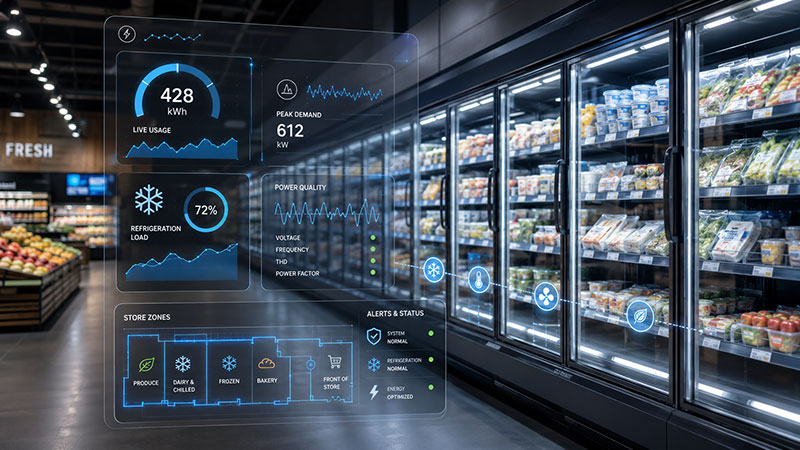
Australian supermarkets are among the most energy intensive commercial environments in the country. Refrigeration, lighting, HVAC, food preparation equipment, automatic doors, loading bays and back-of-house operations all run for long hours. In many stores, critical systems operate around the clock. Even small inefficiencies become expensive when they continue unnoticed day after day.
This is where smart energy monitoring becomes a practical business tool. It gives supermarket operators the visibility they need to understand where energy is being used, when demand is peaking and which areas of the store are costing more than they should. Instead of waiting for a quarterly bill to reveal a problem, managers can use updated historical data to make faster decisions.
Energy management is no longer just about reducing kilowatt hours. For Australian supermarkets, it is also about protecting margins, supporting sustainability goals, improving maintenance outcomes and keeping essential systems operating reliably. Smart metering and energy management software turn raw electrical data into insights that can be acted on.
Key Points
Refrigeration is the single largest energy load in Australian supermarkets, accounting for around half of total store energy consumption according to the Department of Climate Change, Energy, the Environment and Water (DCCEEW).
Smart energy monitoring gives supermarket operators visibility of consumption by system, load and area so problems can be identified and acted on before they escalate.
Granular sub-metering allows refrigeration, HVAC, lighting and other systems to be monitored separately, making it far easier to pinpoint the source of any change in energy use.
Energy management software turns raw meter data into practical insights that maintenance teams, facility managers, sustainability teams and finance teams can all use.
For multi-site supermarket groups, a small operational improvement at one store can produce a significant outcome when applied across an entire portfolio.
SATEC’s metering solutions, including the PRO Series (PM335 and EM235), provide the accuracy, compact form factor and power quality analysis capability that complex supermarket electrical environments require.
SATEC’s metering solutions EM133-XM, BFM136 or BFM II for multi circuit loads provides compact installations where space is a premium in distribution boards.
Why Supermarkets Need Better Energy Visibility
A supermarket can look efficient from the outside while still wasting significant energy behind the scenes. Refrigeration setpoints may be drifting. Lighting may be running after trading hours. HVAC systems may be working harder than necessary. Equipment faults can cause unusual consumption patterns long before anyone notices an operational issue.
The DCCEEW identifies refrigeration as the largest energy consumer in food and grocery stores, operating continuously and responsible for around half of total store energy use. Lighting and general power account for a further 25%, with HVAC making up the remainder. In a sector where profit margins are tight, even a modest reduction in energy waste can have a meaningful impact on the bottom line.
Traditional utility bills do not show these problems clearly. They provide a broad view of total consumption over a billing period. That can help with basic cost tracking but it does not explain what happened inside the store. Supermarkets need more detailed visibility than a single end of period figure.
Smart energy monitoring gives operators the ability to separate energy use by area, load or system. Refrigeration, HVAC, lighting, bakery equipment, deli equipment, EV chargers and solar generation can all be monitored separately where the right metering structure is in place. This makes it much easier to identify what is normal, what is changing and what needs attention.
Turning Meter Data Into Useful Insights
Meter data on its own is only the starting point. The value comes from turning that data into clear information that store managers, facility teams and energy managers can use.
Smart meters can help identify demand spikes that occur when several large systems start at the same time. Once those patterns are visible, managers can investigate whether equipment schedules can be adjusted to reduce peak demand charges. This is particularly relevant in the Australian National Electricity Market (NEM), where demand tariffs can represent a substantial portion of a commercial electricity bill.
In a multi-site supermarket group, energy data can also be used to compare similar stores and identify which locations are performing outside expected ranges. Smart energy monitoring also supports better maintenance planning. A refrigeration load that suddenly begins consuming more energy may indicate a mechanical issue, poor control performance or a developing fault. A lighting circuit that remains active overnight may point to a scheduling problem. A power quality issue may help explain nuisance tripping, equipment stress or premature asset failure.
The right monitoring system helps answer practical questions:
- Which store is using the most energy after hours?
- Which equipment is driving the highest demand?
- Has a recent upgrade delivered the expected result?
- Is rooftop solar generation being consumed effectively on site?
- Are certain stores showing unusual power quality patterns?
These are the kinds of questions that turn energy monitoring from a reporting exercise into a cost saving strategy.
Real Savings Come From Faster Action
The biggest financial benefit of smart monitoring often comes from speed. When a problem is visible quickly, it can be fixed before it becomes a major cost. A supermarket refrigeration fault, incorrect schedule or abnormal demand event can waste energy for weeks if the only trigger is the next utility bill. With smart monitoring, unusual patterns can be identified much earlier.
This helps maintenance teams prioritise issues based on evidence rather than guesswork. Real savings can come from several areas:
- Lower energy consumption
- Reduced peak demand charges
- Improved equipment performance
- Fewer avoidable service callouts
- Better validation of energy saving projects.
For supermarket chains, the savings are multiplied across multiple stores. A small operational improvement at one site may become a significant business outcome when applied across an entire portfolio. Smart energy monitoring can also support capital planning. If data shows that one site has consistently high demand or poor load balance, that information can guide future upgrades. If solar is being considered, accurate load data helps size the system more effectively. If EV chargers are planned, metering data helps assess capacity and demand implications before installation.
Why Granularity Matters
Whole-site monitoring has value but supermarkets often need more detail to make confident decisions. Granular metering helps separate the major energy users and gives each system a clearer performance profile.
If total site energy increases, the cause may not be obvious. It could be refrigeration, HVAC, food preparation equipment or new customer-facing loads. Without sub-metering, teams may spend time investigating the wrong area. With granular monitoring, the source of the change can be narrowed down much faster.
This is especially important in supermarkets where many systems operate simultaneously. Refrigeration alone can include display cases, cool rooms, condensers and control systems. HVAC performance can vary by season, occupancy and trading hours. Lighting loads may change after refits. New equipment can alter the site profile.
Granular data gives operators a more accurate picture of how the store behaves. It also makes reporting more useful. Rather than simply stating that a store used more energy, teams can explain why it happened and what can be done next.
Comparing Monitoring Approaches
The table below outlines the key differences between whole-site monitoring and granular sub-metering in a supermarket context.
| Feature | Whole-site monitoring | Granular sub-metering |
|---|---|---|
| Visibility | Total site consumption only | By system, load or area |
| Fault detection | Difficult to isolate cause | Source identified quickly |
| Demand management | Limited insight into peak drivers | Identifies which loads drive peaks |
| Maintenance planning | Reactive | Evidence-based and proactive |
| Solar optimisation | Basic generation vs import view | Load matching by system |
| Multi-site benchmarking | High-level comparisons only | System-level comparison across sites |
| Reporting usefulness | Shows what happened | Shows what happened and why |
| Capital planning support | Limited | Accurate load data for upgrades |
The Role of Software in Energy Management
Meters collect the data. Software makes that data easier to understand and act on.
An effective energy management platform can display consumption trends, demand patterns, power quality measurements, alarms and site comparisons in a clear format. For busy supermarket teams, this matters. Data needs to be accessible and actionable, not buried in spreadsheets or technical reports.
Expertpower, SATEC’s energy management software, supports this shift from measurement to action. It helps users view, analyse and manage electrical data across sites. For supermarkets, this can support day-to-day monitoring as well as longer-term energy strategy.
With the right software environment, energy data can be used by different people across the business. Facility managers can monitor performance. Maintenance teams can investigate abnormal patterns. Sustainability teams can support emissions reporting. Finance teams can better understand energy cost drivers. Store leaders can see whether operational changes are making a measurable difference.
SATEC Metering Solutions for Supermarkets
Advanced electrical metering forms the foundation of any effective energy monitoring programme. For supermarkets that need accurate data across complex electrical systems, the right metering hardware is critical.
The PRO Series, which includes the PM335 panel-mount meter and the EM235 DIN-rail meter, is well suited to supermarket environments. Both models offer Class 0.2S accuracy, AC and DC metering capability, power quality analysis, extensive data logging and multiple communication options including dual Ethernet, RS-485 and USB. The compact form factor of the EM235 is particularly useful in retrofit situations where switchboard space is limited. The PM335’s graphical display and intuitive interface make local data access straightforward for on-site teams.
Beyond the PRO Series, the broader SATEC range supports main incomer monitoring, sub-metering with the EM133-XM, BFM136, BFM II providing detailed analysis of major loads such as refrigeration, HVAC and lighting. This gives operators the flexibility to monitor the whole site while also drilling down into the areas that matter most.
Power quality monitoring is another important advantage in supermarket environments. Voltage variations, harmonics and phase imbalance can affect the reliability and lifespan of sensitive, high-value electrical equipment. Metering that captures power quality data gives maintenance and facility teams the visibility they need to investigate and manage these conditions before they cause equipment damage or unplanned downtime.
When paired with Expertpower, SATEC meters become part of a broader energy management solution. The result is a system that does more than measure consumption. It helps supermarkets understand performance, identify waste and make better energy decisions across every store.
From Data to Better Decisions
Smart energy monitoring for supermarkets is not about collecting data for the sake of it. It is about giving operators the confidence to act.
When energy performance is visible, supermarkets can move from reactive management to proactive control. They can identify waste earlier, manage demand more effectively, support maintenance decisions and validate the impact of energy saving initiatives. For a sector where margins are tight and energy use is constant, these improvements matter.
Smart metering, granular monitoring and intelligent software can help turn everyday electrical data into measurable savings. With the right monitoring in place, energy management becomes clearer, faster and more valuable across every store in a portfolio.
FAQs - Smart Energy Monitoring for Supermarkets
Why is refrigeration such a priority for energy monitoring in Australian supermarkets?
Refrigeration operates continuously and accounts for around half of total store energy consumption according to the DCCEEW. Even small inefficiencies in refrigeration systems can compound into significant costs over time without any visible fault or temperature breach.
How can smart metering help reduce peak demand charges on Australian electricity bills?
Smart meters can identify when multiple large systems start simultaneously and create demand spikes. This gives operators the information they need to adjust equipment schedules and reduce peak demand charges, which can represent a substantial portion of a commercial electricity bill in the NEM.
What is the difference between whole-site metering and sub-metering in a supermarket?
Whole-site metering shows total consumption across the store but cannot identify which system is responsible for a change. Sub-metering separates energy use by load or area, such as refrigeration, HVAC and lighting, so the source of any issue can be found and acted on much faster.
Which SATEC meters are suitable for supermarket energy monitoring?
The PRO Series PM335 and EM235 are well suited to supermarket environments, offering Class 0.2S accuracy, power quality analysis and compact form factors that work in both new and retrofit switchboard installations. The broader SATEC range EM133-XM, BFM136 & BFM II also supports main incomer monitoring and detailed sub-metering across all major store loads.
Explore related topics:
For Your Industry
Related Reading
- Smart Energy Metering: Turning Your Energy Data Into a Competitive Advantage
- Compact Multi-Circuit Energy Meters: Smarter Retrofits for Australian Switchboards
- What Is A Power Energy Data Logger And When Should You Use One?
Trending in Your Sector


