

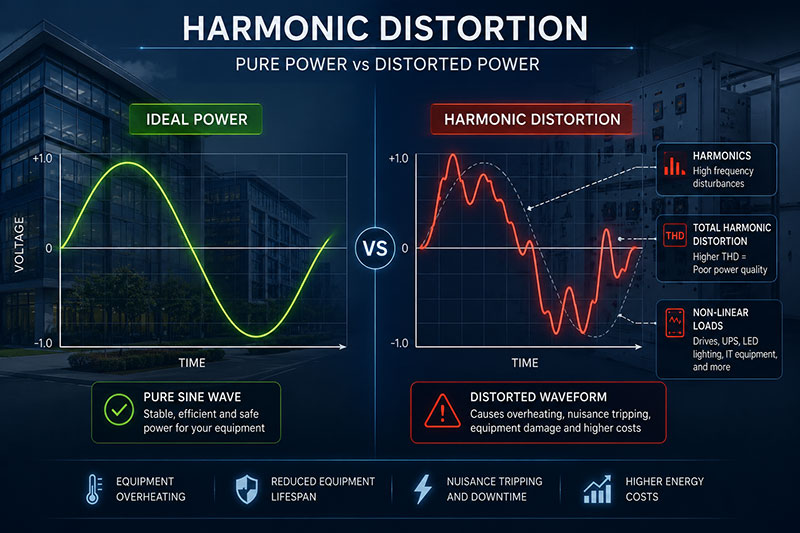
Harmonic distortion is a growing concern for Australian electrical systems. As facilities across the country add more non-linear loads, the quality of electrical power is increasingly under pressure. Variable speed drives, LED lighting and power electronics are now commonplace in commercial buildings, data centres and industrial sites.
Left unmanaged, harmonic distortion leads to overheating, equipment failure, nuisance tripping and reduced system efficiency. Reducing harmonic distortion requires smart design, effective mitigation technology and continuous visibility into system performance. This article explores practical ways to review harmonic distortion in Australian facilities, with a focus on filters, monitoring and proven best practices.
Key Points
Harmonic distortion is increasing across Australian facilities as non-linear loads such as variable speed drives, LED lighting and power electronics become more widespread.
Unmanaged harmonics cause overheating, equipment failure, nuisance tripping and reduced system efficiency across commercial, industrial and critical facility environments.
Passive, active and hybrid filters offer different levels of performance and each suits a different load profile and operational environment.
Continuous power quality monitoring enables a proactive approach to harmonic management and helps organisations act on trends before problems escalate.
In Australia, harmonic voltage distortion is governed by the National Electricity Rules and AS 61000.3.6 making compliance an active operational obligation rather than a background concern.
The Expertpower platform combined with SATEC’s Class A power quality analysers gives Australian facilities the data-driven foundation needed to monitor, analyse and act on harmonic distortion effectively.
Understanding Harmonic Distortion in Australian Electrical Systems
Harmonic distortion occurs when electrical waveforms deviate from a pure sinusoidal shape. Devices that draw current in short pulses rather than smoothly and continuously are the primary cause. These distorted currents generate harmonics that flow back into the electrical system and interact with other connected equipment.
Australian facilities are particularly exposed to this problem. The widespread adoption of electronic loads has made harmonic distortion a routine challenge in data centres, commercial offices, hospitals and industrial sites. Variable speed drives, switch-mode power supplies, UPS systems, EV chargers and inverter-based resources all contribute to distortion in modern electrical systems.
In Australia, power quality is governed by the National Electricity Rules (NER) and the AS 61000 series. The key standard for harmonic voltage distortion is AS 61000.3.6 which sets emission limits for distorting installations connected to medium and high voltage power systems. The standard is compatible with IEEE 519 guidelines. If a supply authority is dissatisfied with the level of voltage distortion at the point of common coupling it may require harmonic filtering to achieve compliance.
The challenge for most facilities is not simply identifying the presence of harmonics. It is managing their ongoing impact as loads evolve and systems change over time.
Using Filters to Reduce Harmonic Distortion
Filters are one of the most widely used solutions for reducing harmonic distortion. They work by targeting specific harmonic frequencies and preventing them from circulating through the electrical system.
Passive filters use inductors and capacitors to absorb harmonics at specific frequencies. They are relatively simple and cost-effective, particularly in systems where harmonic loads are stable and predictable. Passive filters must be carefully designed to avoid resonance issues and to match the harmonic profile of the site. In Australian installations, detuned passive filters are often specified to reduce the risk of resonance with the distribution network.
Active filters take a more dynamic approach. These devices continuously monitor the electrical system and inject counteracting currents to cancel harmonics in real time. Active filters are well suited to environments where loads change frequently. Commercial buildings with variable occupancy and industrial facilities with fluctuating processes are typical applications. Modern active harmonic filters can compensate harmonics up to the 50th order.
Hybrid filters combine elements of both passive and active filtering. This approach addresses both steady-state and variable harmonic conditions. Hybrid systems are often chosen where cost and performance need to be carefully balanced across a site with mixed load profiles.
Selecting the right filter solution depends on several factors including load type, system size and the level of distortion present. Without accurate monitoring data, filter selection can be ineffective or counterproductive.
The Role of Monitoring in Managing Harmonic Distortion
Effective monitoring is essential for reducing harmonic distortion. Without clear visibility into power quality it is difficult to understand the extent of the problem or to measure the effectiveness of any mitigation strategy. Power quality meters play a central role in this process. They provide detailed insight into harmonic levels, total harmonic distortion and the contribution of individual harmonic orders. This data allows engineers and facility managers to identify problem areas and prioritise corrective actions.
In Australia, instruments used for compliance-grade monitoring should meet Class A requirements under IEC 61000-4-30. Class A instruments provide the highest level of measurement accuracy and ensure that monitoring data meets the requirements for reporting to distribution network service providers. Continuous monitoring also helps detect changes over time.
Harmonic distortion is not a static problem. It evolves as new equipment is added, loads change and operating conditions shift. A system that was compliant last year may exceed acceptable limits today. This is particularly relevant in Australian facilities where rooftop solar, EV charging infrastructure and battery storage are increasingly common additions to existing electrical systems.
Monitoring enables a proactive approach. Rather than reacting to equipment failures or unexplained downtime, organisations can identify trends early and take action before problems escalate. This leads to improved reliability and reduced maintenance costs. Software platforms further enhance the value of monitoring by turning raw data into actionable insights. Visual dashboards, threshold alarms and historical analysis make it easier to understand complex power quality issues and communicate findings clearly across teams.
Best Practices for Reducing Harmonic Distortion
Filters and monitoring are most effective when supported by good system design and sound operational practices. Assessing harmonic levels during the design phase is an important first step. Engineers should evaluate expected loads and consider their harmonic impact before equipment is installed. This allows mitigation strategies to be built into the system from the outset rather than added later as a reactive measure.
Load balancing across phases is another key practice. Uneven distribution of loads can worsen harmonic distortion and increase neutral currents. This is a particular concern in Australian commercial buildings where single-phase loads such as IT equipment and LED lighting are distributed across a three-phase supply. Ensuring balanced loads reduces stress on the system and improves overall power quality.
Equipment selection also matters. Many modern devices are designed with improved harmonic performance. Choosing equipment that complies with relevant Australian Standards can significantly reduce the introduction of harmonics into the system.
Regular audits and maintenance should not be overlooked. Electrical systems change over time and periodic reviews help ensure that mitigation measures remain effective. This includes checking filter performance, verifying meter accuracy and reviewing monitoring data against current load conditions.
Collaboration between electrical engineers, facility managers and energy specialists is also important. Harmonic distortion is a system-wide issue and requires a coordinated approach to manage it effectively.
How SATEC Supports Harmonic Distortion Management
Accurate measurement is the starting point for any effective harmonic mitigation strategy. The range of Class A power quality analysers available through SATEC is designed to capture detailed power quality data including harmonic distortion levels and total harmonic distortion across multiple points in a network. This allows organisations to pinpoint sources of distortion and understand how harmonics propagate through their systems.
The Expertpower cloud platform enhances this capability by providing real-time visibility and historical analysis. Users can track harmonic trends, set alarms for threshold breaches and generate reports that support both compliance and operational decision making. Monitoring at this level of detail enables a proactive approach to power quality management rather than a reactive one.
Instruments across the range comply with IEC 61000.4.30 meaning measurement data meets the accuracy requirements for reporting to distribution network service providers. This is an important consideration for Australian businesses with compliance obligations under the National Electricity Rules. The metering solutions are well suited to retrofit environments where space is limited and upgrading infrastructure can be challenging. A compact design combined with advanced functionality makes them a practical choice for modern buildings that need high-performance monitoring without extensive modifications.
Support for communication protocols including Modbus and IEC 61850 means the meters integrate directly with existing SCADA systems and building management platforms. By combining precise metering with the analytics capability of the Expertpower platform, organisations can move beyond reactive fixes and towards a data-driven strategy for managing harmonic distortion across single or multiple sites.
Building a Long-Term Strategy
Reducing harmonic distortion is not a one-time task. It requires ongoing attention and a willingness to adapt as systems evolve. Filters can address immediate issues and improve power quality but their effectiveness depends on accurate data and proper configuration. Monitoring provides the visibility needed to guide decisions and measure outcomes.
Best practices ensure that systems are designed and operated in a way that minimises the introduction of harmonics from the outset. Organisations that take a holistic approach are better positioned to maintain reliable and efficient electrical systems. They can reduce the risk of equipment damage, improve energy performance and demonstrate compliance with the AS/NZS 61000 series and the National Electricity Rules.
As Australian electrical systems become more complex, with growing numbers of rooftop solar installations, EV chargers and inverter-based loads adding to the harmonic burden, effective management will only become more important. With the right combination of technology and strategy, harmonic distortion is a challenge that can be effectively managed.
FAQs - How to Reduce Harmonic Distortion
What is the Australian standard for harmonic distortion?
The key standard for harmonic voltage distortion in Australia is AS 61000.3.6, which sets emission limits for distorting installations connected to medium and high voltage power systems. It is compatible with IEEE 519 guidelines and is enforced through the National Electricity Rules.
What causes harmonic distortion in commercial and industrial facilities?
Harmonic distortion is caused by non-linear loads that draw current in short pulses rather than smoothly and continuously. Common sources include variable speed drives, LED lighting, switch-mode power supplies, UPS systems and EV chargers.
What type of filter is best for reducing harmonic distortion?
The right filter depends on your load profile. Passive filters suit stable and predictable loads, active filters are better suited to environments with frequently changing loads and hybrid filters offer a balanced solution for sites with mixed load types.
How does power quality monitoring help manage harmonic distortion?
Power quality monitoring provides continuous visibility into harmonic levels and total harmonic distortion, allowing engineers and facility managers to identify problem areas early and measure the effectiveness of any mitigation strategy. Without this data, it is difficult to know whether harmonic levels are within acceptable limits or whether corrective actions are working.
Explore related topics:
For Your Industry
Related Reading
- How to Identify Nonlinear Loads in Your Facility
- How To Diagnose Nuisance Tripping In Electrical Systems
- How to Identify Hidden Energy Losses in Your Facility
Trending in Your Sector


