

Since 1 July 2026, every embedded network seller in NSW has had to join the Energy and Water Ombudsman NSW (EWON) and publish its prices online. Maximum prices and a residential billing standard are expected to follow in the first half of 2027. Most of the commentary on these reforms has focused on pricing.
We think the bigger exposure sits one step earlier, inside the switchboard. A price ceiling only protects you if the kilowatt hours underneath it are legally measured. Once residents can compare their bill against a published maximum, the next question is obvious. How do you know my consumption figure is right?
This guide sets out what a sub meter must meet before it can bill a tenant in NSW. It covers pattern approval, verification, accuracy class and data. It also explains how the 2026 reforms raise the stakes on each one.
Key Points
NSW embedded network sellers have been required to join EWON and publish their prices, premises and service types since 1 July 2026.
IPART expects maximum prices and a residential billing standard to commence in the first half of 2027, subject to ministerial approval.
Any sub meter used to bill a tenant is a trade instrument and must hold NMI pattern approval before it can be verified and placed into service.
Accuracy class is fixed by the approval certificate for the exact meter and sensor arrangement, not by the headline figure on a datasheet.
On market child meters must also satisfy Chapter 7 of the National Electricity Rules, where a Type 4 installation needs at least a Class 1 meter with Class 0.5 current transformers.
SATEC supplies the NMI approved EM133-XM and BFM136, giving NSW embedded networks approved single circuit and multi circuit billing options.
What The 2026 Reforms Change For Metering
The Energy Legislation Amendment Act 2025 brought embedded networks into the NSW consumer protection framework. The first stage commenced on 1 July 2026. Sellers must now belong to EWON and keep their prices and services published on a website.
The national layer moved on the same day. Version 7 of the AER’s network and retail exemption guidelines took effect on 1 July 2026. It tightens metering conditions for exempt networks and requires exempt sellers to show their tariffs against the local area retailer’s standing offer.
IPART is now working on the second stage. That covers a maximum price methodology and a billing standard for residential customers. Default Market Offer protections for embedded network customers are expected in 2027 to 2028.
None of these instruments sets a new meter specification. They do something more pointed. They make every bill comparable and every complaint independently reviewable. A reading that nobody ever questioned becomes a reading EWON can ask you to explain.
Requirement One: NMI Pattern Approval
An energy meter is used for trade when its measurement determines what someone pays. Billing residents in an embedded network is trade use. So is recovering power costs from a retail tenancy on a per kilowatt hour basis.
Trade measurement law has applied to electricity meters installed on or after 1 January 2013 that measure less than 750 MWh a year. Almost every apartment, retail or retirement village sub meter falls inside that band. Each one must be of a pattern approved by the National Measurement Institute (NMI).
Older certificates usually cite NMI M 6-1. Newer approvals may reference NMI M 6, NMI M 13 or NMI R 46 depending on the pathway taken. European MID marks test reports do not substitute for any of them.
Requirement Two: Verification Before Use
Pattern approval confirms the design. Verification confirms the individual meter on your wall. A utility meter verifier tests each instrument against NITP 14.0 and NITP 14.2 before it is used for trade.
The evidence is a verification mark or a certificate listing meters by serial number. Keep it with the building records. It is the first document anyone will ask for in a dispute.
There is no workaround for an unapproved meter. Only approved patterns can be verified. Discovering the problem after handover means replacing the meters, usually with an outage and switchboard work.
Requirement Three: The Right Accuracy Class
Class is where specifications most often drift. The class that counts is the one printed against your exact arrangement in the certificate schedule.
The EM133-XM certificate shows this clearly. Its direct connected and 5 A CT variants hold Class 0.5S. The same meter supplied with HACS current sensors holds Class 1 for each approved combination. One instrument can carry two classes depending on how it is connected.
Off market child meters are billed privately by the embedded network operator. For these, trade measurement law is the governing test. On market child meters have their own NMI in the National Electricity Market so the resident can choose a retailer. Those installations must also meet Chapter 7 of the National Electricity Rules with a metering coordinator appointed. For a Type 4 installation below 750 MWh a year, the floor is a Class 1 meter with Class 0.5 current transformers.
Our advice is to specify above the floor where the budget allows. A Class 0.5S meter leaves headroom when the CTs, burden and wiring add their own error.
Requirement Four: Correct Mapping And Usable Data
An accurate meter billed against the wrong apartment produces a perfectly measured wrong bill. We see mapping errors far more often than faulty meters. They can sit unnoticed for years.
The coming billing standard is designed to show residents how their charge compares with the permitted maximum. Every line on that bill needs a clear trail back to a tariff, a consumption figure and a dated reading. Remotely read interval data makes that trail quick to produce. Manual readings entered into a spreadsheet rarely do.
NSW Embedded Network Meter Checklist
| Requirement | What It Means | Applies To | Evidence To Keep |
|---|---|---|---|
| NMI pattern approval | Meter model and variant listed on an NMI certificate of approval | All sub meters used to bill residents or tenants | Certificate number and technical schedule |
| Verification | Each meter tested by a utility meter verifier against NITP 14 | Every individual billing meter before use | Verification mark or certificate by serial number |
| Approved accuracy class | Class stated in the certificate for the exact meter and sensor arrangement | All billing meters | Certificate schedule matched to the installed variant |
| NER Chapter 7 compliance | Type 4 floor of a Class 1 meter with Class 0.5 CTs and an appointed metering coordinator | On market child meters only | Metering coordinator and commissioning records |
| Tenancy mapping | Each meter identified against the correct apartment or tenancy | All billing meters | Signed meter to tenancy register |
| Price disclosure | Prices, premises and service types published online | NSW embedded network sellers from 1 July 2026 | Website record and EWON membership |
How SATEC Supports Compliant Embedded Network Billing
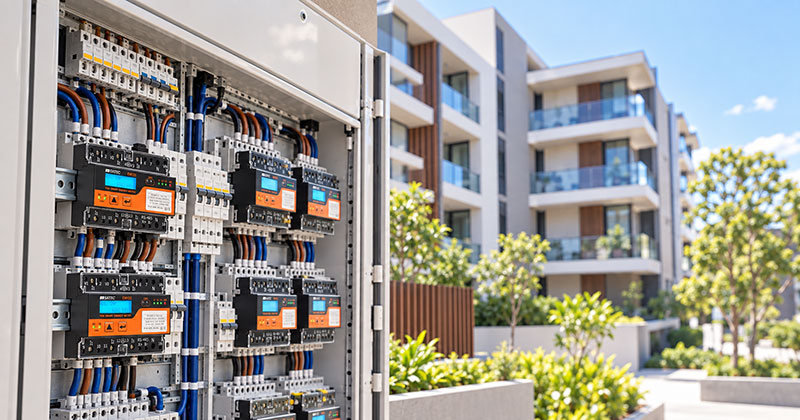
Two NMI approved platforms cover most NSW embedded network requirements. The EM133-XM is a compact DIN rail meter approved under NMI 14/2/72. It suits apartment switchboards where space is tight and offers RS-485, Ethernet or cellular communications.
Larger sites often need dozens of billing points in one place. The BFM136 is approved under NMI 14/2/80 and meters up to 36 single phase or 12 three phase circuits from a single instrument. It was the first multi circuit meter to achieve Australian pattern approval.
Both meters feed Expertpower, our energy management platform hosted on Australian Microsoft Azure infrastructure. Tariff setup, consumption tracking and invoicing sit in one place. That removes the spreadsheet step where most billing errors creep in.
Residents can also view their own usage through the eXpertConnect app. This applies where individual sub meters are connected to Expertpower and the resident is an approved user. Common area consumption is not visible to residents.
No meter makes a network compliant on its own. What 50-plus years of energy measurement engineering has taught us is simpler. Approved metering and accessible interval data make every other obligation easier to meet.
Audit Your Meters Before The Price Ceiling Arrives
The first stage of the NSW reforms is already live. The pricing stage is months away. That gap is the cheapest window you will get to fix metering problems calmly rather than in response to a complaint.
Contact SATEC or call 02 4774 2959 to arrange a review.
FAQs - Meter Requirements For Embedded Network Billing In NSW
Do sub meters in a NSW apartment building need to be NMI approved?
Yes, if the readings are used to bill residents. Billing is trade use under the National Measurement Act 1960 so the meter must be pattern approved and individually verified. Meters used only for monitoring are not caught.
What accuracy class does an embedded network meter need?
The meter must perform within the class stated on its NMI certificate for the installed arrangement. On market child meters also need at least a Class 1 meter with Class 0.5 CTs under the Type 4 rules. Specifying Class 0.5S gives useful headroom for CT and wiring errors.
Do the NSW reforms require me to replace my meters?
Not directly. The reforms do not set a new meter specification. They do make bills comparable and disputes reviewable by EWON, which leaves unapproved or unverified meters exposed.
What is the difference between on market and off market child meters?
An on market child meter has its own NMI in the National Electricity Market so the resident can choose a retailer. An off market child meter is billed privately by the embedded network operator. Both must meet trade measurement law and on market meters must also comply with National Electricity Rules Chapter 7.


