
Electrical measurements sit at the core of energy management, compliance and operational performance. As Australia pushes toward greater energy transparency, electrification and grid stability, the expectations around measurement accuracy and compliance have become more demanding.
Businesses are no longer asking whether they need reliable electrical measurements. They are asking how precise, compliant and actionable their data can be. Understanding the current standards and regulatory landscape is essential for consultants, contractors and facility managers who want to stay competitive and avoid costly compliance issues.
Key Points
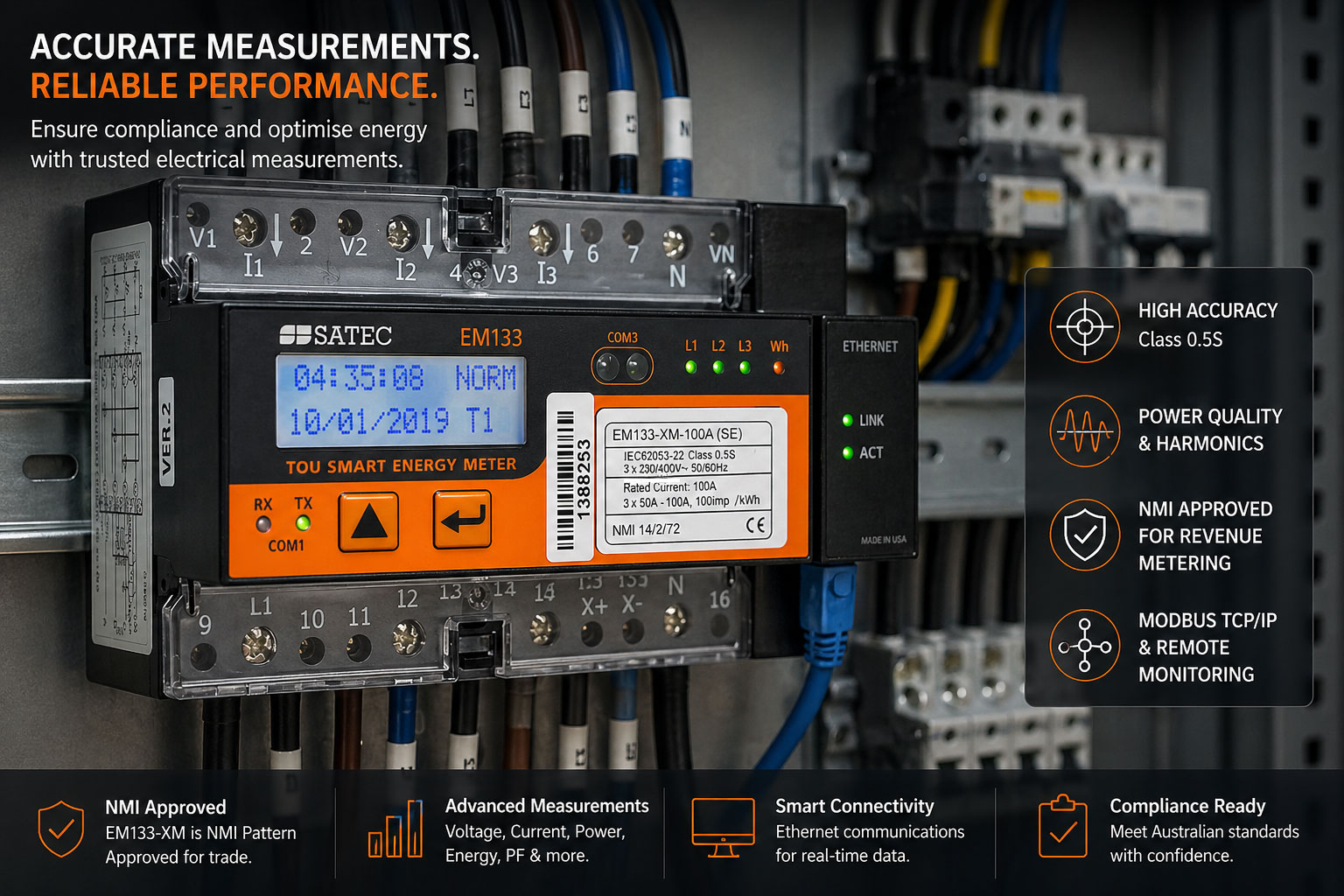
Any electricity meter used for billing or trade purposes in Australia must hold National Measurement Institute (NMI) pattern approval under NMI M 6-1.
Power quality is now a compliance concern governed by the National Electricity Rules and the AS 61000 series, covering harmonics, voltage fluctuation and unbalance.
Smart meters are increasingly central to compliance, providing real-time data capture, remote access and auditable records aligned with NER Chapter 7 requirements.
The National Electricity Rules (NER) require interval data storage and remote communication capability for meters used in the National Electricity Market (NEM).
Participation in advanced energy markets such as Frequency Control Ancillary Services (FCAS) requires highly accurate and responsive metering that meets AEMO’s Market Ancillary Services Specification (MASS).
SATEC’s NMI-approved meters and Expertpower platform provide a verified, future-ready solution for Australian businesses needing billing accuracy, power quality monitoring and FCAS-capable measurement in a single integrated system.
Why Electrical Measurements Matter More Than Ever
Electrical measurements underpin billing accuracy, system performance, energy efficiency and participation in advanced energy markets such as demand response and FCAS.
Australia’s energy transition has introduced more distributed energy resources, EV charging infrastructure and complex building systems. This has increased the need for high-resolution and highly accurate measurements that can capture dynamic loads and power quality issues in real time. Poor measurement practices can lead to incorrect billing, undetected inefficiencies and non-compliance with regulatory frameworks.
Accurate and compliant measurement systems, by contrast, provide a foundation for smarter decision-making and long-term cost savings.
Key Standards Governing Electrical Measurements In Australia
Australia has a well-established framework for electrical measurements that combines national standards, regulatory requirements and industry guidelines.
Staying compliant means understanding how these layers interact.
National Measurement Institute (NMI)
The National Measurement Institute (NMI) regulates electricity metering used for trade. Any meter used for billing purposes must hold NMI pattern approval, assessed in accordance with NMI M 6-1 for active-energy electricity meters. Once approved, individual meters must also be verified under NMI NITP 14, with all test reports traceable by serial number.
This process ensures that electrical measurements meet strict accuracy and reliability requirements and provides confidence that energy data used in financial transactions is fair and consistent. It is worth noting that not all meters need to be pattern approved. Meters used solely for energy management and not for trade or billing are generally exempt, so understanding where pattern approval applies can avoid unnecessary cost.
Australian Standards And IEC Alignment
Electrical measurements in Australia are shaped by international IEC standards and their local Australian equivalents. Power quality measurement, for example, is governed by the AS 61000 series.
Instruments used for compliance-grade monitoring should meet Class A requirements under IEC 61000-4-30 (adopted in Australia as AS 61000.4.30), which defines measurement methods for parameters including voltage variations, frequency deviations, harmonics, interharmonics, voltage unbalance and flicker.
Compliance with these standards ensures that measurement systems are not only accurate but also safe and interoperable across different applications.
National Electricity Rules (NER)
The National Electricity Rules define how electrical measurements are used within the National Electricity Market (NEM). NER Chapter 7 and Schedule 7.4 set out requirements for metering installations, data collection and communication. Type 4 metering installations used in the NEM must incorporate features including a real-time clock, interval data logging, remote communications and disconnect and reconnect capability.
For larger sites or those participating in energy markets, compliance with the NER is critical. It governs how measurement data is validated and shared with market operators.
State-Based Regulations
Each state may impose additional requirements relating to electrical measurements, particularly for safety and licensing. In New South Wales, this includes compliance with local electrical safety regulations and installation standards.
Understanding these nuances is important for projects that span multiple jurisdictions.
What Has Changed In 2026?
The regulatory environment has not been static. Several key developments have shaped the standards and compliance landscape in recent years.
Greater Emphasis On Data Granularity
There is a growing expectation for more granular data. In Australia, peak demand charges are typically measured over 15 or 30-minute intervals depending on meter type and there is increasing appetite for even finer-resolution data to support better demand management and more accurate forecasting.
In December 2025, the AEMC published final rules requiring that all new smart meters installed from 30 November 2028 must have the capability to wirelessly communicate real-time data to consumers and their appointed representatives. This reflects a broader push toward greater data transparency and consumer empowerment in the NEM.
Power Quality As A Compliance Priority
Power quality is now a central concern rather than a niche topic. Voltage fluctuations, harmonics and transient events can impact equipment performance and energy costs.
In Australia, power quality is governed by the National Electricity Rules and the AS 61000 series, which set limits for harmonic distortion, voltage fluctuation and unbalance. Businesses are increasingly expected to monitor and manage these parameters as part of their compliance obligations.
Integration With Digital Platforms
Electrical measurements are increasingly integrated into cloud-based platforms and energy management systems. Compliance now extends beyond hardware accuracy to include data integrity, cybersecurity and system interoperability.
Support For Advanced Energy Markets
Participation in FCAS markets requires highly accurate and responsive metering. AEMO’s Market Ancillary Services Specification (MASS) defines compliance for recording, requiring a response of less than 50 milliseconds for very fast and fast FCAS services. This demands both precision and reliability under dynamic conditions.
Comparison: Meter Compliance Requirements By Application
The table below summarises key compliance requirements across common metering applications in Australia.
| Application | NMI Approval Required? | Governing Standard | Interval Data Required? | Power Quality Monitoring? |
|---|---|---|---|---|
| Billing / trade metering | Yes | NMI M 6-1 / NITP 14 | Yes | Recommended |
| NEM connection point metering | Yes | NER Chapter 7 / Schedule 7.4 | Yes (≤30 min intervals) | Recommended |
| Sub-metering (energy management only) | Generally no | AS / IEC applicable standards | Varies by application | Recommended for sensitive loads |
| FCAS market participation | No | AEMO MASS / NER Chapter 7 | AEMO specification (≤50ms sampling) | Yes |
| Power quality compliance monitoring | No | AS 61000 series / IEC 61000-4-30 Class A or Class S | Yes | Yes (mandatory) |
| Embedded network tenant billing | Yes | NMI M 6-1 / NMI M 6-2 / NITP 14 | Yes | Recommended |
Common Compliance Challenges
Even experienced operators can encounter difficulties when dealing with electrical measurement compliance. Common issues include:
- Selecting meters that are not fit for purpose. A device that meets basic requirements may not satisfy the accuracy or functionality needed for advanced applications such as NEM participation or FCAS.
- Installation practices can also create problems. Incorrect wiring or configuration can compromise measurement accuracy even when the meter itself is fully compliant.
- Data handling is another area of risk. Inaccurate data logging or communication failures can lead to gaps in records that affect compliance and reporting obligations.
- Finally, many organisations struggle to keep pace with evolving standards. What was compliant a few years ago may no longer meet current expectations under the NER or the AS 61000 series.
The Role Of Smart Metering In Compliance
Smart meters have transformed how electrical measurements are captured and used. They provide real-time data, remote access and advanced analytics capabilities. These features make it easier to maintain compliance by ensuring that data is accurate, accessible and auditable. They also enable proactive management of energy use and system performance.
For meters installed in the NEM, NER Chapter 7 already requires features such as a real-time clock, interval data logging and remote communication. The December 2025 AEMC rule change requiring real-time wireless data capability in all new smart meters from late 2028 signals that these expectations will only increase.
Smart metering is no longer simply a convenience. It is becoming a baseline requirement for organisations that want to stay aligned with modern standards and regulatory expectations.
How SATEC Supports Compliance And Performance
SATEC’s range of smart meters is designed to meet the demands of electrical measurement in Australia. With NMI-approved models verified to NITP 14 under ISO 17025, the product range provides a strong, auditable foundation for billing, sub-metering and embedded network applications.
The meters deliver high accuracy and support bi-directional energy measurement, which is critical for sites with solar generation or battery storage. Class 0.5S accuracy is available for commercial and industrial installations and the product range is well suited to retrofit projects where space constraints and integration challenges are common.
Advanced power quality capability is also available across the SATEC range. Using Class A-compliant instruments ensures monitoring meets the accuracy requirements of AS 61000.4.30 and supports compliance reporting with distribution network service providers. This helps organisations identify power quality issues early and maintain system reliability.
For organisations participating or planning to participate in FCAS markets, the SATEC PRO Series provides precision frequency measurement with 0.002% accuracy and a resolution of 0.0001 Hz. Sampling at 20 ms intervals for Very Fast and Fast FCAS, the PRO Series meets AEMO MASS data recording requirements directly.
Beyond the hardware, the Expertpower cloud platform adds a further layer of capability. It provides automatic data collection from energy meters, customisable dashboards, multi-user access, and integration with third-party systems such as BMS and SCADA platforms. Rather than presenting raw numbers, the platform turns interval data into usable operational insight for energy management, billing, power quality analysis and demand monitoring.
Together, the metering hardware and Expertpower platform provide an integrated approach to electrical measurement that goes beyond compliance and supports ongoing energy strategy.
Staying Ahead Of Compliance Requirements
Electrical measurement standards will continue to evolve as energy changes. Staying ahead requires a proactive approach. Organisations should regularly review their metering systems to ensure they meet current requirements. This includes checking accuracy, functionality and data handling processes against the standards applicable to their specific application.
Investing in quality metering solutions is an important step. Reliable devices reduce the risk of errors and provide a stronger foundation for compliance. Training and awareness also matter. Teams need to understand how electrical measurements impact compliance and operational performance so that decisions are made on accurate information. Partnering with experienced providers can make a significant difference.
Turning Compliance Into A Competitive Advantage
Electrical measurements are no longer a background function. They are central to compliance, efficiency and participation in energy systems.
In Australia, the standards governing electrical measurements are becoming more rigorous and more closely tied to digital and market-driven outcomes. Organisations that invest in accurate, compliant and future-ready metering solutions will be better positioned to navigate this landscape.
With the right tools in place, electrical measurements can move from a compliance requirement to a strategic advantage.
FAQs - Electrical Measurements Standards And Compliance In Australia
Do all electricity meters in Australia need to be NMI pattern approved?
No. Pattern approval is required for meters used for trade or billing purposes but meters used solely for energy management and not connected to any billing function are generally exempt.
What is the difference between Class A and Class S power quality analysers?
Class A instruments provide the highest level of measurement accuracy under IEC 61000-4-30 and are required for compliance reporting, dispute resolution and regulatory applications, whereas Class S instruments are suited to general indicative monitoring where that level of precision is not mandatory.
What does FCAS metering compliance require in Australia?
Participation in FCAS markets requires metering that meets AEMO’s Market Ancillary Services Specification (MASS), including a sampling response of 50 milliseconds or better for very fast and fast FCAS services.
Can SATEC meters be used in retrofit projects where switchboard space is limited?
Yes. SATEC’s meter range is designed to work well in retrofit environments where space is constrained, and the Expertpower platform supports integration with existing building management and SCADA systems without requiring major infrastructure changes.
Explore related topics:
For Your Industry
- Multi-function Power Meters for Commercial Buildings
- Shadow Metering Solutions: Ensuring Fair Tenant Billing in Australia
Standards & Compliance
Related Reading
Trending in Your Sector


