
As substations across Australia become more digital, the need for fast and reliable communication between devices has become essential. Protection relays, energy meters, bay controllers and SCADA systems all need to exchange information clearly and in real time.
IEC 61850 is an international standard designed for communication networks and systems in electrical substations. It gives utilities, engineers and system integrators a common framework for how intelligent electronic devices communicate, share data and work together.
Instead of relying on a mix of vendor-specific protocols, IEC 61850 creates a more consistent and interoperable environment. That matters more than ever. Modern substations are expected to do far more than simple switching and protection. They need to support automation, improve visibility, handle growing data volumes and integrate into broader digital grid strategies.
Key Points
IEC 61850 is an international communication standard that defines how intelligent electronic devices in substations share data, creating a common language across protection, control and metering systems.
Unlike older protocols, IEC 61850 standardises both how data moves and what it means, reducing integration effort and improving interoperability between devices from different manufacturers.
Australia is among the most active adopters of IEC 61850, with the standard increasingly specified across transmission and distribution networks as the grid integrates more renewables and distributed energy resources.
IEC 61850 replaces expensive hardwired signalling with networked communication, reducing copper wiring, simplifying system architecture and streamlining substation design and commissioning.
Digital substations rely on IEC 61850 as a foundation, enabling faster information exchange, more intelligent automation and seamless integration across SCADA, protection and energy management systems.
SATEC power meters and analysers are fully compatible with IEC 61850, combining revenue-grade accuracy with Class A power quality analysis and Expertpower software to deliver the metering layer that makes digital substation infrastructure genuinely useful in practice.
What Is IEC 61850?
At its core, IEC 61850 is a communication standard for substation automation. It defines how data is structured, named and exchanged between devices inside the substation. That includes relays, meters, control systems, transformers and monitoring equipment.
What makes IEC 61850 different from older communication approaches is that it is not just a transport protocol. It also standardises the data model. In other words, it does not only describe how information moves. It also describes what that information means.
This is a significant shift. In a conventional setup, two devices might communicate successfully yet still require considerable engineering effort to interpret each other’s data correctly. With IEC 61850, the structure and meaning of the data are defined in a standardised way. That reduces integration effort and improves interoperability between devices from different manufacturers.
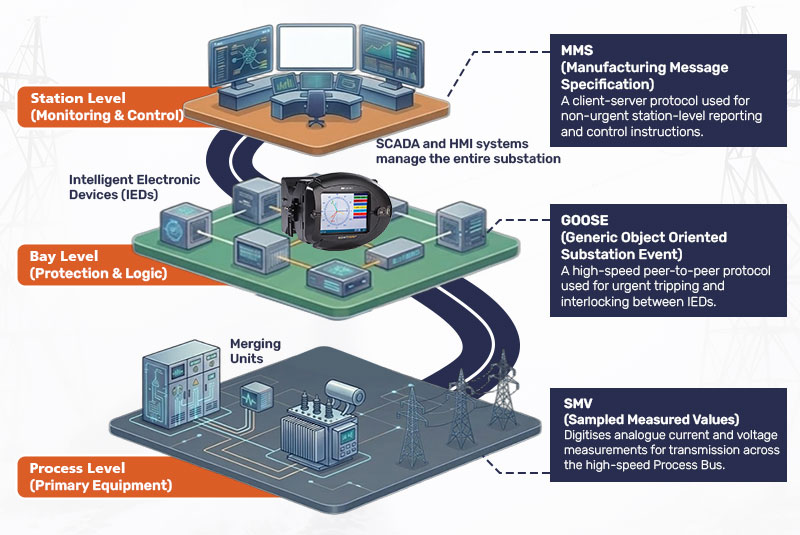
The standard also includes GOOSE messaging for fast event-based communication and Sampled Values for digital measurement streams. These capabilities are especially important in modern protection and control applications where timing and precision are critical.
Why Substations Need A Common Language
Substations contain many devices that must coordinate quickly and accurately. A protection relay may detect a fault and send a trip command. A meter may record the event and provide supporting data. A SCADA system may need to display alarms and status changes immediately. If all of these systems speak different languages, engineering becomes more complex and operations become harder to manage.
IEC 61850 provides that common language. It allows devices to exchange information in a structured and understandable way across the entire system. This brings practical benefits during both project delivery and long-term operation.
Interoperability is one of the biggest advantages. Utilities are not locked into a single vendor ecosystem just to make their substation work. Engineers can design systems with more flexibility and choose best-fit components for protection, metering and control. It also improves scalability.
As substations evolve, new devices can be added more easily when they follow the same standard. This is particularly valuable for Australian utilities modernising legacy sites in stages rather than replacing everything at once.
Why IEC 61850 Matters In Real-World Substations
The value of IEC 61850 is not limited to theory. It solves real substation problems. Traditional hardwired signalling can be expensive, time-consuming and difficult to expand. IEC 61850 enables more data to move over networked infrastructure which reduces copper wiring and simplifies system architecture.
This has already been demonstrated in Australian projects such as AusNet’s first end-to-end IEC 61850 substation, where the shift to fibre communications and GOOSE messaging delivered a faster and more cost-effective result than older systems.
It also improves engineering consistency. The use of standardised naming conventions and Substation Configuration Language (SCL) helps streamline design, documentation and commissioning. Teams can work from a shared structure rather than rebuilding project logic from scratch each time.
Modern substations need detailed operational and power quality data, not just basic status points. IEC 61850 makes it easier to bring rich information into higher-level systems where operators and engineers can use it for diagnostics, analysis and asset management.
Finally, it supports the transition to digital substations. As utilities adopt process bus architectures, advanced monitoring and more intelligent automation, IEC 61850 becomes a foundation for the entire system.
IEC 61850 And The Australian Energy Transition
Australia is among the most active adopters, with the standard increasingly specified for both greenfield and upgrade projects across the transmission and distribution network. This aligns with the broader push from network operators and the Australian Energy Market Operator (AEMO) to modernise the grid as it integrates more distributed energy resources, utility-scale renewables and battery storage.
The challenges facing the Australian grid are significant. Networks are becoming more dynamic as rooftop solar, grid-scale wind and storage change the way power flows. Substations need to respond faster and provide greater visibility across the network. IEC 61850 gives engineers the communication framework to support these demands without the constraints of legacy proprietary systems.
Cybersecurity is also a growing consideration in Australian critical infrastructure. IEC 61850 works alongside the IEC 62351 standard series to support secure data exchange between devices, which is increasingly important as substations become more networked and interconnected.
The Link Between IEC 61850 And Digital Substations
A digital substation is not simply a substation with more equipment. It is a substation where information is available faster, decisions can be made with better context and integration across systems is more seamless. IEC 61850 gives engineers the framework to build toward that outcome.
Utilities across Australia are under pressure to modernise networks while maintaining reliability and controlling costs. IEC 61850 supports that by enabling digital workflows, richer data exchange and more integrated system design. It is widely recognised as a key enabler of the digital substation and its importance will only grow as grid complexity increases.
Where Metering Fits In
Metering is sometimes treated as a separate layer from protection and control. In reality, it plays an important role in modern substations. Operators need accurate electrical measurements for visibility, analysis, compliance, fault review and energy performance. They also need that information to flow into SCADA, energy management systems and other platforms without unnecessary complexity.
That is why metering solutions that support IEC 61850 are increasingly important. A meter in a modern substation should do more than capture values locally. It should communicate in a standardised way, fit into the broader automation architecture and provide meaningful data where it is needed. When metering is aligned with IEC 61850, the result is a cleaner integration path and a more coherent digital infrastructure.
Why SATEC Is The Metering Solution
For substations adopting this communication method, SATEC offers a strong fit as the metering solution. SATEC’s range includes advanced power meters and analysers designed for utility and substation environments where communication, visibility and power quality all matter.
The SATEC PRO Series and PM180 are fully compatible with IEC 61850 and support GOOSE messaging, allowing them to function as active communication nodes within the substation network. These meters combine revenue-grade accuracy (Class 0.2S per AS 62053-22) with Class A power quality analysis and event recording.
They also support dual-port Ethernet and multiple protocols including DNP3 and IEC 60870-5-101/104, making them well suited to the mixed-protocol environments common in Australian substations where legacy and modern systems coexist.
In many substations, engineers need more than simple energy metering. They need detailed power quality insight, fault recording and integration into wider monitoring and control systems. That is where SATEC adds value. Its products support the kind of rich data environment that makes IEC 61850 genuinely useful in practice.
SATEC also complements its hardware with Expertpower software, giving users a way to visualise data, analyse performance and turn measurements into operational insight. That makes the solution stronger for utilities and asset owners who want metering to support both day-to-day operation and broader energy intelligence.
In short, IEC 61850 creates the communications framework and SATEC provides the metering layer that helps make that framework useful.
Why IEC 61850 Will Keep Gaining Importance
The shift toward automation, interoperability and digital grid infrastructure is not slowing down. Across Australia and globally, utilities want substations that are easier to integrate, easier to scale and better equipped for future demands. IEC 61850 supports all three.
Substations are no longer isolated technical assets. They are becoming data-rich operational hubs within a larger intelligent network. A standard that improves communication, simplifies integration and supports digital architecture has a clear long-term role.
For Australian utilities, consultants and engineers planning new projects or upgrading existing sites, understanding IEC 61850 is no longer optional. It is part of building substations that are ready for the future.
FAQs - IEC 61850
What is IEC 61850 used for?
IEC 61850 is used to standardise communication between devices in substations such as protection relays, meters and control systems. It helps these devices exchange data more efficiently and work together within a unified automation framework.
Why is IEC 61850 important in substations?
IEC 61850 is important because it improves interoperability, reduces integration complexity and supports faster more reliable communication. It also provides a strong foundation for digital substations and smarter grid operations.
Does IEC 61850 only apply to new substations?
No. IEC 61850 can also be used in retrofit projects where utilities are upgrading existing substations in stages. It helps modernise communication and integration without requiring a complete rebuild from scratch.
How does SATEC fit into an IEC 61850 substation?
SATEC provides metering solutions that support modern substation environments where accurate data and system integration are essential. Our energy meters and Expertpower software help turn electrical measurements into useful operational insight.


