

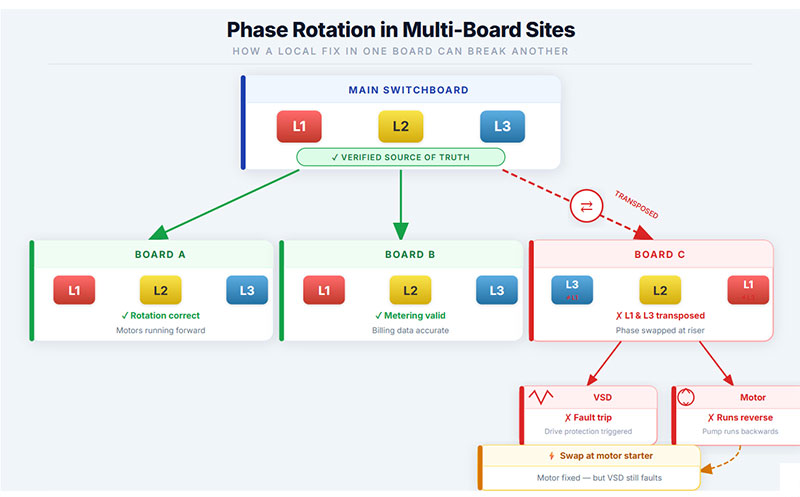
Multi-board electrical sites are full of good intentions and hidden complexity. A new tenancy fit-out gets energised. A switchboard extension is added. Someone upgrades a meter, replaces CTs or reconnects a generator changeover. Everything looks tidy — then a pump runs backwards, a VSD starts faulting or the building management system throws alarms that make no sense.
In a single-board installation, phase sequence mistakes are often obvious and local. In multi-board sites, phase rotation errors can ripple across switchboards, interconnects and loads in ways that are surprisingly hard to diagnose. The frustrating part is how often the “fix” happens in the right place for one problem and accidentally creates a new one somewhere else.
This post walks through why that happens, what to look for and how to stop phase rotation from becoming a recurring commissioning headache.
Key Points
Phase rotation errors in multi-board sites can ripple across switchboards, interconnects and loads, making faults hard to trace back to the original change.
Swapping two phases “locally” can fix a backwards motor while creating inconsistent phase identity for other downstream equipment on the same feeder.
Bus couplers, multiple incomers and generator/ATS changeovers amplify the risk when phase sequence is not consistent across all supply paths.
Incorrect phase sequence can silently corrupt metering and monitoring, producing plausible-looking data that drives wrong decisions for billing and fault finding.
Preventing recurring issues requires a system approach: set an MSB “source of truth”, verify at board boundaries and both ends of critical feeders and re-validate metering after any phase work.
SATEC’s NMI-approved metering, compact hardware, power quality monitoring and Expertpower software help keep multi-board sites visible, consistent and defensible.
Why Phase Rotation Becomes A Multi-Board Problem
Phase rotation, also called phase sequence, is the order in which the three phases reach their voltage peak. In Australia, conductors are typically labelled L1, L2 and L3.
In older installations wired to the pre-2000 standard, you may encounter red, white and dark blue conductors. Post-2000 installations harmonised with international standards use brown, black, and grey. Swap any two phases and the rotation reverses. That can change motor direction, confuse some protection schemes and scramble metering assumptions.
In multi-board sites, phase rotation is not just “a supply thing.” It is also a distribution and documentation thing. A typical commercial or industrial site in Australia might include:
- A main switchboard (MSB) with multiple outgoing feeders
- One or more distribution boards (DBs) on different floors or zones
- Tenant boards with their own isolation and metering
- Mechanical services boards for HVAC, pumps and lifts
- A generator or UPS with changeover or automatic transfer switch (ATS)
- Bus couplers or interconnects that allow reconfiguration.
Every interconnect is an opportunity for phase identity to drift away from the labels on the door.
How Fixes In One Board Can Break Another
A common scenario starts with a simple symptom: a motor runs backwards after new work.
The quickest field fix is also the most tempting… swap two phases at the motor starter or at a local isolator. That approach can solve the immediate mechanical problem and still create problems elsewhere, especially when the affected feeder supplies multiple loads or when downstream boards share common references for protection or monitoring.
Local Phase Swaps Can Create Inconsistent ``Truths`` Across The Site
A swap at one local point does not just change rotation for one motor. It changes rotation for everything downstream of that swap.
If the same feeder also supplies a VSD panel, a metering point, a control transformer feeding interlocks or another sub-board serving different equipment, then rotation may now be “correct” at one load and “wrong” at another, depending on where the swap was made.
Multi-board sites often end up with islands of correct rotation that do not match each other. Maintenance teams then inherit a site where L1-L2-L3 means different things in different places, even though the labels look consistent.
Bus Couplers And Changeovers Amplify The Risk
Sites with a bus coupler or multiple incomers, introduce another layer of complexity. Rotation needs to match when switchboards are paralleled or transferred.
If one incomer (or one section of the bus) has a different phase sequence, closing a coupler can cause serious issues. Some systems will block the operation. Others will trip protection. Some will allow a transfer that leads to immediate equipment faults.
Generator changeovers are a classic trouble spot. A generator can be electrically healthy and still be connected with the wrong phase rotation relative to the building supply.
Metering And Monitoring Can Be Silently Corrupted
One of the most costly outcomes of phase rotation errors is not a trip or a fault. It is bad data that looks plausible.
Energy meters and power quality monitors rely on consistent assumptions about which voltage corresponds to which current (phase mapping), CT polarity and orientation and the expected relationship between phase angles. A local phase swap can produce readings that appear reasonable while being wrong enough to cause real downstream decisions such as tenant billing, load balancing, demand management or fault investigations to be based on inaccurate data.
Common clues include power factor that suddenly shifts for no operational reason, kilowatts appearing on the “wrong” phase or directionality that flips in ways that do not match the site’s actual import or export behaviour.
Why Multi-Board Sites Are Uniquely Prone To Phase Rotation Errors
The root causes tend to be straightforward, repeatable and human.
Documentation drift. Switchboards evolve over years. Labels and single-line diagrams do not always keep up with modifications.
Colour assumptions. Australian wiring has seen two distinct colour conventions – the pre-2000 red, white and dark blue system and the post-2000 harmonised brown, black and grey system.
On any site with a mix of old and new work, conductor colour alone is not a reliable guide to phase identity. Labels and testing beat colour memory every time.
Staged works. A retrofit might involve temporary supplies, partial energisation and multiple handovers. Phase identity can change between stages without anyone noticing.
Multiple contractors. Different teams work on different boards. Each team solves their local problem and nobody validates the whole-of-site phase truth after the works are complete.
A Practical Approach To Preventing Cross-Site Problems
Multi-board sites need a method that treats phase rotation as a system property, not a local wiring detail.
Start With A Single Source Of Truth
Pick the MSB incomer as the reference and verify its phase sequence with a proper phase rotation tester or analyser. Mark it clearly. From that point, verify phase identity at each downstream board in a structured order.
A simple habit helps: treat every board boundary like a border crossing. Verify what you think is happening before you allow the next step.
Verify At Both Ends Of Critical Feeders
Long runs, risers and intermediate terminations all create opportunities for phase transposition. Verification at the MSB does not guarantee correctness at the DB.
Critical feeders to check include mechanical services and pump boards, lift supplies, fire system interfaces, generator and ATS connections and any switchboard that feeds other switchboards.
Fix At The Right Location, Not The Fastest Location
Swapping phases at the motor starter solves one symptom. Fixing rotation at the board origin keeps the site consistent.
The right location is usually the point where phase identity first becomes wrong – often a termination, a changeover or a switchboard extension. Correcting it upstream preserves a consistent phase map for everything downstream, including metering.
Re-Validate Metering After Any Phase Work
Phase rotation errors and metering errors go hand in hand. Any time phases are swapped, re-check voltage-to-current mapping, CT orientation and polarity, total kW and kVA sanity checks against known loads and phase angles and balance.
This step protects tenant billing integrity and avoids long-term analytics problems.
Where SATEC Fits: Metering That Keeps Multi-Board Sites Honest
Multi-board sites live or die by visibility. When phase identity, energy data and power quality are aligned, commissioning gets faster and troubleshooting becomes far less chaotic.
SATEC’s metering solutions are designed for exactly these environments, especially retrofits where space is tight and accuracy matters.
Accurate, compliant metering at key board boundaries.
SATEC supplies National Measurement Institute (NMI) approved energy meters suitable for applications where metering integrity is essential, including tenancy sub-metering and site-wide monitoring.
NMI approval means meters meet Australian trade measurement requirements and are verified against NMI M 6-1 standards, making readings defensible for billing purposes.
Compact hardware for real switchboard realities.
Multi-board upgrades often happen in crowded switchboards. Compact metering options help reduce the “we can’t fit it” compromises that lead to messy installs and future errors.
Power quality visibility where faults actually happen.
Phase rotation errors often show up alongside other issues – unbalance, transients or nuisance trips. Adding SATEC power quality monitoring at the right points helps separate wiring problems from genuine supply or load problems.
Expertpower software for consistent reporting.
Expertpower cloud software supports centralised visibility of energy and electrical performance so anomalies stand out sooner.
When phase mapping is validated and metering is consistent, your reports, alarms and dashboards become reliable tools rather than noise.
The best outcome is a site where phase sequence checks, metering validation and ongoing monitoring reinforce each other. That is how you avoid the cycle of “fix, break, repeat” across multiple boards.
A Smarter Commissioning Mindset For Complex Sites
Multi-board sites reward discipline. A local fix might solve a local symptom and still leave the site less stable than it was before. A system-level approach makes phase rotation a one-time problem instead of a recurring surprise.
Phase rotation errors are easy to prevent when the site has a clear reference, verified board-to-board identity and metering that reflects reality. That combination saves time during commissioning, prevents equipment damage and keeps energy data trustworthy long after the contractors have packed up.
FAQs - Phase Rotation Errors in Multi-Board Sites
What are phase rotation errors?
Phase rotation errors happen when two phases are swapped, reversing the phase sequence and potentially causing motors to run backwards, protection to misoperate or metering to read incorrectly.
Why do phase rotation errors cause problems in multi-board sites?
Multi-board sites have multiple distribution points and interconnects, so a phase swap in one location can create inconsistent phase identity downstream and trigger faults “somewhere else.”
Can I fix phase rotation errors by swapping two phases at the motor?
Swapping two phases at the motor can correct rotation for that single load but it can also create mismatches for other downstream equipment and corrupt metering or control assumptions.
How can I confirm phase rotation is correct across multiple boards?
Verify phase sequence at the main switchboard first, then test at each downstream board and critical feeder end and re-check metering phase mapping after any phase changes.