

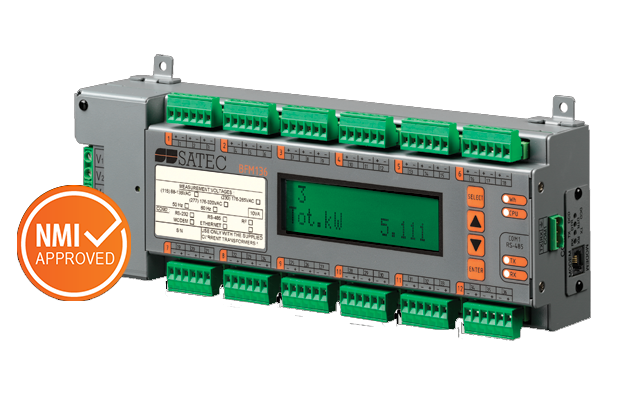
NABERS rating for data centre power metering, load management and performance has been introduced to encourage improved environmental performance within the commercial built arena, improving innovation and outcomes for reducing energy consumption and reduced green-house gas (GHG) emissions. SATEC’s solution with the BFM136 for multiple circuit metering leads the market in performance metering.
The BFM136 can meter up to 36 single phase electrical loads, or 12 three phase loads or a combination of both using SATEC current sensors (HACS) in a compact Din Rail or Wall mounted design. Together with SATEC current transformers/HACS (current sensors) monitoring of loads can be as low as 50 milliamps up to 3000 Amps providing a metering solution unequal in low load monitoring performance. In addition, the BFM136 has been designed to withstand 12KV impulse testing as required by National Measurement Institute of Australia (NMI).
SATEC metering is used in many electrical metering applications, including industrial and commercial smart metering for energy profiling, load management and electricity billing solutions.
Find more about data centre power metering, visit our BFM136 Multi-Channel Energy Meter page. View the BFM136 Multi Channel Energy Meter Datasheet.
Explore related topics:
For Your Industry
- How To Improve Load Factor And Reduce Electricity Demand Charges In Australia
- How To Find Phantom Loads Using Smart Metering Data
Standards & Compliance
- Is Your Building Compliant? NCC J9 Energy Monitoring Requirements Explained
- NCC J9D3 Sub-Metering Guide: HVAC, Lighting & Lift Compliance for Commercial Buildings
- Green Star Compliant Metering Systems: Complete Guide for Commercial Buildings
Related Reading
- Building Energy Management Analytics: The Complete Guide for Commercial Buildings
- Neutral Current Monitoring For Commercial Buildings: What It Is And How To Do It Well
Trending in Your Sector
- 3 Phase Electricity Meter: What It Is, How It Works and When You Need One
- Three Phase Electric Meter vs Single Phase Meter: What’s the Difference?
Trending Outside Your Sector


