

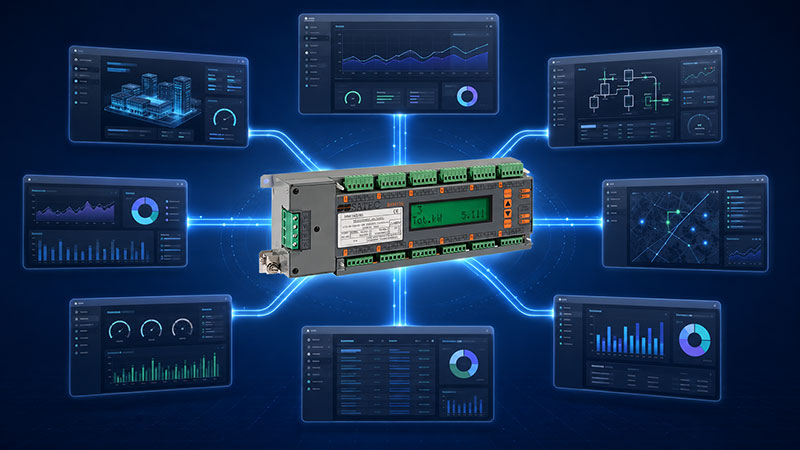
Energy data is becoming more valuable across commercial buildings, infrastructure, industrial sites, embedded networks and large multi-tenant facilities. It supports billing, reporting, sustainability goals, asset management, power quality investigations and smarter operational decisions.
Yet one important question is often overlooked when a site is choosing energy metering hardware: Can the meter work with other software platforms which a customer may have a preference to use?
This is where energy metering with third-party software becomes important. A meter should not trap valuable energy data inside a closed ecosystem. It should give customers, consultants, contractors and facility managers the freedom to send accurate data into the software platform systems of their choosing.
For some customers, a complete hardware and software package makes sense. For others, the building already has a BMS, EMS, SCADA platform, tenant billing system or corporate sustainability dashboard in place.
In those cases, the role of the meter is not to force a new platform into the project. Its role is to measure accurately, communicate reliably and make energy data available where it is needed.
Key Points
Energy data from metering hardware should be accessible across the platforms that best suits the customer, not locked into a single software ecosystem.
Many Australian commercial, industrial and infrastructure sites already have BMS, SCADA or EMS platforms in place. Flexible meters integrate with these rather than replacing them.
Closed metering ecosystems create long-term risk. When meters only work properly with one platform, customers face limited options for integration, reporting and future growth.
Open protocol support including Modbus, DNP3 and IEC 61850, is what determines whether a metering investment remains useful as site requirements evolve.
Metering flexibility is especially important for multi-site organisations, where different locations may use different software platforms but still need consistent, accurate measurement at the hardware layer.
SATEC meters support both pathways: customers can use Expertpower as an integrated platform or connect SATEC hardware into third-party software systems, giving consultants and facility managers genuine design freedom.
Why Flexibility Matters in Modern Energy Projects
Energy projects rarely exist in isolation. A commercial office building may need energy data for NABERS reporting, tenant billing, solar performance tracking and HVAC optimisation. A data centre may need branch circuit data for capacity planning, tenant accountability and infrastructure monitoring. A hospital or industrial site may need power quality data, demand data and alerts connected into existing operational systems.
In these environments, a single software platform may not do everything. Different teams often rely on different tools. Facilities teams may use one platform, finance may use another and sustainability teams may report through a corporate system used across multiple sites.
This is why metering flexibility matters. When hardware can communicate with third-party software, the customer is not forced to change their entire digital environment just to access metering data. Instead, the metering layer can fit into the existing project architecture.
That is a much more practical approach for real-world Australian sites where systems, contractors, consultants and operational requirements are often already well established.
The Problem With Closed Metering Ecosystems
A closed metering ecosystem can seem convenient at first. The hardware and software are bundled together, the sales message is simple and the project may appear easier to specify. The problem emerges later when the customer wants to change, expand or integrate.
If meters only work properly with one software platform, the customer may have limited options. They may struggle to connect data into a BMS, export information into a reporting tool or use a different energy management platform across a broader portfolio. They may also face higher switching costs if their needs change.
This can become especially frustrating for customers who already have capable software in place. Forcing another platform into the mix may create duplication instead of clarity. It can also mean additional logins, extra training and more data silos.
Energy hardware should support long-term flexibility. Meters are often installed inside switchboards, distribution boards and critical infrastructure where replacement is not as straightforward as changing a software subscription. That makes the hardware decision especially important. The meter should remain useful even if the software environment changes around it.
Your Meter Should Serve Your Data Strategy
A good metering strategy starts with a simple principle: the customer owns the data.
That data should be available for the customer’s chosen purpose. It may need to support energy monitoring, cost allocation, emissions reporting, tariff analysis, billing validation, load studies or power quality investigations. It may need to be viewed in Expertpower, a third-party EMS, a BMS, a SCADA system or a custom reporting platform.
The software layer should be a choice, not a restriction.
This is especially relevant for consultants and electrical contractors designing systems for long-term operation. They need metering hardware that can support the immediate project requirements while leaving room for future changes. Today’s brief may focus on tenant billing. Tomorrow’s priority may be demand response, electrification, solar integration, battery monitoring or ESG reporting.
Metering with third-party software helps make that possible. It allows the metering infrastructure to remain useful as site priorities evolve.
Integration Is Not Just a Technical Detail
It is easy to treat integration as a background technical issue. In reality, it has a direct impact on project outcomes.
When metering hardware can communicate effectively with other platforms, data becomes easier to use across the business. Facility managers can make better decisions. Consultants can design more flexible systems. Contractors can deliver solutions that fit existing site infrastructure. Customers can avoid being locked into a single pathway.
Reliable integration also reduces frustration after handover. A site may have accurate meters installed yet still fail to gain value from the data if that information cannot be accessed in the right place. Good metering is not just about measuring energy. It is about making that information available in a useful and practical way.
That is why protocol support, communications options and system compatibility matter. They may not sound as compelling as a dashboard but they are often what determines whether a metering project remains valuable over time.
Open vs Closed Metering: A Comparison
| Feature | Open/Flexible Metering | Closed Metering Ecosystem |
|---|---|---|
| Software compatibility | Works with multiple third-party platforms | Tied to one proprietary platform |
| BMS/SCADA integration | Supported via open protocols (Modbus, DNP3, IEC 61850) | Limited or requires additional gateways |
| Tenant billing flexibility | Data can feed into multiple billing platforms | Restricted to bundled billing tools |
| Multi-site portfolio management | Sites can use different software while using consistent hardware | May require uniform software across all sites |
| Future-proofing | Hardware remains useful as software evolves | Platform changes may require meter replacement or workarounds |
| Consultant/contractor design freedom | High — hardware fits around the project architecture | Low — project must fit around the platform |
| Switching costs | Low — software can change without replacing meters | High — platform dependency limits options |
| Data ownership | Customer controls data and destination | Platform may limit data portability |
Where Expertpower Fits
SATEC offers Expertpower as a powerful cloud energy management platform for customers who want a complete SATEC hardware and software solution. Expertpower can support energy monitoring, reporting, billing insights, alerts and broader visibility across sites.
The important distinction is that SATEC meters are not only for Expertpower.
Customers can choose Expertpower when it suits their needs or they can use SATEC hardware with third-party software platforms where the project requires it. This gives customers more control over their energy data strategy. It also gives consultants and contractors greater flexibility when designing metering systems for different environments.
This approach is especially useful when a customer already has existing systems in place. Rather than replacing or duplicating those systems, SATEC meters can form part of a broader integrated solution where the hardware layer remains consistent and the software layer reflects what the site actually needs.
SATEC Products as the Energy Metering Solution
The SATEC hardware range is well suited to projects where accurate metering and flexible communication are both essential.
EM133-XM
The EM133-XM provides NMI Pattern Approved metering under NMI M 6-1 for applications where billing-grade accuracy and compliance are required. It is suitable for commercial, industrial and multi-tenant environments where dependable electrical measurement is critical. Communication options include RS485 as standard, with optional Ethernet, making it straightforward to integrate with Expertpower or third-party platforms via Modbus.
BFM136
The BFM136 is also NMI Pattern Approved under NMI M 6-1 and is a strong fit for projects that need multi-circuit monitoring in limited switchboard space. It can monitor up to 12 three-phase circuits or 36 single-phase circuits from a single compact device. That makes it especially useful for retrofit projects, tenant energy monitoring, branch circuit visibility and applications where installing many individual meters would add unnecessary complexity. Data can be sent to SCADA, BMS and EMS systems via RS485 or optional Ethernet using Modbus protocols.
PRO Series (PM335 and EM235)
The PRO Series power analysers (EM235 and PM335) offer Class 0.2S accuracy combined with Class A power quality analysis per IEC 61000-4-30 Edition 3.1. These devices support a wide range of communication protocols including Modbus, DNP3, IEC 61850 and IEC 60870-5-101/104. That makes them highly adaptable for integration into SCADA systems, BMS platforms and substation automation architectures. Both the PM335 (panel mount) and EM235 (DIN-rail) form factors are available.
PM180
The PM180 is a Class A power quality analyser per IEC 61000-4-30 Edition 3. It is suited to industrial, utility and critical infrastructure applications where detailed visibility of voltage events, harmonics, fault recording and demand behaviour is required. The PM180 supports Modbus, DNP3, IEC 60870-5-101/104 and optional IEC 61850, allowing direct integration with existing SCADA and substation architectures. Across the range, all meters are designed to support practical integration into wider energy systems. They can be used with Expertpower or connected into third-party software platforms depending on project requirements.
For customers, this creates a flexible metering foundation. For consultants, it provides design freedom. For contractors, it supports more practical delivery. For building owners and operators, it helps ensure energy data remains usable beyond the first software decision.
Better Outcomes for Multi-Site and Mixed-System Environments
Many organisations do not manage just one site. They may operate offices, industrial facilities, retail sites, hospitals, campuses, data centres or distributed infrastructure across multiple locations. These sites may not all use the same software platform.
A rigid metering approach can make portfolio-wide energy management harder. Flexible hardware makes it easier to standardise the metering layer while still allowing different sites to connect with the software platforms that suit them.
This is valuable for organisations that are growing, upgrading older buildings or working to bring more consistency to energy reporting. It also helps when different assets have different requirements. A tenant billing site may need one type of data workflow while a critical infrastructure site may need deeper power quality monitoring and operational alerts.
Metering with third-party software allows the hardware to support these different needs without forcing every site into the same software model.
Choosing Energy Hardware With the Future in Mind
Software changes quickly. Buildings change too. Tenants move, loads increase, EV chargers are added, solar and batteries become part of the energy mix and reporting requirements become more detailed.
Meters are a longer-term infrastructure decision. Once installed, customers should be able to keep using them as their systems evolve. That is why flexibility should be considered at the specification stage rather than after installation.
A meter that can communicate with third-party platforms gives the customer more options over time. It reduces the risk of being locked into one software environment and supports a more open, adaptable approach to energy management.
A Smarter Way to Think About Metering
The best metering solution is not always the one that comes with the most tightly bundled software. It is the one that gives the customer accurate data, reliable communications and the freedom to use that data where it delivers the most value.
SATEC’s approach supports both pathways. Customers can use Expertpower when they want an integrated SATEC platform or they can connect SATEC hardware with third-party software when that better suits the project.
That flexibility matters. It respects the customer’s existing systems, supports future growth and makes metering infrastructure more valuable over the long term.
Your meter should not dictate your platform. Your meter should support your data strategy.
FAQs - Your Meter, Your Data, Your Platform: Why Energy Hardware Should Work With Third-Party Software
Can SATEC meters connect to platforms other than Expertpower?
Yes. SATEC meters support open communication protocols including Modbus, DNP3 and IEC 61850, which allow them to integrate with a wide range of third-party platforms including BMS, SCADA and EMS systems.
What is the risk of choosing a closed metering ecosystem?
If meters only function properly with one software platform, customers can face significant constraints when they want to change software, integrate additional systems or manage energy data across a broader portfolio. Hardware replacement is also far more disruptive and costly than changing software.
Which SATEC meters are NMI Pattern Approved for billing purposes in Australia?
The EM133-XM and BFM136 are both NMI Pattern Approved under NMI M 6-1, making them suitable for trade measurement and tenant billing applications in Australia.
Why does third-party software integration matter for multi-site organisations?
Different sites within a portfolio often use different operational platforms. Flexible metering hardware allows consistent, accurate measurement at every site while still connecting into whichever software platform that site uses — without forcing a single software model across the entire organisation.


