

Australia is home to one of the world’s most dynamic electricity networks. With rooftop solar on nearly one in three homes, rapidly growing EV charging infrastructure and an ever-increasing mix of power electronics in commercial and industrial buildings, Australian electrical systems are under more pressure than ever before.
One of the most significant yet least visible threats to system reliability is harmonic distortion. Left unmanaged, harmonic distortion causes overheating in transformers and cables, nuisance tripping, equipment failures and avoidable energy losses. It can affect sites of all types, from warehouses and shopping centres to hospitals and data centres. The problem is that it often goes undetected until the damage is already done.
This article explains what harmonic distortion is, why it is becoming more common in Australian conditions and why real-time power quality monitoring is the most effective way to manage it.
Key Points
Harmonic distortion occurs when non-linear loads distort the electrical waveform, creating heat, instability and equipment damage across commercial and industrial sites.
Australia’s rapid uptake of rooftop solar, EV chargers and variable speed drives is accelerating harmonic distortion across the National Electricity Market.
The relevant Australian standard for harmonic voltage distortion is AS 61000.3.6, with a maximum Total Harmonic Distortion (THD) of 8% for low voltage systems
Occasional or portable testing is no longer sufficient. Harmonic distortion varies with time of day, season, load changes and generation output, and can only be reliably tracked with continuous monitoring.
Real-time power quality monitoring turns harmonic distortion from a hidden liability into measurable, actionable data that supports maintenance planning, fault response and regulatory compliance.
SATEC’s IEC 61000-4-30 Class A certified power quality meters, paired with Expertpower software, give Australian facilities a compliant, scalable and audit-ready monitoring solution backed by nearly 50 years of expertise.
What Is Harmonic Distortion?
In a healthy AC electrical system, voltage and current follow a smooth sinusoidal waveform. In Australia, the fundamental frequency is 50 Hz. Harmonic distortion occurs when this waveform is no longer clean because non-linear loads draw current in pulses rather than continuously. This creates additional frequencies that are integer multiples of the fundamental, such as 150 Hz (3rd harmonic), 250 Hz (5th harmonic) and beyond.
The standard measure of this distortion is Total Harmonic Distortion or THD. Current harmonic distortion increases heating and losses in cables, transformers and switchgear. Voltage harmonic distortion can affect the performance of equipment across the wider network. Under AS 61000.3.6, the relevant Australian standard for harmonic voltage distortion, the maximum THD permitted for low voltage systems is 8%.
In practice, many sites already operate closer to this limit than their teams realise, particularly as non-linear load density increases.
Why Harmonic Distortion Is Growing in Australia
Australia’s energy landscape is changing faster than most. The country is the global leader in rooftop solar per capita, with 26.8 GW of installed capacity across 4.2 million homes and small businesses as of mid-2025. Add to this the rapid uptake of battery energy storage systems, EV chargers, variable speed drives and LED lighting and the electrical profile of a typical Australian commercial or industrial building looks very different from what it did a decade ago.
Each of these technologies relies on power electronics. Each can introduce harmonic distortion into the local network. Individually, a single device may meet all relevant standards. Cumulatively, across a busy commercial building or industrial site, the combined harmonic load can push the network toward or beyond acceptable limits.
Industrial sites face particular challenges. Variable speed drives, rectifiers, welders and automation equipment are all common sources of harmonic current. Commercial buildings are not immune. Office equipment, HVAC controls, LED drivers and EV chargers all contribute to the problem. Critical environments such as hospitals, data centres and pharmaceutical manufacturing facilities have even less tolerance for poor power quality because the operational consequences of equipment failure are severe.
The question is no longer whether a site has harmonic distortion. Most do. The question is whether it is within limits, whether it is trending upwards and whether it is starting to affect reliability.
The Problem with Occasional Testing
Traditional power quality investigations typically involve a specialist visiting site, connecting a portable analyser and recording data for a short period. This approach can be valuable when there is a known and active issue but it captures only a snapshot of a system that is constantly changing. Harmonic distortion is not static. It varies with time of day, occupancy, production cycles, weather and changes in both load and generation.
A test conducted on a Tuesday morning may not capture the conditions that occur when EV chargers operate at peak demand in the evening, when rooftop solar output ramps up rapidly in the morning or when a large drive starts under load. The event that matters most is often the one the temporary test misses.
Real-time power quality monitoring closes this gap. It makes harmonic distortion continuously visible rather than relying on a short window of captured data. It also enables teams to compare baseline operation against abnormal events, giving much clearer evidence of what is causing a problem and when.
What Real-Time Monitoring Makes Possible
Real-time monitoring transforms harmonic distortion from a hidden risk into a measurable, manageable parameter. When power quality data is available continuously, electrical and facilities teams can detect emerging trends before they become failures, correlate disturbance events with specific loads or operational periods and respond with confidence rather than guesswork.
The practical benefits are significant. Continuous monitoring supports better maintenance planning by identifying where infrastructure is under stress before failure occurs. It helps validate whether mitigation measures such as harmonic filters or load rebalancing are actually working. It provides the data needed to demonstrate compliance with AS 61000.3.6 and to respond to queries from distribution network service providers.
For sites with multiple buildings or a portfolio of facilities, real-time monitoring also enables comparison between locations. A site that has recently added EV charging capacity can be watched closely for changes in power quality performance without waiting for a scheduled inspection. Perhaps most importantly, real-time monitoring shifts power quality management from a reactive exercise to an informed and ongoing practice. That shift has direct benefits for equipment life, maintenance budgets and operational confidence.
Monitoring vs Testing: A Quick Comparison
The table below summarises the key differences between traditional portable testing and real-time power quality monitoring.
| Factor | Portable / Occasional Testing | Real-Time Continuous Monitoring |
|---|---|---|
| Coverage | Limited to the number of days installed | 24/7, across all operating conditions |
| Event capture | May miss peak demand periods or irregular events | Captures all events including intermittent or time-of-day variations |
| Trend detection | Not possible from a single visit and/or number of days installed | Trends visible over days, weeks and months |
| Response speed | Delayed until next visit or review | Alerts and data available immediately |
| Mitigation validation | Requires a follow-up visit to confirm | Immediately visible in ongoing data |
| Compliance evidence | Single-point data, difficult to use for reporting | Continuous records suitable for AS 61000.3.6 reporting |
| Cost over time | Recurring specialist visit costs | Fixed infrastructure with ongoing visibility |
| Suitable for multi-site portfolios | Difficult to scale and compare | Centralised visibility across all locations |
SATEC Meters and Expertpower: Built for Australian Conditions
For sites that need more than basic energy data, the right metering solution must provide accurate power quality measurement, continuous monitoring capability and compliance with Australian standards. The meters need to be up to the job.
SATEC’s PRO Series power quality meters are certified to Class A (Edition 3.1) under IEC 61000-4-30, the international standard adopted across Australian industry. Class A is the highest accuracy category and is the appropriate specification for compliance-grade power quality monitoring in Australia. Harmonic measurement extends to the 63rd order, providing a level of detail that goes well beyond the requirements of most standard installations.
The PM180 power quality analyser is also IEC 61000-4-30 Class A (Edition 3) certified and is suited to applications where detailed harmonic analysis and accurate event capture are required. These instruments are designed to operate across the full range of Australian site conditions, from commercial switchboards and embedded networks to industrial facilities and critical infrastructure. They are suitable for installation at main incomers, distribution boards and on significant individual loads where harmonic performance needs to be tracked over time.
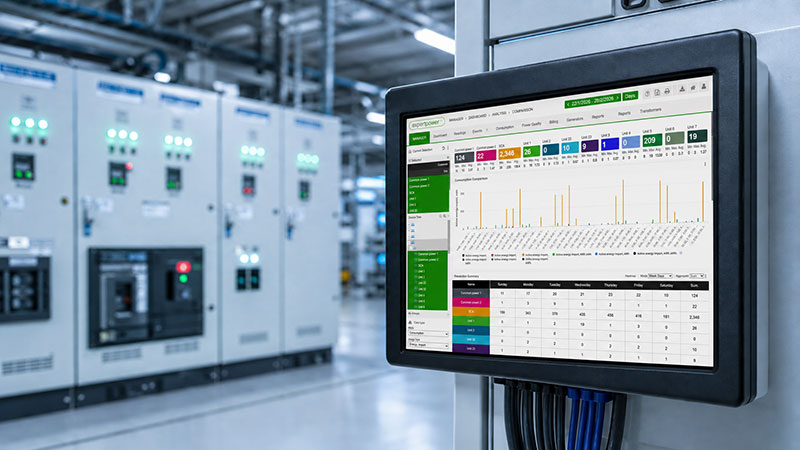
When paired with Expertpower software, the monitoring solution becomes considerably more powerful. Expertpower transforms raw metering data into meaningful insight, with real-time dashboards, trend analysis, configurable alarms and reporting tools that support both operational decisions and compliance requirements. For organisations managing multiple sites, Expertpower allows power quality performance to be viewed and compared across a portfolio from a single platform, without relying on site visits or manual data collection.
With nearly 50 years of global experience in power metering and power quality, SATEC brings a depth of knowledge that is directly relevant to the challenges Australian sites face today.
Building a More Reliable Electrical Network
Australia’s electrical systems are becoming more complex with every passing year. The continued growth of rooftop solar, battery storage, EV charging and inverter-based technology means that power quality can no longer be treated as an occasional concern for a specialist to address when something goes wrong.
Real-time power quality monitoring provides the visibility needed to understand what is happening inside the electrical network on a continuous basis. It supports faster troubleshooting, better maintenance planning and clearer evidence for compliance reporting. Most importantly, it shifts the management of harmonic distortion from reactive problem solving to informed and proactive practice.
For any Australian facility that depends on reliable electrical performance, monitoring harmonic distortion in real time is a practical and increasingly essential step toward a safer, more resilient energy future.
FAQs - Why Real-Time Power Quality Monitoring Matters for Harmonic Distortion
What is Total Harmonic Distortion and what is the acceptable limit in Australia?
Total Harmonic Distortion (THD) measures how much an electrical waveform has deviated from the ideal sine wave. Under AS 61000.3.6, the maximum THD permitted for low voltage systems in Australia is 8%.
Why is harmonic distortion becoming more of a problem for Australian sites?
Australia’s rapid uptake of rooftop solar, EV chargers, variable speed drives and LED lighting has significantly increased the density of non-linear loads across commercial and industrial networks. Each of these technologies can introduce harmonic distortion and the cumulative effect across a site can push power quality toward or beyond acceptable limits.
Why is occasional portable testing no longer sufficient for managing harmonic distortion?
Harmonic distortion varies with time of day, occupancy, load changes and generation output, meaning a short test window can easily miss the events that matter most. Continuous real-time monitoring captures disturbances across all operating conditions, including peak demand periods and rapid changes in solar output.
What Australian standard applies to power quality metering instruments?
Instruments used for compliance-grade power quality monitoring in Australia should meet Class A requirements under IEC 61000-4-30. SATEC’s PRO Series meters are certified to Class A (Edition 3.1) under this standard, making them suitable for compliance reporting and ongoing harmonic monitoring.
Explore related topics:
For Your Industry
Related Reading
- Cloud Energy Monitoring: The Practical Guide to Real-Time Visibility
- PMU Grid Events: What They Are, Why They Matter and How to Measure Them Better
- What Is Power Factor and Why Is It Important?
Trending in Your Sector


