

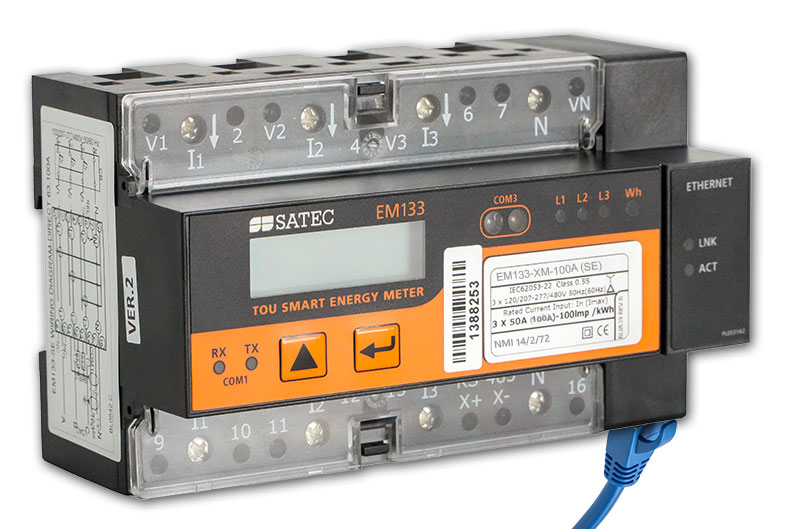
The SATEC EM133-XM smart energy meter is already well-known as a compact, NMI-approved DIN-rail meter for serious revenue and energy management applications. It’s designed for projects ranging from retrofit billing through to renewables, NABERS/Green Star reporting and Power of Choice metering. But one feature often underestimated is its ability to communicate over Ethernet.
Ethernet connectivity isn’t just “another comms option”, it’s what turns the EM133-XM from a standalone meter into a powerful node on your energy data network. When you connect it via Ethernet to SCADA, BMS or cloud software like SATEC’s Expertpower, you unlock faster commissioning, richer analytics and more flexible integration.
Let’s break down why that matters in real projects.
A Quick Recap: What is the EM133-XM?
The EM133-XM is a smart multi-function DIN-rail energy meter designed for revenue billing and advanced energy management. It carries NMI approval for electricity billing in Australia and provides time-of-use (TOU) capabilities for complex tariffs. The XM designation refers to its extended memory version, which enables interval data logging with significantly more storage capacity than standard models.
The meter is fully compatible with applications like NABERS, Green Star and LGC reporting, making it a device you can confidently base billing, compliance and performance reporting on. Ethernet then layers modern, IP-based communication on top of this solid metering foundation.
Ethernet vs Traditional Serial: Why it Matters
Traditionally, most meter manufacturers only provide communications over serial RS-485 and/or RS-232. SATEC’s EM133-XM not only supports RS-485 as a standard feature but can incorporate dual communications with the addition of the ethernet module TCP/IP. Supporting protocols such as Modbus RTU, the EM133-XM opens up an expanded level of flexibility.
With the Ethernet module installed, the EM133-XM family supports:
Modbus TCP/IP
IEC 60870-5-104 over TCP for utility and SCADA integration
Expertpower client for secure cloud connectivity
TCP notification client to push data or events to remote servers
Supports multiple sockets
Webserver
What does that mean in practice? It means your meter can talk the same language as the rest of your IP network – switches, firewalls, servers and cloud platforms – without protocol converters, serial gateways or extra boxes that add cost and complexity.
Faster Commissioning and Simpler Networking
If you’ve ever sat in a plant room trying to work out why a serial daisy chain isn’t talking, Ethernet feels like a breath of fresh air.
With Ethernet on the EM133-XM you can address each meter directly by IP rather than guessing which device is at what position on a serial chain. You can use standard IT tools like ping, IP scanning and browser-based access where supported to confirm connectivity immediately.
Commissioning becomes significantly faster when using SATEC’s PAS (Power Analysis Software) over Modbus TCP, with streamlined IP setup, automatic retries and online monitoring capabilities.
For integrators and commissioning engineers, this can dramatically reduce time onsite. For end users, it means less downtime and fewer “mystery comms issues” later in the life of the installation.
Seamless Integration with SCADA, BMS and Cloud Platforms
The EM133-XM isn’t just about kWh; it’s about data you can act on. With Ethernet, the meter integrates naturally into:
SCADA systems using Modbus TCP or IEC 60870-5-104
Building Management Systems (BMS) for load monitoring and alarms
SATEC’s Expertpower cloud SaaS for energy management, billing, LGC tracking and power quality analytics
In practical terms, Ethernet lets you stream interval data directly into your MDM, billing or analytics platform, centralise monitoring for multiple sites on one dashboard and set up alarms and notifications based on thresholds, events or outages. For large solar or renewable generation sites, this is particularly powerful.
EM133-XM meters are already used in applications where accurate interval data is required for Large-Scale Generation Certificates and Clean Energy Council compliance. Ethernet makes it much easier to collect that data reliably and in near real-time.
Better Visibility for Operators and Facility Managers
From the operator’s perspective, Ethernet connectivity makes the EM133-XM feel much more like a live, networked device than a “black box in the switchboard”. You can view real-time load, power factor and voltage profiles from a central workstation, drill into historical logs for investigations without having to visit the meter and correlate events like voltage sags or breaker operations across multiple meters and sites.
The XM model has extended memory, so you can keep a rich history of data and events inside the meter and retrieve it over the network when needed, rather than relying on frequent onsite downloads.
This is particularly valuable for:
Troubleshooting power quality issues
Back-checking billing data
Supporting audits and compliance reporting
Reduced Hardware and Cabling Costs
It might sound counterintuitive, but adding Ethernet can actually reduce overall system cost. You can often eliminate RS-485 to IP gateways and their configuration entirely, reuse existing IP network infrastructure in many facilities and benefit from point-to-point or star topologies that are easier to design and troubleshoot than long serial chains.
In multi-tenant or retrofit installations – the type of projects the EM133-XM is often chosen for – panel space and cable pathways are at a premium. A compact DIN-rail meter with built-in support for an Ethernet module fits neatly into that world.
Ready for Modern Cybersecurity and IT Policies
More and more organisations require field devices to align with corporate IT and cybersecurity policies. Serial-only devices can be harder to manage securely because they require bespoke gateways and one-off integrations.
By using Ethernet, network teams can apply standard firewall rules, VLANs and access controls, traffic can be monitored with existing tools and segregated metering networks can still be integrated securely with cloud or corporate systems.
When combined with secure architectures and good configuration practices, Ethernet-enabled EM133-XM meters can slot into a modern, policy-compliant OT/IT environment far more easily than legacy metering solutions.
Scalable from Single Site to Portfolio
One of the biggest advantages of Ethernet is scalability. You might start with one EM133-XM on a key incoming feeder. Later, you decide to add more meters on submains or major tenants, connect a solar array or battery system, or roll the same approach out across multiple buildings.
Ethernet and IP networking are effectively “infinite” from a metering perspective, so you don’t hit the usual serial limitations around node counts, cable lengths or baud rates. You simply add more meters, allocate IP addresses within your network design and bring them into your SCADA, BMS or Expertpower instance.
That makes the EM133-XM a strong choice when you know your data needs will grow over time.
The Bigger Picture: Ethernet + EM133-XM + Expertpower
The real magic happens when you combine three elements:
Accurate, NMI-approved measurement from the EM133-XM
Ethernet connectivity for high-speed and reliable data transfer
Cloud or centralised software such as Expertpowerr for analysis, billing and reporting
Together, they give you a defensible billing-grade metering backbone, real-time visibility into consumption and generation, automated reporting for NABERS, LGCs, Power of Choice and internal KPIs and a scalable architecture that can expand with your portfolio.
So while it’s easy to focus just on the NMI approval or the accuracy class, the Ethernet capability is what amplifies the value of the EM133-XM across your entire organisation.
The SATEC EM133-XM smart energy meter is a compact device that punches far above its weight. Its Ethernet connectivity transforms it from a simple meter into a fully networked data source that fits comfortably in modern SCADA, BMS and cloud architectures.
If you’re planning a retrofit, a new build or a portfolio-wide metering upgrade, it’s worth asking a simple question: How much easier will my life be if my revenue meters speak Ethernet from day one?
With the EM133-XM, the answer is: a lot.
Contact our team today to discuss how the EM133-XM can transform your metering solution.
FAQs - SATEC EM133-XM Smart Energy Meter With Ethernet Connectivity
Is the EM133-XM suitable for revenue billing and compliance?
Yes. The EM133-XM is NMI-approved for electricity billing in Australia and supports applications like NABERS, Green Star, LGC reporting and Power of Choice metering.
What are the main benefits of using Ethernet on the EM133-XM instead of RS-485 serial?
Ethernet allows direct IP access to each meter, faster commissioning with tools like PAS, easier troubleshooting and integration without extra protocol converters or serial gateways.
Which systems and protocols can the EM133-XM connect to over Ethernet?
With the Ethernet module, it supports Modbus TCP/IP, IEC 60870-5-104, Expertpower cloud connectivity and TCP notification clients for SCADA, BMS and other IP-based platforms.
Is the EM133-XM a good choice for multi-site or growing portfolios?
Yes. Ethernet and IP networking make it easy to add meters over time, centralise data in SCADA/BMS/Expertpower and scale from a single site to a large portfolio without typical serial network limits.