

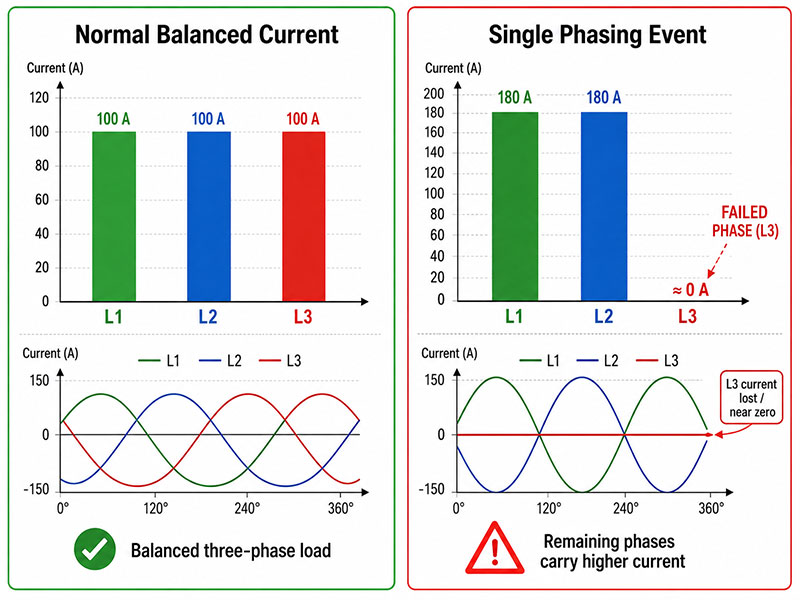
Three phase motors run the machinery most Australian sites depend on. Pumps, fans, compressors, conveyors, chillers and process equipment all rely on a balanced 400 V supply arriving at the motor terminals. When one of those three phases disappears, the motor does not simply stop. It often keeps turning, quietly destroying itself.
This condition is called single phasing. It can appear in an instant or come and go over weeks. Either way it places severe thermal stress on the windings and the damage is frequently well advanced before anyone notices anything unusual.
Key Points
Single phasing is the loss of one phase while the other two stay energised, and a running motor usually keeps rotating, which makes the fault far harder to spot than a total supply failure.
On a fully loaded motor the two healthy phases can carry around 173 per cent of the pre fault load current.
Negative sequence current induces 100 Hz currents in the rotor on Australia’s 50 Hz supply and the resulting heat attacks insulation quickly.
Motor circuit protection is deliberately sized to tolerate starting current, so a partly loaded motor can single phase for a long time without tripping anything.
Protection clears the fault while metering explains what led to it, which matters enormously when the fault is intermittent.
SATEC meters measure voltage and current on every phase, log events and unbalance, and feed Expertpower so teams can trend conditions across an entire site rather than guessing.
What Single Phasing Actually Is
Single phasing occurs when one phase of a three phase supply is lost while the remaining two continue to energise the circuit. The motor is no longer seeing balanced conditions. It is now being fed by what amounts to a single phase supply across two windings.
A stopped motor will generally refuse to start. It hums, draws heavy current and sits there. That failure is obvious and someone investigates.
The dangerous case is the motor that was already running. Momentum and the rotating field carry it through the loss of a phase and it continues to drive its load. Torque falls away. Current climbs. Nothing looks wrong from the walkway.
Common Causes On Australian Sites
Upstream Of The Motor
A blown fuse on a single phase is the classic cause. Failed fuse holders, damaged contactors and loose cable terminations produce the same outcome. Supply network faults and broken conductors on long rural feeders also account for their share, particularly in irrigation and remote pumping applications.
At The Connection Itself
Worn contactor tips become resistive before they open. A termination that was tightened once at commissioning works loose under thermal cycling. Coastal humidity, salt, dust and vibration all accelerate the process, which is why sites in Queensland, the Northern Territory and along any exposed coastline tend to see connection faults earlier than a temperate metropolitan switchroom would.
The frustrating cases are intermittent. A marginal connection opens under load, then reseats when the plant stops and everything cools. A technician attends, measures three healthy phases and closes the job. Three weeks later the motor fails.
Signs And Symptoms To Watch For
The symptoms differ depending on whether the motor is starting or already turning. Common warning signs include:
- A motor that hums loudly but will not start
- Reduced torque, slower cycle times or a pump that cannot hold pressure
- Unusually high current on two phases with near zero on the third
- Overheating, increased vibration or the sharp smell of hot varnish
Protective devices may also trip repeatedly without an obvious cause. In many cases the motor appears to run acceptably until load increases, which delays investigation and gives heat time to build inside the windings.
Relying on what a person can see or hear is not a strategy. Measuring current and voltage on each phase is.
How Single Phasing Damages A Motor
When one phase is lost the motor tries to maintain its power output through the remaining two windings. On a fully loaded motor the healthy phases end up carrying roughly 173 per cent of the pre fault current. That alone is enough to cause rapid heating.
The more serious mechanism is less visible. Unbalanced supply produces negative sequence current, which creates a magnetic field rotating against the direction of the rotor. An induction motor presents a much lower impedance to negative sequence current than to positive sequence current, with the ratio typically falling somewhere between three and ten.
The result is a large induced current in the rotor at twice supply frequency, which is 100 Hz here in Australia.
That 100 Hz rotor current generates heat the stator overload element was never designed to model. Insulation is the first casualty. As a rule of thumb, every 10°C above rated operating temperature halves the expected life of the insulation system, so a motor can survive a phase loss event and still lose years of service life.
Bearings and driven equipment suffer too, since a motor producing pulsating torque transmits that disturbance into couplings, shafts and gearboxes.
Why Standard Protection Sometimes Misses It
This is the part that surprises people and it is worth dwelling on.
Motor circuits are protected against short circuit by devices that must also tolerate starting current, which can reach six or seven times full load. Under AS 3000:2018 the fixed wiring rules allow a fuse protecting a motor circuit to be rated up to four times the motor’s full load current and a circuit breaker up to two and a half times. The Wiring Rules also permit overload protection and short circuit protection to be provided by separate devices.
Now apply the 173 per cent figure to a motor that is not fully loaded. A motor running at 50 per cent load draws half its full load current. Lose a phase and the healthy phases carry around 86 per cent of full load current. That is below the motor’s own nameplate rating, comfortably below the thermal overload setting and nowhere near the short circuit device.
Nothing trips. The rotor is being cooked by 100 Hz current the whole time.
Plenty of plant across Australia runs below full load for most of its duty cycle. Standby pumps, oversized HVAC fans, conveyors between production runs and any variable duty application spend hours in exactly this condition. A properly configured negative sequence element will catch it. A conventional overcurrent device very often will not.
Protection And Monitoring Compared
| Device | What It Does | Detects Single Phasing? | Main Limitation |
|---|---|---|---|
| Fuse or circuit breaker | Clears short circuits and gross overcurrent | Only at or near full load | Sized to ride through starting current so a partly loaded motor stays well under the trip threshold |
| Thermal overload relay | Models winding heating from stator current | Partially | Responds to total current rather than unbalance so rotor heating is underestimated |
| Phase failure relay | Trips on phase loss, reversal or undervoltage | Yes | Usually monitors one point so a fault downstream of the relay may go unseen |
| Motor protection relay with negative sequence element | Calculates thermal capacity including unbalance heating | Yes, reliably | Depends entirely on correct settings and protects only the motor it is fitted to |
| Power quality or multi circuit meter | Measures and records per phase voltage, current, unbalance and events | Records rather than trips | Does not disconnect the motor so it complements protection instead of replacing it |
What Monitoring Adds
Protection acts on the fault. Metering explains it. Those are different jobs and confusing them leads to sites that trip repeatedly without anyone ever learning why.
A relay tells you a motor stopped. It rarely tells you that phase B had been sagging for six weeks, that unbalance climbed every afternoon when the neighbouring load came on, or that the same pattern is developing on three other feeders in the same switchboard.
Australian network conditions make this worth measuring properly. The National Electricity Rules set system standards for voltage unbalance, measured as negative sequence voltage, so a site with a genuine supply side problem has a factual basis for raising it with the distributor. Without recorded data that conversation goes nowhere.
Intermittent faults are the strongest argument of all. If the condition will not reproduce while someone is standing in front of the switchboard, historical data is the only thing that will find it.
How SATEC Metering Helps Detect Phase Loss
Measuring three phase systems accurately is what these meters are built for, which makes motor circuits a natural application. By capturing voltage and current on every phase, the meter exposes the imbalance created the moment one phase is lost. Depending on the model, event logs, waveform capture and configurable alarms turn that measurement into something a maintenance team can act on.
For a motor control centre feeding dozens of starters, the BFM136 multi circuit monitor covers many circuits from a single device, which makes per feeder visibility affordable at a scale that individual meters rarely achieve.
Where the question is deeper, the PM180 is a Class A power quality analyser to IEC 61000-4-30 and records events with the detail needed to reconstruct exactly what happened in the seconds surrounding a trip. The PRO Series PM335 and EM235 add Class A Edition 3.1 measurement together with an embedded PLC controller, so alarm logic can live in the meter itself.
Connect any of these to Expertpower and the picture extends across time. Trends can be compared between assets, recurring patterns become visible and a fault that only appears on hot Thursday afternoons stops being a mystery. Expertpower is hosted on Australian Microsoft Azure infrastructure, which keeps site data onshore.
One honest caveat. These are meters, not protection relays and they will not disconnect a motor. Their value is accurate measurement, event evidence and the ongoing visibility that supports faster diagnosis and better maintenance decisions.
Protecting Three Phase Motors Starts With Visibility
Single phasing can begin with something as ordinary as a blown fuse or a termination that worked loose over a summer. The consequence is a motor that appears to be running normally while excessive current and 100 Hz rotor heating quietly consume its insulation.
Correctly specified protection remains essential and nothing here replaces it. Monitoring adds the layer protection cannot provide, which is a record of what each phase was doing before, during and after the event.
If your site depends on pumps, fans, compressors or conveyors, and you have ever replaced a motor without ever establishing why it failed, that is the gap worth closing.
Talk to SATEC about monitoring the three phase circuits that matter most on your site. Contact our team for an assessment of your motor circuits, or arrange a demonstration of Expertpower to see how phase level data looks across a full plant.
FAQs - Single Phasing In Three Phase Motors
Can a three phase motor keep running after losing one phase?
Yes, and that is exactly what makes single phasing dangerous. A motor already turning will usually continue to drive its load while drawing heavily increased current on the two remaining phases. A stopped motor, by contrast, will generally hum and fail to start.
Will my overload relay protect the motor from single phasing?
Not always. A thermal overload responds to stator current and a motor running below full load can lose a phase while still drawing less than its rated current, so nothing trips. A negative sequence or phase failure element is far more dependable for this condition.
How quickly can single phasing damage a motor?
A fully loaded motor can sustain winding damage within minutes because the healthy phases carry around 173 per cent of the pre fault current. A lightly loaded motor may run for weeks while rotor heating slowly degrades the insulation. Both outcomes shorten motor life.
Do SATEC meters replace motor protection relays?
No, and they are not intended to. SATEC meters measure and record voltage, current, unbalance and events on every phase, which supports diagnosis and long term trending. Protection relays remain responsible for disconnecting the motor during a fault.
Explore related topics:
Trending in Your Sector


