

Artificial intelligence (AI) is reshaping the way data centres are designed, powered and managed. As AI workloads expand, facilities are being pushed to support higher rack densities, larger electrical loads and more complex power infrastructure.
The focus is often on capacity, cooling and energy consumption, yet one critical issue can sit quietly in the background until it begins to affect reliability: harmonic distortion.
Harmonic distortion is not a new power quality problem. Data centres have always relied on electrical equipment that can introduce distortion into the power system. What has changed is the scale and intensity of demand.
AI-driven environments place new pressure on electrical networks, making it more important than ever to understand how harmonics behave, how they affect infrastructure and how they can be monitored before they create costly problems.
Key Points
Harmonic distortion occurs when non-linear loads distort the electrical waveform, creating excess heat, instability and equipment stress across data centre infrastructure.
Australia’s supply frequency is 50 Hz, meaning the third harmonic sits at 150 Hz, the fifth at 250 Hz, and so on. Each adds distortion to the system.
Under AS 61000.3.6, the maximum Total Harmonic Distortion (THD) permitted for low voltage systems in Australia is 8%.
AI workloads create more variable and intense electrical profiles, increasing the risk of harmonic distortion compared with traditional enterprise computing environments.
Periodic spot testing is not sufficient. Harmonic conditions in data centres change continuously and require ongoing monitoring to detect trends and intermittent issues.
SATEC power quality analysers, supported by the Expertpower platform, give data centre operators continuous visibility of harmonic distortion and broader power quality conditions across their sites.
What Is Harmonic Distortion?
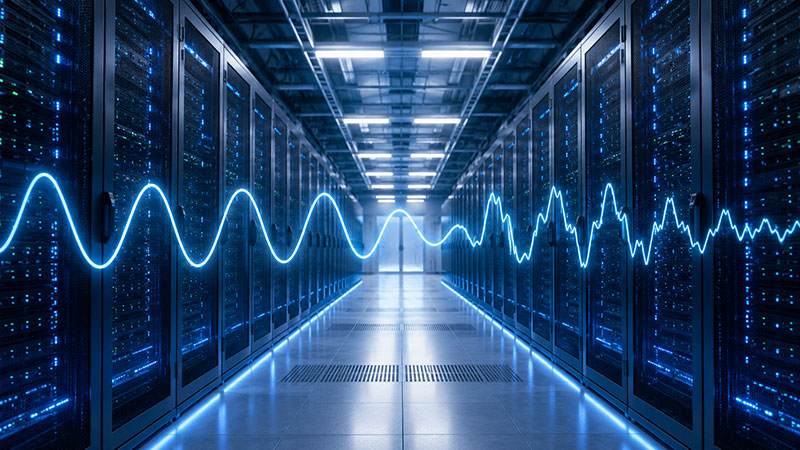
In an ideal electrical system, voltage and current waveforms follow a smooth sinusoidal pattern. Harmonic distortion occurs when electrical loads draw current in a non-linear way, causing the waveform to become distorted. Instead of a clean sine wave, the system carries additional frequency components known as harmonics.
These harmonics are multiples of the fundamental frequency. In Australia, where the supply frequency is 50 Hz, the third harmonic sits at 150 Hz, the fifth at 250 Hz and so on. Individually, these frequencies may sound like abstract engineering detail. In a live data centre environment, they can translate into overheating, reduced efficiency, nuisance tripping, equipment stress and shortened asset life.
The most common measurement used to assess harmonic levels is Total Harmonic Distortion, referred to as THD. THD gives operators a clearer view of how distorted a voltage or current waveform has become. Monitoring THD over time helps facilities teams understand whether harmonic distortion is stable, increasing or linked to specific operating conditions.
Under AS 61000.3.6, the relevant Australian standard for harmonic voltage distortion, the maximum THD permitted for low voltage systems is 8%. In practice, many sites already operate closer to this limit than their teams realise, particularly as non-linear load density increases.
Why AI Growth Makes Power Quality More Important
AI infrastructure places very different demands on data centres compared with traditional enterprise computing. High-performance servers, GPU clusters, advanced cooling systems, UPS systems and power conversion equipment all contribute to a more dynamic electrical environment.
The issue is not simply that AI data centres use more power. It is that the electrical profile can be more variable and more intense. Loads can ramp up and down quickly. Power electronics are used extensively across the facility. Cooling systems may operate under heavier and more fluctuating demand. This creates more opportunities for waveform distortion and other power quality issues to appear.
The scale of this shift in Australia is significant. According to AEMO’s latest official forecasts, data centre energy demand in the National Electricity Market is expected to triple to nearly 12 TWh by 2030, equivalent to around 6% of the NEM’s electricity. As that growth continues to accelerate, so does the pressure on electrical infrastructure to perform reliably under more demanding conditions.
Harmonic distortion in data centres can become especially problematic when facilities are expanded, retrofitted or upgraded for AI without a detailed understanding of existing electrical conditions. A site may have operated reliably for years under one load profile and then begin experiencing power quality issues after new equipment is added. Without accurate metering, these changes can be difficult to diagnose.
Where Harmonic Distortion Comes From in Data Centres
Modern data centres contain many sources of non-linear load. Servers and IT equipment use switched-mode power supplies. UPS systems rely on rectifiers and inverters. Variable speed drives may be used in cooling and ventilation systems. Battery energy storage, power distribution units and other electronic equipment can also influence harmonic behaviour.
These systems are essential to the operation of a data centre. The goal is not to remove them but to understand how they interact with the electrical infrastructure.
When multiple non-linear loads operate at the same time, harmonic currents can accumulate. Depending on the design of the electrical system, this can place additional stress on neutral conductors, transformers, switchgear, capacitors and protective devices. In high-demand environments, even small inefficiencies or repeated stress can become significant over time.
The Hidden Risks of Harmonic Distortion
One of the reasons harmonic distortion deserves attention is that it is not always obvious. A facility may appear to be operating normally while underlying power quality issues are building. By the time symptoms are visible, the problem may already be affecting equipment performance or increasing operational risk.
Harmonic distortion can contribute to excess heat in transformers and conductors. It can reduce electrical efficiency, increase losses and add stress to key assets. Sensitive equipment may experience interference or reduced performance. Protective devices may trip unexpectedly. Capacitors used for power factor correction can be affected if resonance occurs. In environments where uptime is critical, these risks cannot be ignored.
For data centre operators, the commercial impact can be serious. Downtime is expensive. Equipment failure is disruptive. Energy waste affects operating costs. Poor visibility into power quality can slow down troubleshooting and make it harder to plan future upgrades with confidence.
Why Periodic Testing Is Not Enough
Periodic power quality testing can be useful, especially during commissioning or after a major infrastructure change. However, harmonic distortion in data centres is often dynamic. Conditions can change across the day, between operating modes or during periods of high AI compute demand.
A one-off test may capture the site at a single point in time. It may not show what happens when loads peak, when cooling systems ramp up or when backup systems operate. It may also miss intermittent issues that only occur under specific conditions.
The table below summarises the key differences between periodic spot testing and continuous monitoring.
| Factor | Periodic Spot Testing | Continuous Monitoring |
|---|---|---|
| Visibility | Snapshot at a single point in time | Ongoing view across all operating conditions |
| Trend detection | Not possible from a single test | Identifies trends over days, weeks and months |
| Intermittent issues | Likely to be missed | Captured as they occur |
| Peak load behaviour | May not be tested under peak conditions | Recorded during actual operating peaks |
| Commissioning value | Useful at commissioning or after major changes | Valuable at all stages of site operation |
| AI workload variability | Does not account for variable compute demand | Tracks changes as AI load ramps up and down |
| Standards compliance (AS 61000.3.6) | Provides a point-in-time compliance check | Supports ongoing compliance verification |
| Response time | Issue detected retrospectively | Enables proactive response before failure |
| Data available for planning | Limited | Rich historical dataset supports upgrades and maintenance |
Continuous monitoring gives facilities teams a more complete view. It allows them to track THD, voltage, current, demand, power factor and other power quality indicators over time. This makes it easier to identify trends, correlate events and detect abnormal behaviour before it becomes a major issue.
The Role of Advanced Metering in Power Quality Visibility
Advanced metering is central to managing harmonic distortion in data centres. Operators need accurate data at the right points in the electrical system, from incoming supply through to major distribution boards and critical loads.
Without this visibility, it is difficult to know whether distortion is entering from the grid, being generated within the facility or being amplified by certain operating conditions.
Good metering also supports better decision making. It can help engineers assess whether harmonic filters are required, whether equipment is operating within expected limits and whether new loads are affecting existing infrastructure. Over time, this data becomes valuable for maintenance planning, energy management and capacity upgrades.
For AI data centres, this level of visibility is especially important. As electrical demand grows, operators need to know not only how much energy is being used but how clean and stable that power is.
How SATEC Supports Harmonic Distortion Monitoring
Effective harmonic monitoring starts with the right metering equipment, and SATEC’s power quality analysers are well suited to the demands of data centre environments. The PM180 provides detailed three-phase measurements including voltage, current, power, power factor, THD, TDD, K-factor and harmonic spectrum analysis up to the 50th and 63rd order respectively. The PM180 is compliant with IEC 61000-4-30 Class A Edition 3, the most rigorous standard for power quality measurement.
These instruments are equally suited to new installations and retrofit programmes where panel space and integration effort may be limited. For data centres expanding or upgrading to support AI workloads, they provide the ongoing electrical visibility needed to assess whether infrastructure is coping with additional load.
When paired with Expertpower, SATEC’s software platform, metering data becomes easier to monitor, analyse and report. Expertpower helps turn raw power data into practical insight, giving operations teams a clearer view of energy use and power quality conditions across their site. This supports faster investigation, more proactive maintenance and better long-term planning.
The value is not in measuring harmonic distortion once. It is in having continuous access to reliable data that helps teams see what is changing, where risks may be forming and which areas need attention.
Managing Harmonic Risk as Data Centres Evolve
AI growth will continue to reshape data centre power requirements. Facilities that were once considered high capacity may need to support loads that are more concentrated, more variable and more demanding. This makes power quality a strategic issue rather than a narrow engineering concern.
Managing harmonic distortion starts with visibility. Once operators can measure and trend harmonic behaviour, they can take targeted action. That may involve reviewing equipment specifications, checking transformer loading, assessing neutral conductor performance, investigating nuisance tripping, considering harmonic filtering or adjusting maintenance strategies.
The key is to avoid guesswork. Harmonic distortion in data centres should be measured, monitored and managed using reliable data. As AI infrastructure grows, the facilities that perform best will be those that understand not only their energy consumption but the quality of the power supporting their operations.
If you cannot see harmonic distortion, you cannot properly manage it. Advanced metering provides the visibility needed to understand power quality conditions and respond before small issues become expensive failures.
FAQs - Harmonic Distortion in Data Centres
What Is Total Harmonic Distortion (THD)?
THD is a measurement that shows how far a voltage or current waveform has deviated from a clean sine wave. It gives data centre operators a clear indicator of harmonic distortion levels across their electrical system.
What Is the Maximum THD Allowed in Australia?
Under AS 61000.3.6, the maximum THD permitted for low voltage systems in Australia is 8%. Many sites operate closer to this limit than their teams realise as non-linear load density increases.
Why Does AI Increase the Risk of Harmonic Distortion?
AI workloads create more variable and intense electrical profiles, with loads that ramp up and down quickly and heavy use of power electronics. This dynamic environment produces more opportunities for waveform distortion than traditional enterprise computing.
Why Is Continuous Monitoring Better Than Periodic Testing?
Periodic testing only captures a single point in time and can miss intermittent issues or peak load behaviour. Continuous monitoring tracks THD and other power quality indicators across all operating conditions so problems can be detected before they cause failures.


