

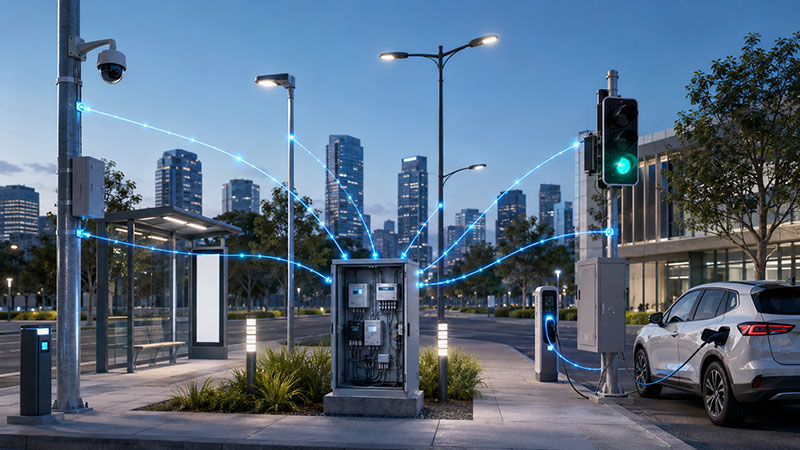
Public infrastructure is becoming smarter, more connected and more energy dependent. Streetlights are no longer simple light sources. EV chargers are appearing on kerbsides and in public car parks.
Bus shelters, CCTV systems, telecommunications cabinets, park lighting and other public assets are drawing electricity in ways that are increasingly difficult to manage through old unmetered arrangements. Type 9 energy meters exist precisely to address this challenge.
Type 9 energy meters are a new metering category under Australia’s Flexible Trading Arrangements, designed to bring street furniture and certain formerly unmetered loads into the National Electricity Market metering framework.
For councils, infrastructure owners and public asset managers, the change is about more than compliance. It is about visibility, accountability and better energy management across public spaces.
Key Points
Type 9 energy meters are a new metering category for street furniture and formerly unmetered public infrastructure loads in the NEM.
The metering type was established under the AEMC’s Flexible Trading Arrangements final determination, published in August 2024, with a commencement date of 31 May 2026.
Applicable assets include smart streetlights, kerbside EV chargers, CCTV, telecommunications cabinets and other small public infrastructure loads.
A Central Management System can be used to aggregate multiple street furniture devices under a single NMI, reducing administrative complexity for councils managing large portfolios.
Moving from estimated consumption to measured energy data supports stronger budgeting, sustainability reporting and asset performance decisions for councils and public infrastructure operators.
SATEC’s NMI pattern approved meters, including the EM133-XM and BFM136, provide accurate energy metering where robust external measurement, multi-circuit monitoring or broader energy data management is needed alongside Type 9 arrangements.
What Are Type 9 Energy Meters?
Type 9 energy meters are a new metering category for specific street furniture connections and certain unmetered public infrastructure loads. They are intended for situations where traditional metering may not be practical, cost effective or physically suitable.
Street furniture can include assets such as smart streetlights, kerbside EV chargers, public lighting, telecommunications cabinets, CCTV systems, traffic signals, bus shelter lighting and other small infrastructure-based loads.
Historically, many of these assets have been managed as unmetered loads. In those cases, energy use may be calculated through approved load tables, estimated operating hours or agreed profiles rather than measured directly at each asset.
That approach may work for simple and predictable equipment. It becomes less suitable when public infrastructure gets smarter. A dimmable smart streetlight does not always consume the same amount of energy. A kerbside EV charger may have highly variable usage. A public asset with remote controls or communication capability may operate differently depending on time, demand and local conditions.
Type 9 energy meters give the market a way to measure these assets more accurately without forcing every street furniture connection into the same framework as a standard customer premises. The minimum specifications for Type 9 meters are set by AEMO and are expected to be lower than those required for a Type 4 smart meter, making them a more cost-effective path for public asset operators.
The Flexible Trading Arrangements Rule Change
Type 9 metering was introduced as part of the AEMC’s final determination on Unlocking Consumer Energy Resources Benefits Through Flexible Trading, published on 15 August 2024.
The rule change was designed to enhance the flexibility of how consumer energy resources are used and traded within the National Electricity Market. Two new metering types were introduced. Type 8 supports bespoke metering of CER within customer premises. Type 9 brings street furniture and previously unmetered supply connections into the NEM metering framework.
Type 9 metering arrangements commenced on 31 May 2026. The remaining elements of the Flexible Trading Arrangements rule take effect from 1 November 2026.
The AEMC estimated the rule change could deliver up to $100 million in benefits over 20 years. Those benefits include reduced metering installation and maintenance costs, reduced wholesale costs from more efficient energy consumption and broader emissions reductions from better integration of consumer energy resources.
Why Type 9 Metering Matters for Councils
Councils manage large portfolios of public assets. Many of those assets are spread across suburbs, roads, parks, car parks and civic spaces. They can be difficult to access, difficult to monitor and difficult to compare.
When energy use is estimated rather than measured, councils may not have a clear picture of what each asset is actually consuming. This can make budgeting harder, reduce confidence in sustainability reporting and limit the ability to identify waste or inefficiency.
Type 9 energy meters can help move public infrastructure from estimated energy use to measured energy data. This matters for councils that are upgrading public lighting, investing in smart city infrastructure or planning kerbside EV charging networks.
Accurate energy data can support better decisions. It can help councils understand whether lighting upgrades are delivering expected savings, whether public EV chargers are being used efficiently and whether different assets are performing as intended.
From Unmetered Loads to Measured Public Assets
Many public infrastructure loads were originally simple and predictable. A streetlight turned on at dusk and off at dawn. A public fitting had a known wattage and a relatively stable operating pattern. That world is changing.
Smart lighting can dim, brighten, respond to movement or be managed remotely. Public EV chargers can operate at different times and volumes depending on driver behaviour. Public safety assets, communication equipment and smart city devices may operate continuously or change their energy use depending on function.
When assets behave dynamically, estimated consumption becomes less reliable. Councils may pay for energy based on assumptions that no longer match actual use.
Type 9 energy meters are designed to support a more modern approach. They make it possible to bring certain street furniture and public infrastructure loads into a metering framework that better reflects actual consumption.
Unmetered Loads vs Type 9 Metered Street Furniture
| Feature | Unmetered Loads (Traditional) | Type 9 Metered Street Furniture |
|---|---|---|
| How energy use is determined | Estimated via load tables, approved profiles or operating hours | Measured directly at the asset or aggregated via a CMS |
| Accuracy | Lower; relies on assumptions about wattage and operating patterns | Higher; reflects actual consumption including variable loads |
| Suitability for smart assets | Limited; does not account for dimming, remote control or variable usage | Well suited; supports dynamic assets with variable consumption |
| Multi-device management | Each asset treated independently under broad estimates | Multiple devices can be aggregated under a single NMI via a CMS |
| NMI assignment | Generally no individual NMI for each asset | Each connection point or CMS arrangement receives an NMI |
| Market settlement | Not individually visible in the NEM | Brought into the NEM metering framework for settlement |
| Council visibility | Low; limited ability to track individual asset consumption | Improved; data can inform budgeting, reporting and asset decisions |
| Suitable asset types | Simple, predictable loads with stable wattage | Smart streetlights, kerbside EV chargers, CCTV, telecoms cabinets |
| Regulatory framework | Unmetered supply provisions under existing NER | Flexible Trading Arrangements, AEMC final determination August 2024 |
| Commencement | Existing arrangements | Type 9 commenced 31 May 2026 |
How Aggregation and Central Management Can Help
One of the useful features of Type 9 metering is that it can support multiple devices through a Central Management System. Instead of treating every small asset as a completely separate metering installation, some arrangements allow multiple devices to be managed under a single NMI.
This is particularly relevant for streetlighting. A council may have hundreds or thousands of lighting assets across a local government area. Installing and managing traditional meters for each individual light would be impractical.
A centralised approach can make the concept more workable. It allows groups of compatible assets to be measured, monitored or managed in a more coordinated way. For councils, this could help reduce administrative complexity while still improving energy visibility across large asset portfolios.
The exact arrangement will depend on the asset type, connection arrangement, metering requirements and market participant responsibilities. Type 9 is not a free-for-all. It must operate within the relevant market procedures and compliance framework set by AEMO.
Type 9 Metering and Kerbside EV Charging
Kerbside EV charging is one of the most relevant Type 9 use cases. As more Australians move to electric vehicles, councils are under pressure to support charging access for residents who do not have off-street parking.
Public charging infrastructure creates a new energy management challenge. Chargers may be installed in streets, council car parks, civic spaces and public destinations. Their usage can change significantly depending on time of day, location and driver behaviour.
Without accurate metering, it can be difficult to understand how much energy is being used, who is responsible for the cost and how the asset is performing.
Type 9 energy meters can help create a clearer framework for this kind of public charging infrastructure. They support the move away from rough estimation and toward better measurement of energy use across public EV charging assets.
What Councils Should Consider Before Moving to Type 9
Type 9 metering is not expected to apply to every public asset. Councils should first identify which assets are currently unmetered, which have variable consumption and which may benefit from more accurate measurement.
Ownership and responsibility also matter. Public infrastructure may involve councils, distribution networks, retailers, charging providers, contractors and technology suppliers. Clear roles will be essential before any metering arrangement is formalised.
Data access is equally important. Measurement is only useful if the data can be reviewed, understood and acted upon. Energy data should support reporting, maintenance decisions, budgeting and long-term asset planning.
Early planning makes a genuine difference. Metering should not be an afterthought added once an asset has already been installed. The best results come when energy measurement is considered as part of the original project design.
SATEC: Supporting Accurate Energy Metering for Public Infrastructure
SATEC supports councils, utilities and infrastructure operators with advanced metering, monitoring and energy data solutions for complex electrical environments. With more than 50 years of energy management experience, we bring deep expertise to the metering challenges of modern public infrastructure.
Where Type 9 arrangements require accurate external metering, multi-circuit measurement or broader energy data management, the EM133-XM and BFM136 provide a technically proven foundation. Both meters are NMI pattern approved under NMI M 6-1, which means they meet Australian trade measurement requirements for billing-grade energy metering.
The EM133-XM is a DIN rail mounted multifunction meter with Class 0.5S accuracy, 8MB of onboard data logging and RS485/Modbus communications as standard. It is well suited to infrastructure cabinets, switchboards and multi-circuit metering environments where compact, accurate measurement is needed.
The BFM136 is capable of monitoring up to 12 three-phase circuits or 36 single-phase circuits within a single unit, making it a practical choice for sites where multiple public assets are served from a common point of supply.
It is worth noting that some Type 9 use cases may rely on approved in-built metrology within the street furniture itself, such as a smart light fitting with integrated measurement capability. In those cases, the appropriate metering approach should be confirmed with the relevant market participants and service providers. Where robust external metering, data logging or multi-circuit visibility is needed, that is where these NMI approved solutions are best placed to support the project.
Expertpower adds the software layer that turns metering data into meaningful insight. Councils and infrastructure operators can use the platform to review consumption across assets, identify unusual trends, compare performance over time and support energy reporting. This can help move energy management from reactive billing review to proactive asset visibility.
A Smarter Future for Public Infrastructure
Type 9 energy meters reflect a simple reality. Public infrastructure is no longer passive, simple or invisible. It is becoming smarter and more connected, which means it needs better energy data.
For councils, this creates both a challenge and an opportunity. The challenge is managing more assets, more data and more complex energy arrangements. The opportunity is gaining a clearer view of how public infrastructure actually performs.
Better measurement can support smarter budgeting, stronger emissions reporting and more informed investment decisions. It can help councils understand whether public lighting upgrades are delivering value, whether EV charging infrastructure is being used effectively and whether public assets are operating as expected.
Type 9 energy meters may sound like a technical market reform but the practical message is clear. Public infrastructure needs energy visibility. As street furniture becomes smarter, measurement needs to catch up.
FAQs - Type 9 Energy Meters Explained
What is a Type 9 energy meter in Australia?
A Type 9 energy meter is a new metering category introduced under the AEMC’s Flexible Trading Arrangements rule to bring street furniture and formerly unmetered public infrastructure loads into the National Electricity Market metering framework. It covers assets such as smart streetlights, kerbside EV chargers and other small public infrastructure connections.
When did Type 9 metering commence in Australia?
Type 9 metering arrangements commenced on 31 May 2026 as part of the first stage of the Flexible Trading Arrangements rule change. The broader FTA rule, including Type 8 metering, takes effect from 1 November 2026.
Can multiple street furniture assets be managed under a single NMI?
Yes. Type 9 metering supports the use of a Central Management System, which allows multiple devices such as streetlights to be aggregated and managed under a single NMI. This reduces the administrative complexity of managing large numbers of individual assets across a council’s public infrastructure portfolio.
Do councils need NMI approved meters for Type 9 street furniture connections?
The metering approach will depend on the specific asset type and arrangement. Some Type 9 use cases may rely on approved in-built metrology within the street furniture itself. Where external metering, multi-circuit measurement or broader energy data management is required, NMI pattern approved meters that meet NMI M 6-1 requirements are appropriate.
Explore related topics:
For Your Industry
Standards & Compliance
- NEM Metering Installation Types Explained: A Complete Guide To Types 1 To 9
- Din Rail Electricity Meter designed & tested to NMI M6 -1 for NMI Pattern Approval requirements
Related Reading
- Type 8 Energy Meters Explained: What Secondary Settlement Points Mean For Large Energy Users
- Types of Electricity Meters in Australia: A Practical Guide for Property Owners and Managers
Trending in Your Sector


