

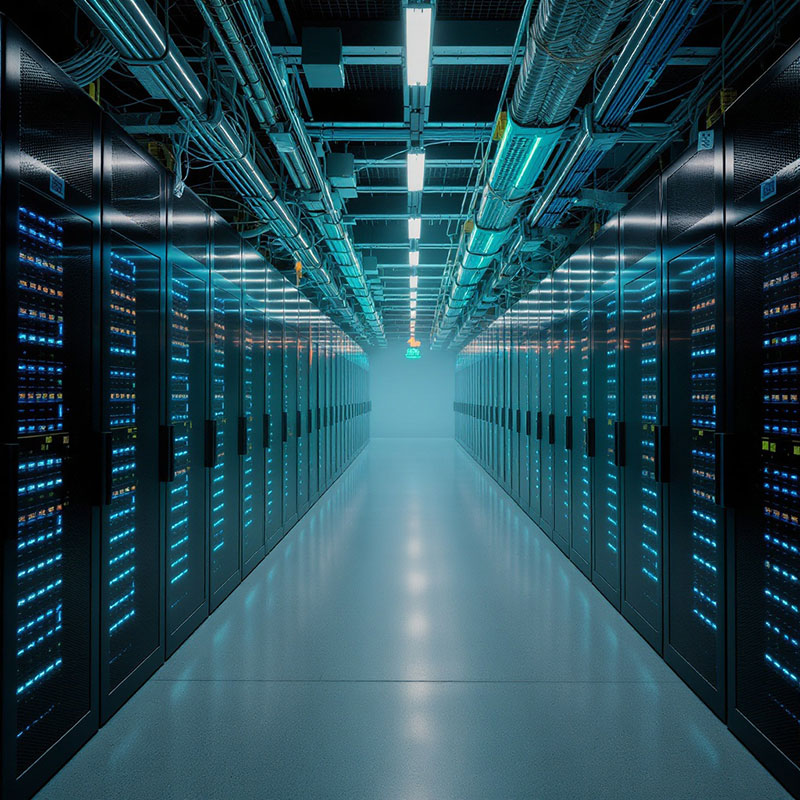
Colocation facilities face mounting pressure to provide accurate, transparent energy billing across multiple tenants.
Australian data centres hosting hundreds of servers for different clients require sophisticated submetering systems that deliver precise energy allocation and comply with National Measurement Institute (NMI) standards. NMI requirements for revenue-grade metering demand exceptional accuracy across varying load conditions.
SATEC’s BFM136 energy meters provide Class 0.5S accuracy for precise tenant billing whilst supporting providing comprehensive electrical monitoring data across multiple single phase and / or three (3) phase circuits.
Multi-Tenant Energy Allocation Challenges in Australian Colocation Facilities
Data centre operators must accurately measure power consumption for each tenant’s equipment rack or cage within shared infrastructure environments.
Traditional approaches using basic current transformers often lack the precision required for revenue-grade billing applications. Modern colocation facilities demand submetering systems that capture detailed energy usage patterns including peak demand, power factor characteristics, and harmonics data.
Australian Standard AS 62053-22 specifies accuracy requirements for electronic energy metres used in revenue applications. SATEC meters exceed these specifications whilst providing real-time data access through multiple communication protocols such as Modbus TCP / IP.
Time-of-Use Billing Standards for Data Centre Operations
Australian electricity markets operate complex time-of-use pricing structures that require sophisticated metering capabilities to accurately allocate costs between tenants.
Data centres must implement submetering systems capable of recording energy consumption across multiple tariff periods whilst maintaining audit-ready records for billing verification. Revenue-grade meters must comply with strict measurement standards to ensure billing accuracy and regulatory compliance across all operational scenarios.
AS 62053-22 Electronic Energy Meter Standards
This Australian Standard defines accuracy classes and test conditions for electronic energy meters used in revenue applications. Class 0.5S meters provide ±0.5% accuracy across wide current ranges, essential for data centre applications where server loads vary significantly.
AS 62053-22 specifications require meters to maintain accuracy from 1% to 120% of rated current, accommodating the dynamic load profiles typical in colocation environments.
Measuring Low Current Rack Loads
In data centres, “quiet” AC racks can draw surprisingly little current. Light or empty racks (just a PDU and network gear) often sit around 50–300 W—about 0.2–1.3 A at 230 V single-phase, or roughly 0.1–0.7 A per phase on 415 V three-phase. Low-utilisation server racks typically run 0.5–2 kW (≈2–9 A at 230 V single phase; ≈0.7–3 A/phase at 415 V 3 phase).
From there, “typical” enterprise racks land near 3–10 kW, while high-density/AI racks jump to 15–40 kW+. For quick conversions (PF ≈ 0.95), 1 kW equates to ~4.6 A at 230 V single phase, ~2.9 A/phase at 208 V 3 phase, or ~1.5 A/phase at 415 V 3 phase.
For accurate low-end monitoring, SATEC provides specialised CTs to ensure accuracy of readings at these extremely low currents measurements.
NMI M6-1 Single Phase & Three Phase Energy Meter Pattern Approval
The National Measurement Institute’s M6-1 pattern approval covers single phase and three phase electronic energy meters used for revenue billing in Australia. This approval ensures meters meet stringent accuracy and reliability requirements under varying environmental and load conditions typical in data centre installations.
NMI pattern approval provides legal certainty for revenue billing applications whilst supporting advanced features like harmonic monitoring and power quality analysis.
SATEC’s BFM136 revenue-grade meters deliver comprehensive colocation billing capabilities via its multi-circuit design for up to thirty-six (36) current inputs in a small, compact footprint.
While providing flexible communication options, these meters provide accurate tenant energy allocation supporting advanced analytics for operational optimisation and regulatory compliance.
Data centre operators benefit from real-time visibility into tenant consumption patterns and facility-wide electricity energy metrics.
Real-Time Tenant Monitoring and Billing Analytics
Modern colocation facilities require continuous visibility into tenant energy consumption patterns to optimise facility operations and ensure accurate billing.
SATEC meters can provide real-time measurement updates via Power Analysis Software (PAS) and high-speed communication interface, enabling facility managers to monitor instantaneous power draw across all tenant spaces. Advanced data logging capabilities store detailed consumption records with timestamps, supporting both real-time billing applications and historical analysis for capacity planning purposes.
Built-in alarm functions via TCP / IP notification provide operators indication of tenant loads which may exceed contracted levels or when power quality issues affect specific rack installations.
Power Quality Metrics for Colocation Infrastructure
Data centre tenants increasingly require detailed power quality reporting to satisfy their own service level agreements and operational requirements.
SATEC meters capture comprehensive power quality metrics including voltage harmonics, current distortion, and power factor measurements for each monitored circuit. Australian energy efficiency initiatives recognise electrical energy monitoring and consumption as essential for optimising facility operations and reducing overall energy usage.
Facility operators can identify problematic tenant equipment affecting shared infrastructure whilst providing tenants with detailed reports demonstrating tenant usage.
Implementing Revenue-Grade Submetering for Colocation Success
Successful colocation energy billing requires meters that combine exceptional accuracy with comprehensive monitoring capabilities.
SATEC’s BFM136 provides the foundation for transparent, individual tenant billing data whilst installing facility-wide power analysers for quality of electrical supply delivered to the facility. Installation of revenue-grade accuracy metering ensures billing disputes are minimised, whilst advanced communication capabilities enable integration with existing facility management systems.
SATEC meters feature robust communication options including multiple methods of connectivity and cloud-based data management through the Expertpower platform. Australian data centre operators trust SATEC metering solutions for reliable, accurate energy measurement that supports transparent tenant billing and regulatory compliance across all operational conditions.
Frequently Asked Questions - Colocation Energy Billing Solutions
How do revenue-grade electricity meters make tenant billing accurate and compliant?
By delivering Class 0.5S accuracy so each tenant’s consumption is measured precisely across wide and varying server loads. They exceed AS 62053-22 requirements and are aligned with NMI M6-1 pattern approval for single phase and three (3) phase meters, giving operators legal certainty and audit-ready billing records across time-of-use tariffs.
What visibility do operators and tenants get beyond kWh?
Broad visibility with continuous electrical data updates, detailed logs with timestamps and built-in alarms. You can track peak demand, power factor and harmonics plus voltage / current distortion and other power-quality Key Performance Indicators (KPIs) – useful for Service Level Agreements (SLA) reporting, identifying problematic equipment and planning capacity with confidence.
Will revenue-grade electricity meters integrate with my existing data centre systems?
Yes. The meters support open protocols like Modbus TCP and IEC 61850 for smooth BMS/SCADA integration plus flexible comms options and cloud analytics. That means real-time monitoring, historical analysis and automated billing workflows without ripping and replacing your current infrastructure.
Explore related topics:
For Your Industry
- Colocation Data Centres: Why Tenant Energy Billing Is Becoming A Competitive Advantage
- How AI Data Centre Load Monitoring Helps Detect Noisy Racks, Pods and Tenants
- Energy Usage in Data Centres: What’s Driving It, How to Measure It and How to Control It
Standards & Compliance
Related Reading
Trending in Your Sector


