

When people discuss electrical systems, the conversation usually stops at the main switchboard. But many of your most disruptive issues don’t start there. They start out on the branch circuits feeding your essential loads.
That’s where power quality branch circuit monitoring comes in. By combining granular branch metering with advanced power quality analysis, facility teams can move from firefighting to proactive, data-driven management of their electrical infrastructure.
What Do We Mean by "Power Quality"?
In a perfect world, your system would see stable voltage close to nominal, a perfect sine wave, balanced phases and neutral currents, with minimal distortion or disturbances. In the real world, facilities deal with voltage sags and swells during motor starts, faults or grid events.
They experience transients and spikes from switching, faults or lightning. Harmonics come from variable speed drives, uninterruptible power supplies, LED lighting, EV chargers, server loads and other non-linear devices. Imbalanced loads stress cables, switchgear and transformers. Poor power factor leads to higher demand charges and capacity issues.
Poor power quality doesn’t just show up on a bill. It shows up as nuisance tripping and breaker operations, overheating of cables, switchboards and transformers, erratic behaviour or premature failure of sensitive equipment and production downtime with unexplained process interruptions.
Traditionally, power quality has been analysed at the main incomer or a handful of key feeders. But as loads become more complex and decentralised, that’s no longer enough.
Why Power Quality at the Branch Circuit Level?
Branch circuits are where your real-world loads live. Data racks, production lines, HVAC zones, lighting groups, EV chargers and more all connect here. That’s also where many disturbances originate.
Monitoring power quality at the branch circuit level unlocks several significant advantages.
Pinpoint the Source of Problems
A voltage disturbance at the main board tells you something happened, but not where or why.
With branch-level power quality monitoring, you can identify which circuit generated harmonics or transients. You can see which tenant, process line or rack is responsible. You can distinguish between grid-side and load-side issues.
That means faster root cause analysis and less finger-pointing.
Protect Critical and Sensitive Loads
Modern facilities are full of equipment that is both critical and sensitive. Servers and data networks, medical equipment, industrial controls and instrumentation and high-efficiency drives and power electronics all require stable power.
Branch power quality monitoring lets you track the actual electrical environment these loads experience. You can detect conditions that could lead to malfunction or failure. You can act before you lose a critical system at the worst possible time.
Optimise Capacity and Avoid Hidden Overloads
Loads have shifted from big central motors to many smaller, electronically driven devices. That can create unexpected neutral overloading from triplen harmonics, phase imbalance between circuits, and localised overheating in panels and risers.
By combining energy and power quality data at the branch level, you can verify that circuits, cables and boards are operating within limits. You can rebalance loads to use existing capacity more efficiently. You can support safe connection of new equipment or tenants.
Improve Compliance and Reporting
Whether you’re targeting higher building performance, responding to standards or meeting customer and regulator expectations, data is everything.
Branch-level power quality data supports evidence for grid connection or network requirements, power quality clauses in tenant or supply contracts and internal standards for reliability and resilience.
Instead of anecdotes, you have timestamps, waveforms and event logs.
What Should You Measure on Branch Circuits?
Effective power quality branch circuit monitoring is more than just kilowatt-hours. At a minimum, consider these measurements:
- Voltage (line-to-neutral and line-to-line) for stability, sags and swells
- Current measurements including RMS, peaks and neutral currents.
- Power factor, both displacement and true power factor.
- Harmonics and total harmonic distortion, especially 3rd, 5th, 7th and triplen harmonics.
- Transients and events that you capture and timestamp.
- Frequency trends, especially in sensitive environments.
On top of that, integrating energy and demand data per circuit lets you tie power quality issues back to actual load behaviour and cost.
Design Tips: Implementing Branch Circuit Power Quality Monitoring
If you’re planning or upgrading a system, a few design principles help.
Start with the Critical Circuits
Target server rooms, key production lines, large variable speed drives, EV chargers, medical areas or high-value tenants first. You can expand over time.
Choose Meters Designed for Multi-circuit Monitoring
Instead of installing a separate meter per circuit, look at multi-channel meters that can monitor many branch circuits from a compact device. This is especially valuable in retrofit situations where space in panels is tight.
Prioritise Communications and Integration
Ensure your meters can talk to your building management system, energy management system or dedicated analytics platform via standard protocols like Modbus and Ethernet. The value is in the data and how easily you can use it.
Set Thresholds and Alarms
Don’t just log data. Turn it into action. Use alarms for voltage sags, total harmonic distortion limits, overcurrent, imbalance or poor power factor so teams can respond quickly.
Plan for Growth
Loads evolve. Choose a metering architecture that can scale with new circuits, new boards and new buildings without a full redesign.
Why SATEC is the Metering Solution for Power Quality Branch Circuit Monitoring
SATEC specialises in advanced energy metering and power quality monitoring. That expertise extends right down to the branch circuit level.
Here’s how SATEC’s products provide a robust metering solution.
True Power Quality Meters, Not Just Energy Counters
SATEC’s power quality analysers are designed from the ground up to capture detailed power quality data. This includes high-accuracy voltage and current measurements, harmonic analysis and total harmonic distortion, event and disturbance recording and waveform capture for in-depth diagnostics.
That means you don’t just know how much energy a circuit is using. You know how clean that energy is.
Multi-circuit, Space-saving Designs for Retrofits
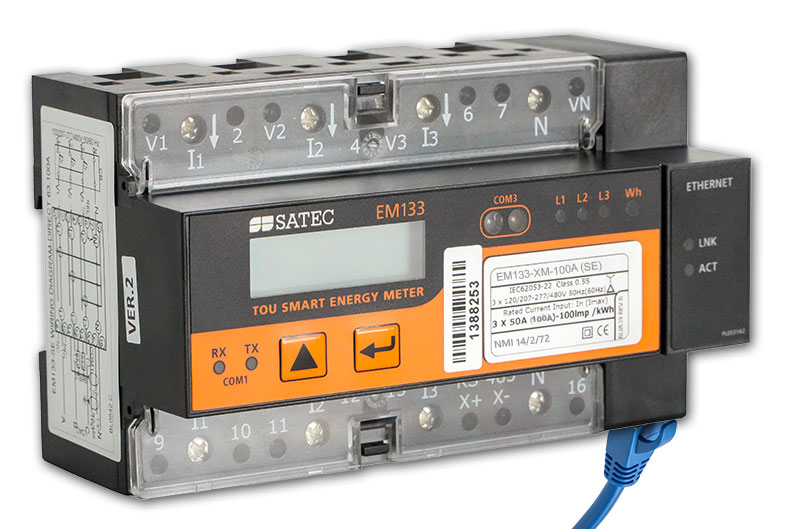
Many sites are dealing with cramped panels and risers. SATEC offers compact, multi-circuit power meters that monitor multiple branch circuits from a single device. They fit neatly into existing switchboards and distribution boards. They reduce wiring, panel space and installation cost.
For retrofit projects where space is at a premium, this is a major advantage.
Revenue-grade and Compliance-ready
SATEC energy meters include NMI approved models with approved performance and revenue-grade accuracy. This supports tenant or cost allocation billing, network and compliance reporting and high trust in the data shared with external stakeholders.
You get a single metering platform that serves both operational and commercial needs.
Deep Analytics with Expertpower Software
SATEC’s Expertpower cloud-based software turns raw branch-level data into insights. It provides interactive dashboards for power quality, load and energy.
Event logs and trend analysis help diagnose issues. Alarms and notifications trigger when thresholds are exceeded. Powerful reporting lets you share information with internal teams, tenants or utilities.
This lets you move from watching individual meters to managing the entire electrical ecosystem as one.
Built for Modern, Complex Facilities
With strengths in power quality and advanced monitoring, SATEC solutions are well suited to commercial towers and mixed-use developments, data centres and critical facilities, industrial plants with high use of drives and power electronics and large campuses and precincts with evolving load profiles.
Where power quality matters, SATEC meters give you the visibility and control you need, right down to the branch circuits.
The Path to Better Power Quality
Electrical systems aren’t getting simpler. As they grow more complex, power quality branch circuit monitoring has become essential rather than optional. It helps you find where disturbances actually start, keeps critical equipment running smoothly, makes better use of your existing infrastructure and gives you the data you need for compliance and reporting.
SATEC brings together advanced power quality meters, multi-circuit designs and Expertpower software in one platform. This combination works particularly well when panel space is tight or you’re upgrading existing systems.
Ready to understand what’s really happening in your branch circuits? SATEC’s solutions can show you exactly that – contact our team today.
FAQs - Power Quality Branch Circuit Monitoring
What is power quality branch circuit monitoring?
Power quality branch circuit monitoring is the measurement and analysis of electrical conditions (like voltage, current, harmonics and events) on individual branch circuits to detect issues and optimise performance.
Why is power quality important at the branch circuit level?
Monitoring power quality at the branch level helps pinpoint the exact circuit causing disturbances, protects sensitive equipment and prevents hidden overloads or imbalance that might not be visible at the main switchboard.
How do SATEC meters support power quality branch circuit monitoring?
SATEC meters combine multi-circuit energy metering with advanced power quality features such as harmonic analysis, event logging and waveform capture, giving detailed visibility down to individual circuits.
Can SATEC’s solution be used in retrofit projects with limited space?
Yes. SATEC offers compact, multi-circuit metering solutions designed for space-constrained panels and retrofits, allowing you to add power quality monitoring without major switchboard redesigns.