

For more than a century, AC and DC power have quietly shaped every part of our modern world, from transmission networks and factory floors to solar farms, batteries and EV chargers.
For energy managers, engineers and asset owners, understanding the difference between AC and DC isn’t just “electrical theory”. It directly affects how you design your system, how you meter it and how you unlock value from your data.
In this article, we’ll break down AC vs DC power in practical terms, look at where each is used, and explain what it means for measurement, compliance and energy management.
What is AC Power?
AC stands for Alternating Current. In an AC system, the direction of current flow reverses back and forth many times per second. In Australia, that happens 50 times per second – 50 Hz.
In a perfect electrical system, the AC voltage would be a smooth oscillating waveform.
That waveform is excellent for:
- Efficient long-distance transmission
- Step-up and step-down of voltages using transformers
- Powering traditional motors, pumps and compressors
Due to those advantages, AC is the backbone of the public grid and most building electrical systems worldwide. Your switchboard, distribution boards and most loads in commercial and industrial sites are supplied with AC.
What is DC Power?
DC stands for Direct Current. In a DC system, the current flows in one direction only, and the voltage is typically steady rather than oscillating.
We’ve always used DC in some form – think batteries, telecoms or industrial control systems. In recent years, DC has become much more prominent thanks to:
- Solar PV arrays (DC on the panel side)
- Battery Energy Storage Systems (BESS)
- Electric vehicle chargers and vehicle batteries
- DC-coupled microgrids and hybrid systems
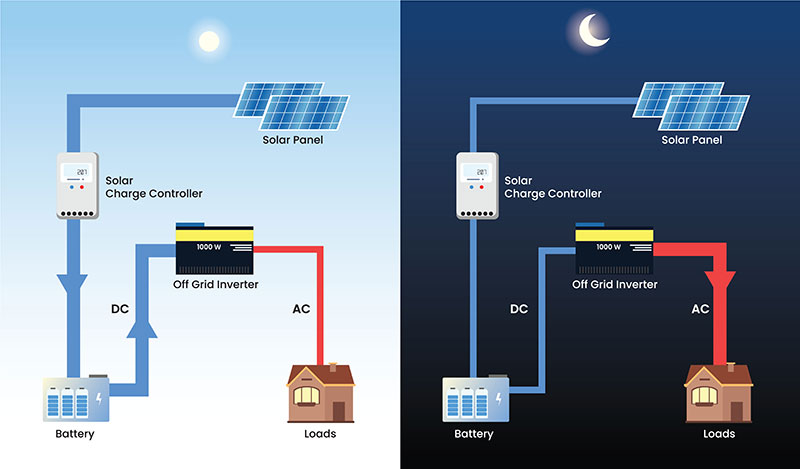
In many modern assets, DC is where energy is generated or stored and AC is where it is distributed and consumed. That simple idea is the heart of today’s AC/DC conversation.
SATEC has recently introduced dedicated DC metering products to give operators better visibility and control over these DC systems, particularly in renewables, EV, telecommunications and other DC-intensive environments.
AC vs DC: Key Technical Differences
You don’t need to be a power systems engineer to understand the essentials. Here’s the big-picture view.
1. Direction of Current
- AC: Changes direction 50 times per second (50 Hz in Australia).
- DC: Flows in one direction only.
2. Voltage Behaviour
- AC: Voltage rises and falls in a waveform (typically sinusoidal).
- DC: Voltage is usually steady (or slowly varying) around a fixed level.
In AC systems, you often care about RMS values, power factor and harmonic content. In DC systems, you tend to focus on current levels, voltage stability and efficiency of conversion.
3. Conversion and Equipment
AC and DC rarely exist in isolation today. Assets often include multiple conversion stages:
- Rectifiers: Convert AC to DC (e.g. for charging batteries or powering DC loads)
- Inverters: Convert DC to AC (e.g. solar export to the grid, battery discharge into a building)
- DC–DC converters: Adjust DC voltage levels (e.g. between a battery bank and a DC bus)
Every conversion stage introduces losses, possible failure modes and measurement points. Accurate, application-specific metering is essential if you’re trying to optimise performance, bill accurately or claim certificates.
Where AC Power Dominates
AC still rules the “front-of-house” side of most power systems. Common AC applications include:
Grid Connection and Utility Metering
Distribution networks deliver three-phase AC. Revenue metering for network interfaces and large customers is typically done with high-accuracy, four-quadrant AC revenue meters that measure import and export energy, plus power quality.
Advanced four-quadrant meters are now critical for managing bi-directional energy flows as distributed energy resources (DERs) such as solar, batteries and embedded generators proliferate.
Commercial and Industrial Facilities
Within a facility, AC powers:
- Motors, pumps, HVAC systems and chillers
- Lighting circuits (even LED lighting usually runs from an AC supply via internal conversion)
- General power outlets and most traditional equipment
Multi-function smart meters and multi-circuit meters are widely used for:
- Sub-billing tenants or departments
- Allocating energy costs to processes or cost centres
- Monitoring demand, power factor and overall load profile
SATEC’s portfolio of multifunction and multi-circuit AC meters, such as DIN-rail sub-meters and panel-mounted analysers, is designed for exactly these kinds of applications, with options for NMI-approved revenue metering where required.
Utilities and Transmission
On the network side, AC power is the default. Utilities rely on high-accuracy AC metering and power quality analysers to:
- Ensure compliance with standards
- Maintain grid stability
- Analyse faults and disturbances
Here, integration with SCADA and other utility systems is just as important as measurement accuracy.
Where DC power is growing fast
While AC is still the public face of electricity, DC is quietly exploding in importance behind the meter.
Solar PV and Batteries
Solar panels generate DC. Batteries store DC. Before any of that energy reaches your AC busbar or the grid, it flows through DC cabling, combiners and converters.
Monitoring DC flows at this level helps you:
- Verify PV output independent of inverter readings
- Track round-trip efficiency of battery storage
- Detect string faults, shading or degradation early
As Australia accelerates solar and storage deployment, DC energy metering is becoming essential for accurate performance monitoring and compliance, not just an optional extra.
Electric Vehicle Infrastructure
EV batteries are DC. Fast chargers typically use DC output to charge vehicles more efficiently.
DC metering at EV sites can:
- Support accurate billing and settlement
- Provide visibility into charger utilisation and load profiles
- Feed data into broader site energy management strategies
SATEC’s new DC metering solutions are designed with these types of DC-heavy applications in mind, enabling better control, optimisation and sustainability.
Telecoms, Data Centres and DC Microgrids
Telecoms systems and many ICT environments have long used DC for reliability. With the rise of edge computing and DC-coupled microgrids, the need for accurate DC metering is expanding into:
- Telecom towers and remote communication sites
- Data centres exploring DC distribution for efficiency
- Industrial DC buses in transport, mining or process industries
In all of these, DC metering supports capacity planning, uptime and targeted efficiency improvements.
Why AC vs DC Matters for Metering and Energy Management
From a metering perspective, AC and DC are not interchangeable. Choosing the right metering approach and integrating it into your energy management system has direct commercial implications.
Measurement Accuracy and Compliance
Standards and compliance requirements often differ between AC and DC applications. For example:
– Revenue metering for grid interfaces and billing requires certified, high-accuracy AC meters.
– Renewable and storage assets may need robust DC metering to support performance verification.
SATEC’s experience in NMI-approved AC metering and emerging DC metering applications helps customers navigate these requirements without over- or under-specifying equipment.
Power quality vs performance monitoring
In AC systems, power quality is a major focus: voltage dips, harmonics, unbalance and transients can affect sensitive equipment and cause non-compliance with grid codes.
In DC systems, you still care about quality but the issues look different:
– Ripple on DC bus voltage
– Converter efficiency and thermal performance
– Over-current conditions and protection coordination
Modern platforms like SATEC’s Expertpower and PAS are designed to collect and analyse both energy and power quality data from a wide range of meters, giving you a single view across AC and DC segments of your system.
Data integration and Meter Data Management (MDM)
As assets multiply, simply “having meters installed” isn’t enough. You need to:
– Aggregate data from AC and DC meters
– Normalise and validate readings
– Feed data into billing, reporting and analytics
Expertpower’s Meter Data Management (MDM) capabilities provide a configurable, scalable platform that standardises interfaces, supports high-capacity data collection and integrates with utility and enterprise systems.
This becomes especially important in mixed AC/DC portfolios, where you may need to:
– Combine AC and DC data for site-wide dashboards
– Track energy flows end-to-end (for example, from DC PV to AC building loads)
– Support complex tariff structures or multi-party settlements
AC vs DC: Which Should you Focus on?
In practice, you almost never choose only AC or only DC. Modern energy systems are hybrid by default. The real question is:
Where should you focus your metering and analytical effort in each part of the system?
Here are three typical scenarios.
1. Traditional commercial building with minimal onsite generation
- Dominant form: AC
- Priority: Revenue-grade AC metering at mains and key tenants, plus multi-circuit AC sub-metering for major loads (HVAC, lighting, production lines).
- Value: Cost allocation, demand control, power quality compliance and identification of efficiency opportunities.
2. Rooftop solar with battery storage on an industrial site
- Forms in play: DC (PV + battery), AC (site load + grid)
- Priority:
- DC metering on PV strings or DC bus to verify generation and inform O&M
- DC metering on battery circuits to track charge/discharge behaviour
- AC four-quadrant metering at grid connection and key sub-boards
- Value: Accurate renewable yield reporting, better utilisation of storage, optimisation of import/export profile and verification of business cases.
3. EV fast-charging hub with behind-the-meter renewables
- Forms in play: DC (chargers, storage), AC (grid and local LV distribution)
- Priority:
- DC metering at charger outputs or DC distribution for billing and utilisation
- AC metering at grid connection and any embedded generation
- Integration into a central MDM/EMS platform for load management and reporting
- Value: Commercially accurate billing, network compliance, demand charge management and planning for future expansion.
In each case, a combination of AC and DC metering, paired with a robust analytics platform, turns raw electrical behaviour into actionable insights.
Bringing it Together: A Single View of AC and DC
The days of thinking “AC in one world, DC in another” are over. Solar farms, batteries, EVs and advanced industrial processes mean that AC and DC are now deeply interconnected inside the same project, facility or portfolio.
SATEC’s approach is to give customers:
- Specialised meters for both AC and DC applications – from multi-circuit sub-meters and four-quadrant revenue meters to newly launched DC metering solutions.
- Flexible communications and integration, so data flows reliably from remote sites and complex assets into your central systems.
- Enterprise-grade software and MDM, via Exprtpower, to standardise, store and analyse data across AC and DC domains, whether you’re focused on billing, power quality, performance or all three.
If you’re planning a new project or reviewing an existing site and you’re unsure where to prioritise AC vs DC metering, the starting point is simple:
- Map out where energy is generated, stored, converted and consumed.
- Identify your compliance, billing and performance obligations at each point.
- Specify meters and data integration that match those obligations, across both AC and DC.
SATEC’s team works with utilities, developers and asset owners across Australia to design metering and data strategies that make sense for today’s hybrid systems and tomorrow’s grid.
If you’d like to explore how AC and DC metering could improve visibility, compliance and ROI in your portfolio, reach out to discuss your specific application.
FAQs - AC vs DC Power: Differences and Applications
Why do we still use AC if so many new technologies run on DC?
AC is ideal for transmitting power over long distances and feeding standard building loads, while DC is often used where energy is generated or stored (like solar and batteries), so most modern systems need both.
Do I need separate meters for AC and DC systems?
Yes. AC and DC are measured differently, so you typically need meters designed specifically for each, especially where accuracy, billing or compliance are involved.
How does AC vs DC affect my energy management strategy?
AC is usually where you manage demand and power quality, while DC is where you optimise generation, storage and conversion efficiency, so having visibility of both is critical.
Where should I start if I’m unsure what to meter on my site?
Begin by mapping where energy is generated, stored, converted and consumed, then prioritise metering at those key points to support billing, compliance and performance monitoring.
Explore related topics:
For Your Industry
Related Reading
- AC vs DC Electricity Meters: Industry Applications
- True RMS vs Average-Responding Meters: Why Your Readings Don’t Match on Modern Loads
- What Is Power Factor and Why Is It Important?
Trending in Your Sector


