
EDL180 · BATTERY
Looking after the EDL180 batteries
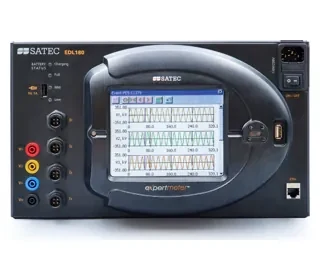
The EDL180 Portable Event & Data Logger is a PM180 power quality analyser in a portable case. Three separate things in or around it involve a battery: the rechargeable UPS that keeps the logger running when the supply is lost, the battery that some of the flexible current sensors require, and the backup battery in the PM180 itself. This article covers what the manufacturer's documents say about each one, and what they do not say.
The internal UPS
The EDL180 has a rechargeable internal UPS. The manual says it provides over 4 hours of power during a loss of external supply, such as a general power failure. That figure was tested at full consumption, with the unit and its RGM screen running. The UPS has over-charge, over-discharge, over-current and short protection.
Charging the UPS
Once the EDL180 is connected to an external supply, the UPS battery starts charging automatically, whether the unit is switched on or not. The manual does not give a charge time.
Four LEDs on the front panel show the UPS state:
- Three battery level LEDs show the battery level.
- The charging status LED is red while charging and blue when full.
Between surveys
The manual recommends switching the unit off when it is not in use, to prevent discharge. It adds that discharge "has not been reported to harm the UPS battery". It gives no storage interval or storage temperature.
SATEC Australia's advice: switch the EDL180 off when it is not in use, and connect it to supply to recharge before a survey.
If the UPS no longer lasts
The EDL180 manual gives no procedure for replacing the UPS battery, and no part number, cell chemistry or service life. The manual's front-panel drawing shows no battery compartment. The manual says that only a duly authorised representative of the manufacturer may open the instrument, in a fully anti-static environment, and that the warranty is on a return-to-factory basis.
SATEC Australia's advice: do not open the EDL180. If the UPS no longer runs the logger for the expected time, contact SATEC Australia with the unit's serial number.
Flexible current sensor batteries
The EDL180 is supplied with four flexible current sensors, according to the ordered model:
- 30/300/3,000 A model: requires a battery, which is not supplied.
- 200 A model: does not require a battery.
On the 30–3,000 A coils, the nominal current is selected on the coil integrator with a scale switch marked OFF, 3KA, 300A and 30A, and the same setting must then be entered in the EDL180. The manual does not give the battery type, where it fits, how long it lasts or how to replace it.
SATEC Australia's advice: if your EDL180 came with the 30/300/3,000 A coils, contact SATEC Australia for the type of battery those sensors require before your first survey.
For any locally sourced sensor, the manual says to contact the manufacturer to confirm compliance and get instructions.
The PM180 inside: memory backup battery
The PM180's own documents describe a separate backup battery. The PM180 Installation Manual specifies a CR1225 lithium 3.0 V cell, held in the PM180's CPU panel, with a BATTERY LOW flag and an event in the Event Log when it runs low. The PM180 Operation Manual describes battery-backed non-volatile memory and a red MEM.BAT.LOW LED on the front of the PM180.
Those instructions and their photographs show a stand-alone PM180. The EDL180 manual does not mention this battery. None of these manuals says whether the PM180's battery can be reached without opening the EDL180 case, or how a low battery shows on the EDL180. The PM180 battery procedure therefore does not apply to the EDL180 as written.
SATEC Australia's advice: if the PM180 inside your EDL180 reports a low backup battery, do not open the case. Contact SATEC Australia with the serial number.
Documents and contact
- EDL180 Installation & Operation Manual, BG0647 Rev. A2, August 2024
- SATEC Australia technical support: our contact form.
Source review: 22 November 2026.