

Australia’s electricity networks are experiencing unprecedented transformation as distributed energy resources reshape how power flows. Four-quadrant advanced revenue meters represent critical infrastructure for capturing bidirectional energy flows.
These advanced energy meters measure both import and export energy across all four power quadrants. The capability ensures accurate billing for prosumers with solar systems. Regulatory regulations require precise metering for grid stability and fair cost allocation.
Advanced electricity meters provide the granular data needed for Australia’s evolving energy landscape.
Understanding Four-Quadrant Metering Technology
Four-quadrant meters capture energy flow in all four power quadrants defined by voltage and current relationships.
- Quadrant 1 measures imported real power with lagging current.
- Quadrant 2 records imported reactive power with leading current.
- Quadrant 3 captures exported real power.
- Quadrant 4 measures exported reactive power.
This comprehensive measurement enables accurate billing for customers with solar panels or battery systems. AS 62053.22 specifies accuracy requirements for revenue-grade applications.
As opposed to single-quadrant energy metering which measures only imported active energy (kWh) – i.e., power flowing from the grid to the load. It does not record bi-directional energy (e.g. from PV or generators) and doesn’t typically capture reactive energy (kvarh) for billing.
Australian Regulatory Framework and Compliance
Australian energy regulations mandate specific metering capabilities for distributed energy integration.
The regulatory framework covers accuracy classes, data collection intervals and communication protocols. Compliance ensures fair cost allocation between consumers and prosumers.
NMI Procedure M6-1
National Measurement Institute (NMI) M6-1 specifies metering installation requirements for electricity networks.
The standard mandates accuracy and testing for revenue metering ensuring confidence in repeatability of these measuring devices. Compliance verification requires NATA-approved testing protocols.
AEMO Market Settlement
AEMO requires 5-minute interval data for market settlement calculations. Four-quadrant meters provide separate registers for import and export energy. Data must be transmitted via approved communication channels.
Settlement accuracy depends on precise time synchronisation across network infrastructure.
Australian Standard AS 62053-22
AS 62053-22 defines accuracy requirements for static electricity meters. Class 0.5S specification ensures revenue-grade precision for four-quadrant measurement.
Temperature and electromagnetic compatibility testing validates field performance. Long-term stability requirements maintain accuracy over operational lifetime.
Smart grid integration requires advanced communication capabilities and data management systems. Modern four-quadrant meters incorporate multiple communication protocols for real-time monitoring.
The integration supports demand response programs and distributed energy optimisation. Operators can implement dynamic tariff structures based on consumption patterns.
Communication Protocols and Data Management
Advanced meters support communication protocols including cellular, Ethernet and serial connections. 4G LTE connectivity enables real-time data transmission to multiple systems. The more advanced energy metering systems offer dual communication options.
Protocol selection depends on network infrastructure and data requirements. Cybersecurity measures protect sensitive consumption information. Remote configuration capabilities reduce operational costs for utilities.
Power Quality Monitoring Integration
Advanced four-quadrant meters incorporate power quality monitoring capabilities. Voltage and current harmonic analysis identifies grid disturbances. Sag and swell detection protects sensitive equipment from power quality events.
AS/IEC 61000.4.30 defines measurement methods for power quality parameters. Class A performance provides the highest level of compliance under this standard. Event recording captures transient disturbances for analysis.
Future-Proofing Australia's Metering Infrastructure
Four-quadrant revenue meters provide essential monitoring capabilities for Australia’s renewable energy transition. These devices enable NMI approved accurate billing whilst supporting grid stability through comprehensive monitoring.
The energy roadmap in Australia emphasises advanced electricity metering modernisation for distributed energy integration. Investment in advanced metering technology delivers long-term benefits for utilities and consumers. The technology supports dynamic pricing models and demand response programs.
Regulatory compliance ensures fair cost allocation across evolving network configurations.
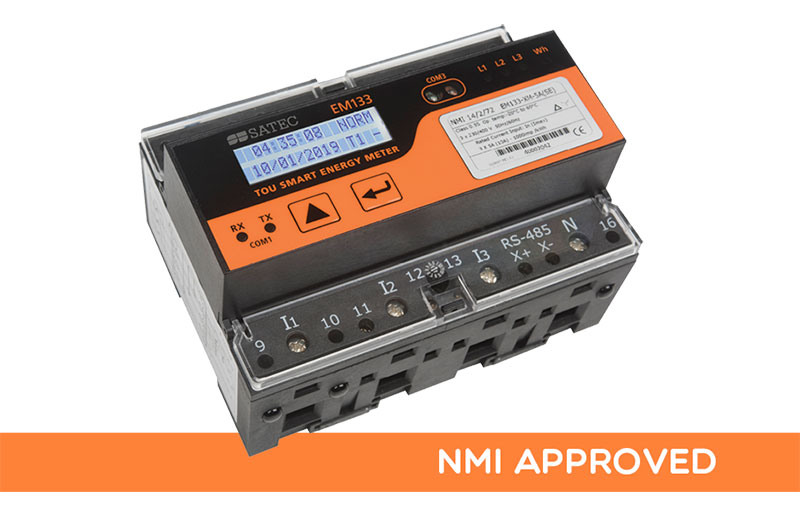
SATEC provides advanced four-quadrant revenue meters designed for Australian metering applications. The EM133-XM delivers Class 0.5S accuracy with basic power quality monitoring. More advanced power quality energy meters are also offered by SATEC.
These meters support multiple communications for real-time data transmission. Cloud connectivity through Expertpower platform enables remote monitoring and configuration. NATA-tested accuracy ensures compliance with Australian metering standards. The robust design withstands harsh environmental conditions typical in Australian networks.
FAQs - Advanced Four-Quadrant Revenue Meters:
What is a four-quadrant revenue meter and why does it matter?
It measures import and export of both active energy and reactive power, enabling accurate billing and grid visibility for sites with solar and batteries.
Which Australian rules do these meters need to meet?
They should comply with NMI M6-1 testing requirements and Class 0.5S accuracy per AS 62053-22 and AS 62052-11, aligning with market requirement and time-sync needs.
How do four-quadrant meters support prosumers?
They maintain separate registers for import/export so tariffs and credits reflect true bi-directional energy flows.
What communications and data features are recommended?
Meters with RS485, 4G or Ethernet provide remote communications and configuration. Interval data at 5 minute intervals along with data logging and real time clock capabilities are essential.