

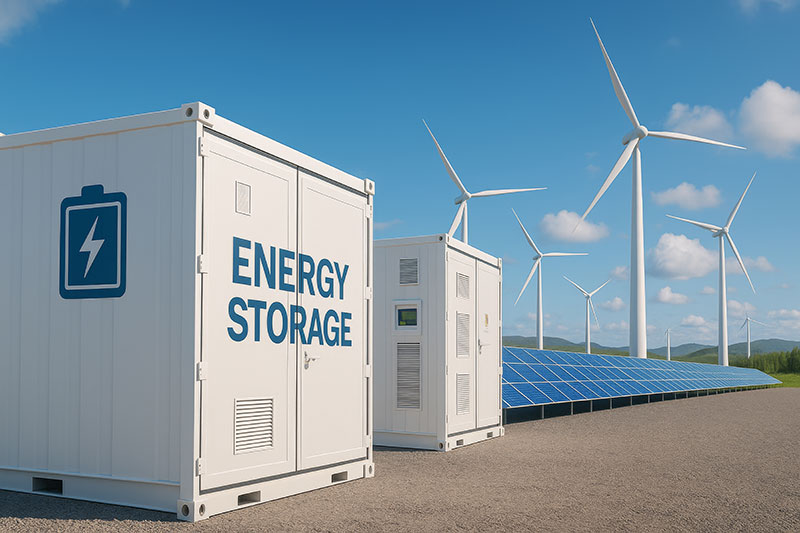
Battery Energy Storage Systems (BESS) are turning into the grid’s shock absorbers but beneath these big assets sits a quieter requirement that increasingly decides whether projects operate smoothly and whether revenue disputes happen at all: accurate, reliable DC metering.
From Basic Instrumentation to Source of Truth
For years, DC metering was treated as basic instrumentation. It was good enough for trending and operational checks. That era is ending. More energy value is being generated, stored, moved and traded on DC links at higher power levels and voltages.
In that world, the meter stops being a “nice-to-have” monitor. It becomes a source of truth for billing, compliance and performance guarantees.
Why DC Metering Has Become Mission-Critical
The global transition towards renewable generation, electric mobility and large-scale BESS has renewed the importance of DC metering. DC systems now sit at the centre of modern power flows.
In a BESS facility, DC metering directly influences energy accounting (what went in versus what came out), efficiency calculations and warranties, verification of grid services delivered (and paid for) and confidence in control decisions made in real time.
In EV fast-charging, it affects fair billing and customer trust. In industrial DC applications, it supports efficiency initiatives and helps teams spot issues earlier, before they become outages or asset damage.
Where Legacy DC Measurement Falls Short
Historically, many DC systems relied on shunt-based measurements or Hall-effect sensors. Those approaches have served the industry well but they often deliver low to medium accuracy performance. They have limited regulatory readiness compared with what modern energy infrastructure now demands.
Two practical issues show up again and again. First, accuracy at scale matters. A small percentage error becomes real money when you’re measuring megawatt-hours every day or thousands of charging sessions per month. Second, stability over time is critical. Drift across temperature swings, electromagnetic noise or simple ageing can make measurements harder to trust, especially when results are used for settlement or contractual performance.
The point isn’t that legacy technology is “bad”. The job description has changed. Monitoring-grade metering isn’t the same thing as revenue-grade metering.
Standards Are Pushing DC Metering Into "Revenue Grade"
Regulatory frameworks are catching up with the shift to DC. Standards such as IEC 62053-41 specify accuracy classes of 0.5 and 1 for static DC watt-hour meters.
ANSI C12.32 establishes performance criteria for revenue-grade DC watt-hour meters. That’s a big change. It raises expectations around traceable accuracy, consistency across operating ranges and the ability to support audits. It also changes procurement conversations. Teams can’t just ask “does it measure?” They have to ask “is it settlement quality and can it stay that way for years?”
High-Voltage DC Makes Safety a First-Order Requirement
At the same time, DC applications are moving into higher voltage levels, often up to 1.5 kV according to standards, with some projects reaching 3.5 to 5 kV. This introduces major insulation and safety challenges.
When you’re dealing with multi-kilovolt DC, design details like isolation boundaries, creepage and clearance decisions, transient behaviour and fault energy are not optional.
Any next-generation DC metering approach has to treat safety and insulation coordination as core engineering work, not as packaging around a measurement module.
Why Precision DC Metering Unlocks Smarter Markets and Smarter Control
The argument for better DC metering isn’t only technical. It’s commercial. Precise DC metering becomes an enabler for advanced applications such as Time-of-Use tariffs, Contracts for Difference (CFD) and higher-fidelity operation of Power Plant Controllers for BESS.
These models depend on trusted, time-stamped energy data. If metering is unstable or unverifiable, settlement becomes harder. Disputes become more likely. Performance claims are harder to prove. If metering is revenue grade, it improves confidence across the ecosystem: owners, operators, offtakers and grid stakeholders.
In storage plants in particular, better DC metering can also support better control behaviour. When the feedback signal is accurate, controllers can dispatch more precisely. Operators can tune performance with higher confidence.
SATEC PRO Series: Revenue-Grade DC Metering
SATEC’s PRO Series positions DC metering as more than “measurement for visibility”, it’s designed to support revenue-grade accuracy and modern compliance needs in high-value DC applications like BESS and fast charging.
The platform approach matters because it pairs precision sensing with a metering foundation intended to stay stable and verifiable over time, not just look good in a one-off test.
At the core of the PRO Series DC concept is SATEC’s use of Ultra-High Accuracy Current Sensors (UHACS) based on flux-gate technology, combined with advanced voltage ratio modules, an architecture aimed at delivering better than ±0.2% accuracy, aligned to emerging “revenue-grade” expectations and standards.
Just as importantly, the PRO Series is framed around the realities of high-voltage DC environments (noting use cases up to roughly 3.5–5 kV DC), where insulation coordination and safety considerations are as critical as accuracy.
In practice, this kind of metering capability helps owners and operators reduce settlement disputes, validate performance guarantees and feed higher-confidence data into plant controls and commercial models (like TOU and CFD) that depend on trusted energy measurement.
Proof Points: Field Deployments Across Demanding Environments
Lab performance is important but long-term field performance is what ultimately matters. This demonstrates both robustness and scalability. That diversity matters because each environment stresses the system differently.
BESS sites demand precise energy accounting and clean feedback for control. Rail and transit bring harsh duty cycles and high safety expectations. Data centres care about efficiency, resiliency and clear visibility into power flows. Telecom power systems value stability and continuous operation.
Across all of them, the goal is the same. Measurement that stays accurate, safe and trustworthy even when the site is noisy, hot and running 24/7.
A Quick Checklist for Specifiers
If you’re selecting DC metering for storage, charging, transport or industrial DC, these questions help frame the decision:
- What accuracy is required, and is it linked to a standard like IEC 62053-41 or ANSI C12.32?
- How stable is the measurement across temperature, dynamic range and time?
- How does the design handle high-voltage isolation (especially above 1 kV DC)?
- Can the data support ToU, CFD and audit-friendly settlement?
- Is the approach proven in real deployments similar to your environment?
DC Metering's New Role in the Energy Transition
DC metering is stepping into a new role. It’s becoming a cornerstone of safety, compliance, control quality and financial settlement in the evolving energy ecosystem. Legacy measurement methods were built for a different era.
With standards driving revenue-grade accuracy and projects pushing into higher-voltage DC, the industry needs metering solutions engineered for modern demands.
Talk to our DC metering team today about your energy metering needs.
FAQs - Revenue-Grade DC Metering: The Quiet Enabler Behind BESS
What does “revenue-grade” DC metering mean?
It means the DC energy meter is accurate enough for billing/settlement, typically around ±0.2% accuracy under standards like IEC 62053-41 and ANSI C12.32.
Why aren’t shunt or Hall-effect sensors always enough?
They’re often low- to medium-accuracy and may lack the precision and stability modern energy infrastructure needs for compliant, trusted measurement.
Why is high-voltage DC metering more complicated?
High Voltage DC can reach 3.5–5 kV, which creates serious insulation and safety design challenges beyond just measuring accurately.
What does “next-generation” DC energy metering technology look like?
It uses high-accuracy approaches like flux-gate–based UHACS current sensors plus advanced voltage measurement, achieving better than 0.2% accuracy while supporting international compliance.
Explore related topics:
For Your Industry
Standards & Compliance
- IEC 62053-41 DC Meter Testing: Complete Accuracy Validation Guide
- DC Shunts and AS/IEC Compliance: What You Really Need To Know
- NITP-14 Electricity Meter Verification: Australian Compliance Guide
Related Reading
Trending in Your Sector


