

The stability of Australia’s national electricity grid faces mounting challenges as renewable energy integration accelerates and extreme weather events become more frequent. Phasor Measurement Units (PMUs) provide the real-time monitoring capabilities essential for detecting early warning signs of potential cascading failures.
These sophisticated devices capture synchronised measurements of electrical quantities across vast geographical areas with microsecond precision. By implementing Wide Area Monitoring Systems (WAMS) based on PMUs, Australian transmission network operators can identify emerging instabilities and prevent widespread outages before they occur.
This advanced technology represents a critical investment in grid resilience and operational security as the energy landscape continues to evolve.
Understanding PMU Technology for Wide Area Monitoring
PMUs, also known as synchrophasors, measure electrical waveforms at rates of up to 200 frames per second with precise time synchronisation via GPS. This allows for real-time comparison of phase angles and frequencies across the entire interconnected network.
Unlike traditional SCADA systems that typically sample data every 2-4 seconds, PMUs capture dynamic system behaviour with millisecond resolution, revealing transient phenomena that would otherwise remain undetected.
The time-stamped measurements enable system operators to observe power oscillations, phase angle separations and frequency deviations as they develop. This heightened visibility transforms grid management from reactive to proactive, particularly valuable for Australia’s long transmission corridors where instabilities can propagate rapidly.
The implementation of PMU technology supports modern energy network operations through enhanced situational awareness and reduced reliance on conservative operating margins, ultimately improving overall system reliability and efficiency.
Key Standards and Requirements for PMU Deployment
The effective deployment of PMUs within Australian power networks requires adherence to rigorous international and national standards. These frameworks ensure measurement accuracy, interoperability between devices from different manufacturers and reliable data communication.
Compliance with these standards supports seamless integration of PMUs into existing network management systems and guarantees the reliability of the collected data for critical decision-making processes.
Australian transmission network service providers should carefully consider these standards when planning WAMS implementations to ensure their investments deliver maximum value and operational benefits.
IEEE C37.118.1-2011 and C37.118.2-2011
These cornerstone standards define the measurement and data exchange requirements for PMUs.
IEEE C37.118.1 specifies performance requirements under both steady-state and dynamic conditions, including accuracy metrics for frequency, rate of change of frequency (RoCoF) and phase angle measurements.
The companion standard C37.118.2 details the communication protocols and data formats for real-time information exchange. Together, they ensure PMUs from different manufacturers can operate harmoniously within the same monitoring system.
The standards define performance classes (P-class and M-class) to accommodate different application needs. P-class for protection-oriented applications requiring faster response and M-class for measurement applications prioritising accuracy.
Australian utilities should select devices that comply with these standards to guarantee interoperability and reliable performance across their wide area monitoring networks.
IEC 61850-90-5
IEC 61850-90-5 technical report extends the IEC 61850 standard to support synchrophasor data transmission, providing a framework for integrating PMUs into modern substation automation systems.
The standard defines how synchrophasor measurements can be communicated using the IEC 61850 protocols, facilitating their incorporation into broader power system monitoring and control architectures.
For Australian utilities already using IEC 61850-based systems, this standard offers a pathway to incorporate PMU data without maintaining parallel communication infrastructures. The standard addresses critical aspects such as security requirements, multicast transmission and efficient bandwidth utilisation, all essential considerations for wide-area deployments spanning across Australia’s vast geographical territory.
Implementation of IEC 61850-compliant systems ensures robust, secure and future-proof synchrophasor networks that can adapt as grid monitoring requirements evolve.
Australian NER Requirements and AEMO Guidelines
The National Electricity Rules (NER) establish specific requirements for power system monitoring within the National Electricity Market (NEM). While these frameworks do not yet comprehensively address PMU technology, they do specify requirements for disturbance monitoring equipment and dynamic system monitoring that PMUs can fulfil.
AEMO’s Power System Data Communication Standard outlines the communication requirements for operational data, including availability and reliability metrics that WAMS implementations should meet.
As Australia’s power system evolves, these regulatory frameworks are likely to incorporate more explicit provisions for synchrophasor technology, recognising its value for system security. Network service providers should maintain awareness of emerging AEMO guidelines that may influence PMU deployment strategies and data sharing requirements across the interconnected Australian grid.
PMU-based WAMS deliver substantial benefits for Australian grid operators, especially as renewable penetration increases and system inertia decreases. The technology enables precise monitoring of system stability margins, early detection of potential cascading failures and post-event analysis for continuous improvement.
These capabilities prove particularly valuable in Australia’s context of lengthy transmission corridors, isolated grid regions and growing renewable generation that introduces new stability challenges.
By implementing comprehensive synchrophasor monitoring networks, transmission operators can enhance grid resilience whilst optimising the integration of clean energy resources.
Real-Time Fault Detection and Blackout Prevention
PMUs excel at identifying the precursors to major system disruptions, providing operators with precious minutes to intervene before localised issues cascade into widespread blackouts. By continuously monitoring phase angle differences between key network nodes, PMUs can detect the onset of angular instability, a common precursor to system separation events.
This capability proves especially valuable across Australia’s long transmission corridors, where significant phase angle differences can develop during system stress conditions. Additionally, PMUs capture low-frequency oscillations that may indicate poor damping and potential instability.
When these oscillations grow in amplitude rather than decay naturally, they signal serious stability concerns requiring immediate operator attention. Modern WAMS platforms incorporate advanced analytics that automatically detect these patterns and alert operators, often using machine learning techniques to distinguish normal variations from concerning trends.
This early warning system provides Australian grid operators with the situational awareness needed to maintain system integrity during challenging operating conditions.
Enhanced Renewable Integration and Grid Optimisation
The integration of variable renewable energy sources introduces new challenges for maintaining power quality and system stability. PMU-based monitoring helps address these challenges by providing visibility into fast-changing system dynamics.
The high-resolution measurements enable operators to track rapid fluctuations in power flows resulting from changes in wind or solar generation, allowing for more responsive control actions.
PMUs also support the validation and refinement of system models used for planning and operational studies, ensuring they accurately represent the behaviour of a grid with high renewable penetration. This model improvement leads to more accurate stability assessments and less conservative operational limits.
For Australian transmission operators, this means greater confidence in maintaining reliability whilst maximising renewable hosting capacity. The technology also enables more precise identification of network constraints, supporting targeted investment in transmission upgrades where they deliver maximum benefit.
By implementing PMU monitoring at key renewable energy zones and interconnection points, operators gain the visibility needed to safely manage increasing levels of renewable generation.
Future Directions for Synchrophasor Technology in Australia
As Australia pursues its energy transition goals, PMU-based wide area monitoring will become increasingly critical for maintaining grid stability and reliability. The technology continues to evolve, with emerging developments including more sophisticated analytics, integration with other monitoring systems and applications in distribution networks.
Future implementations are likely to leverage edge computing capabilities to process PMU data closer to its source, reducing communication bandwidth requirements and enabling faster response to detected issues. Cloud-based WAMS platforms offer scalability and facilitate data sharing between network operators, supporting a coordinated approach to managing the interconnected Australian grid.
The value of PMU data extends beyond operational monitoring to support regulatory compliance, investment planning and renewable integration studies. As measurement technologies advance and costs decrease, we can expect more pervasive deployment across the Australian power system, creating unprecedented visibility into grid behaviour and supporting continued reliability through the energy transition.
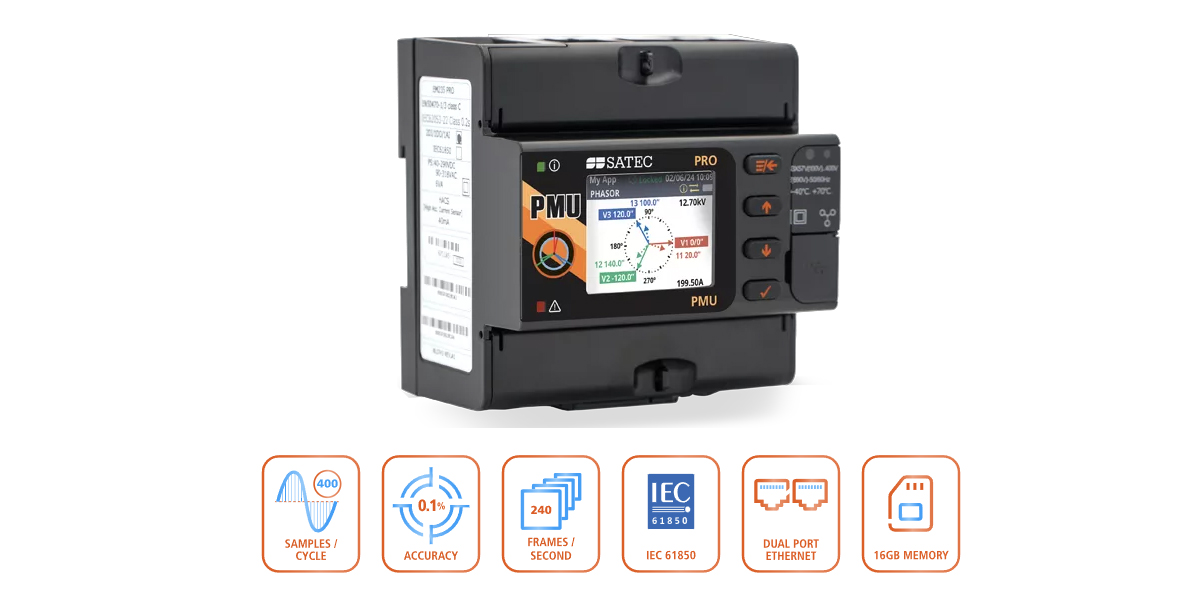
SATEC Australia provides compact, DIN format industry-leading PMU solutions with sampling rates of up to 200 frames per second, delivering the high-resolution monitoring capabilities essential for modern grid management.
Our advanced PMU offers exceptional measurement accuracy, full compliance with IEEE C37.118 standards and seamless integration with wide area monitoring systems. SATEC’s PMU technology supports Australian utilities in maintaining grid stability through precise measurement of frequency, phase angle and other critical parameters across the network.
FAQs - PMU-Based Wide Area Monitoring
What is a PMU and how is it different from traditional SCADA?
A Phasor Measurement Unit (PMU) is a high-speed, GPS-synchronised device that measures voltage and current waveforms up to 200 times per second, whereas traditional SCADA typically samples every 2–4 seconds and can miss fast, transient events.
How do PMU-based wide area monitoring systems help prevent blackouts?
By continuously tracking phase angles, frequency and oscillations across the network in real time, PMU-based WAMS detect early signs of instability so operators can intervene before local issues cascade into widespread outages.
Are PMUs recognised within Australian regulatory and market frameworks?
While the NER and AEMO guidelines don’t yet fully codify PMU requirements, they do specify disturbance and dynamic monitoring needs that PMUs can satisfy, and future updates are likely to place greater emphasis on synchrophasor data.
How do SATEC’s PMU solutions support renewable integration and grid resilience?
SATEC’s IEEE C37.118-compliant PMUs provide high-resolution visibility of fast-changing power flows from wind and solar, improving stability assessments, model accuracy and operational decisions while seamlessly integrating into modern WAMS and IEC 61850-based systems.
Explore related topics:
Standards & Compliance
- Wide Area Monitoring System (WAMS) with IEEE C37.118 Compliant PMUs
- PMU to PDC Real-Time Data Transfer: IEEE C37.118 Interoperability for Australian Grid Infrastructure
- IEEE C37.118 Synchrophasor Systems for Australia’s Renewable Integration
Related Reading
- PMU Grid Events: What They Are, Why They Matter and How to Measure Them Better
- Phasor Measurement Unit – Voltage & Current Synchrophasers
Trending in Your Sector


